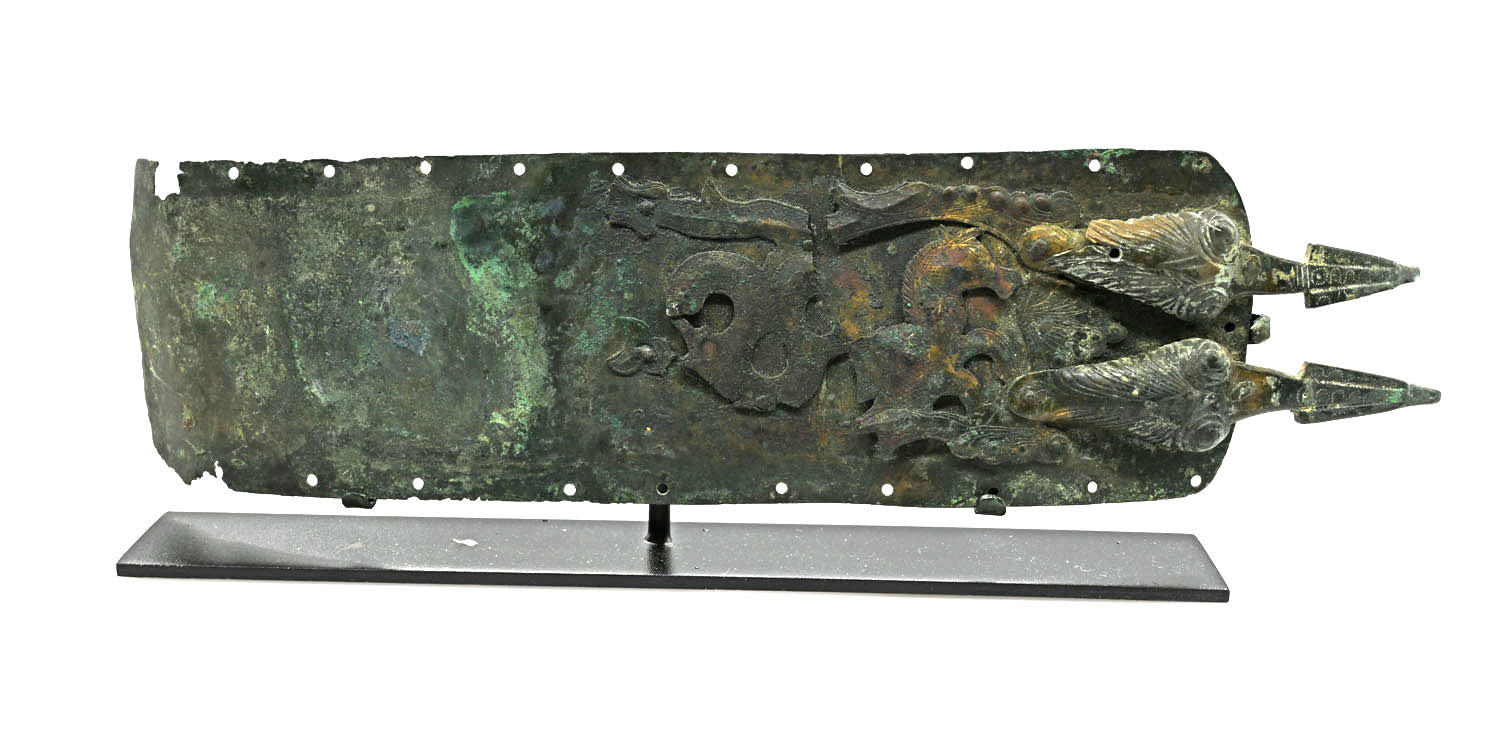
A Roman/Samnite Bronze Gladiator Belt Fragment, ca. 350–325 BCE
Dieses Objekt ist für den kostenlosen und schnellen weltweiten Versand qualifiziert.
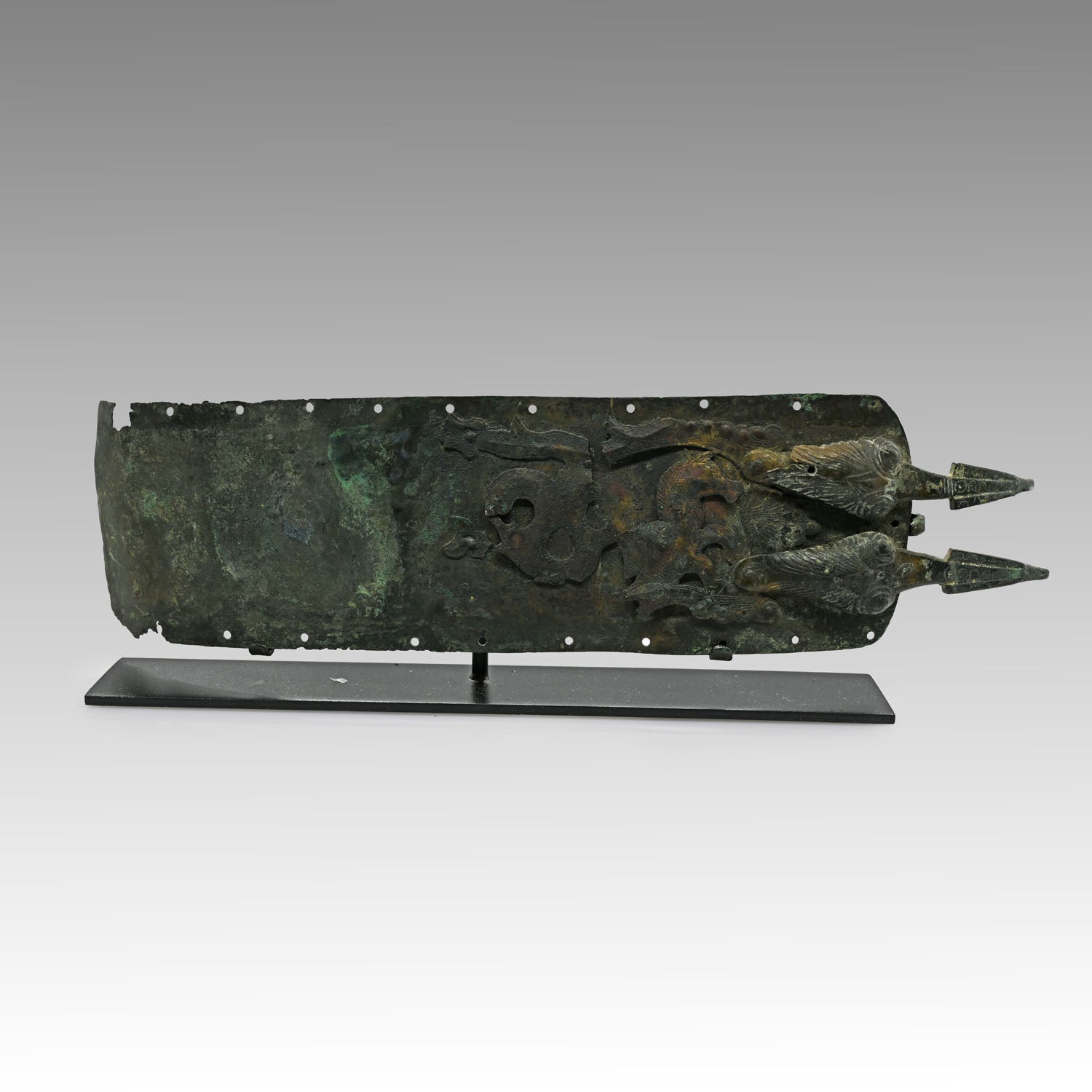
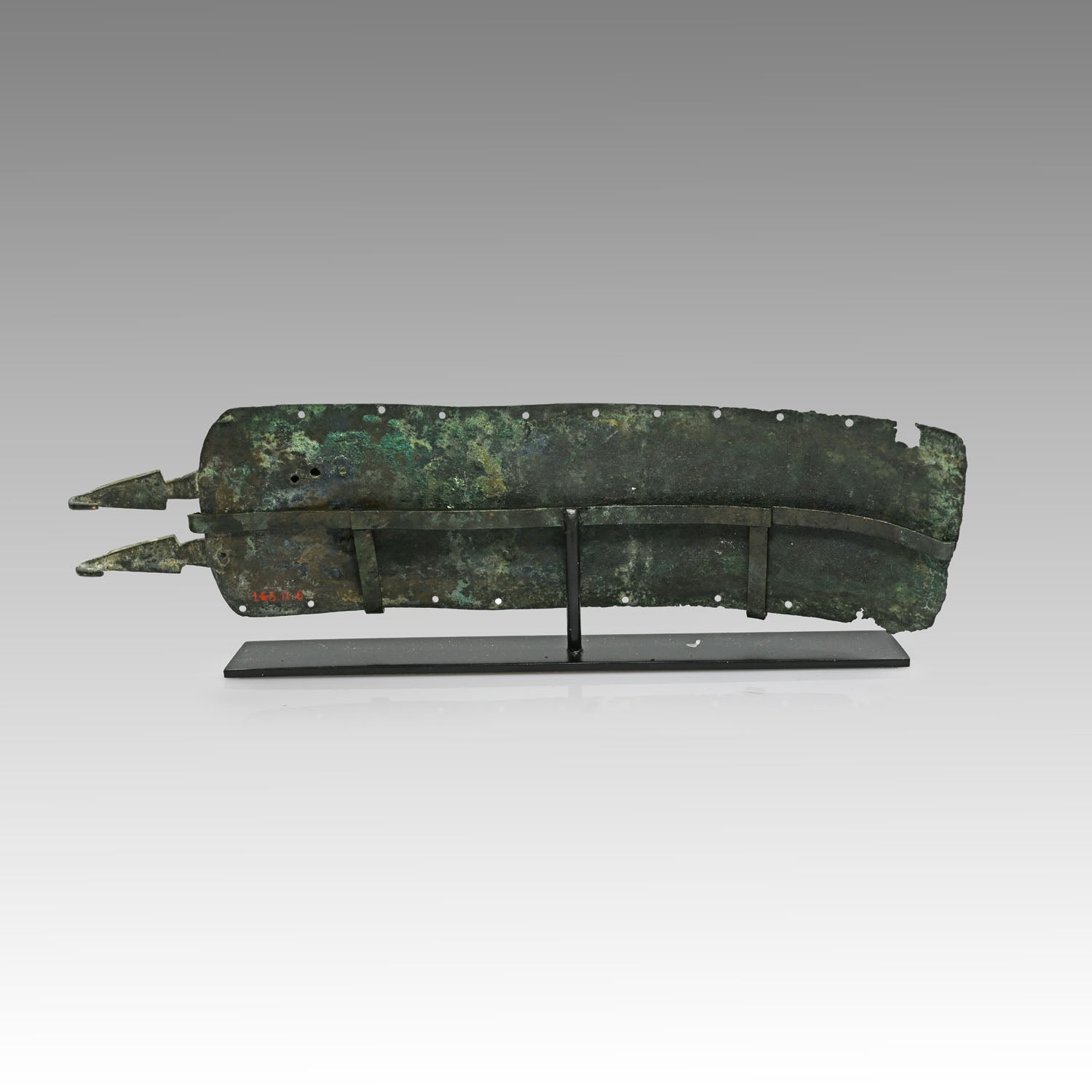
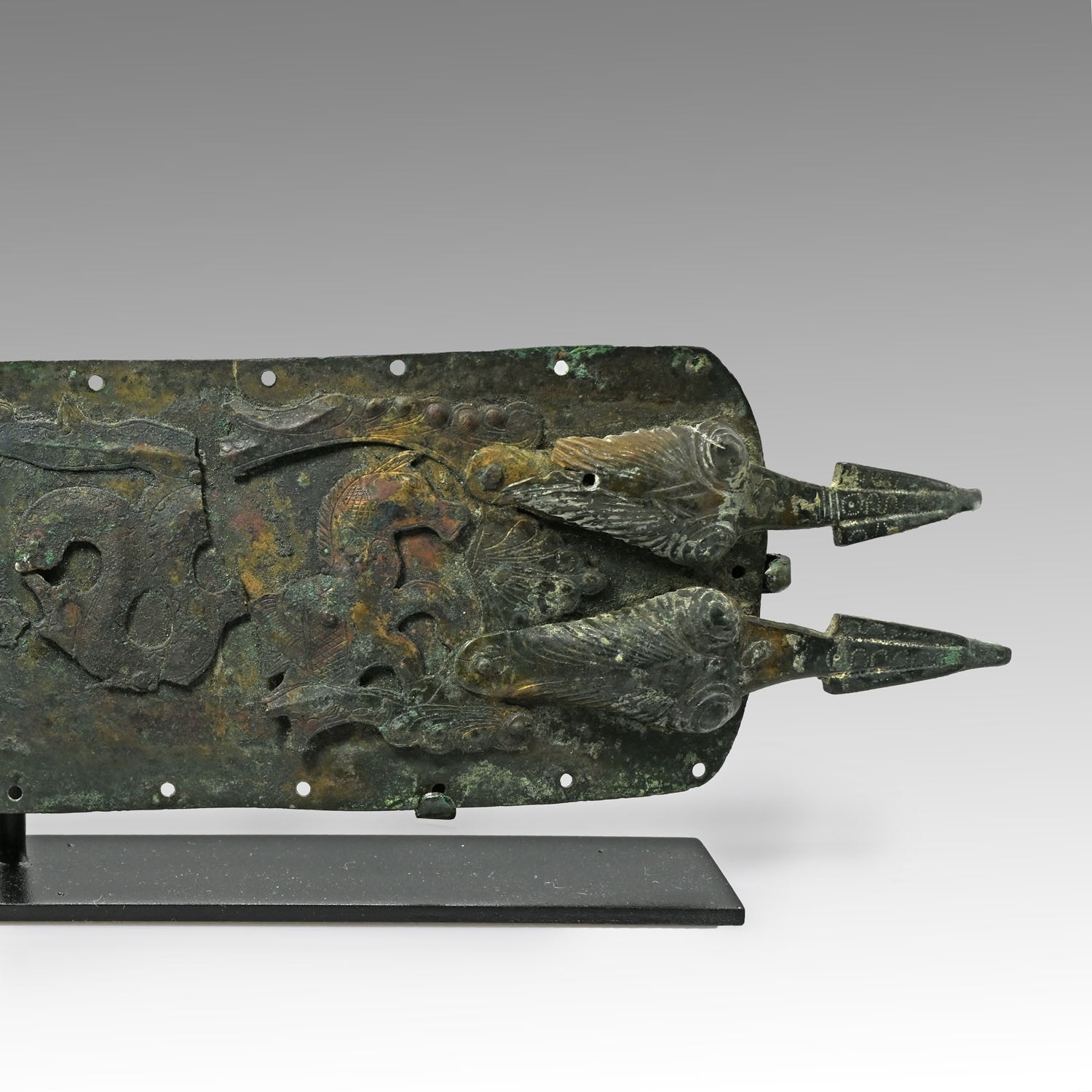
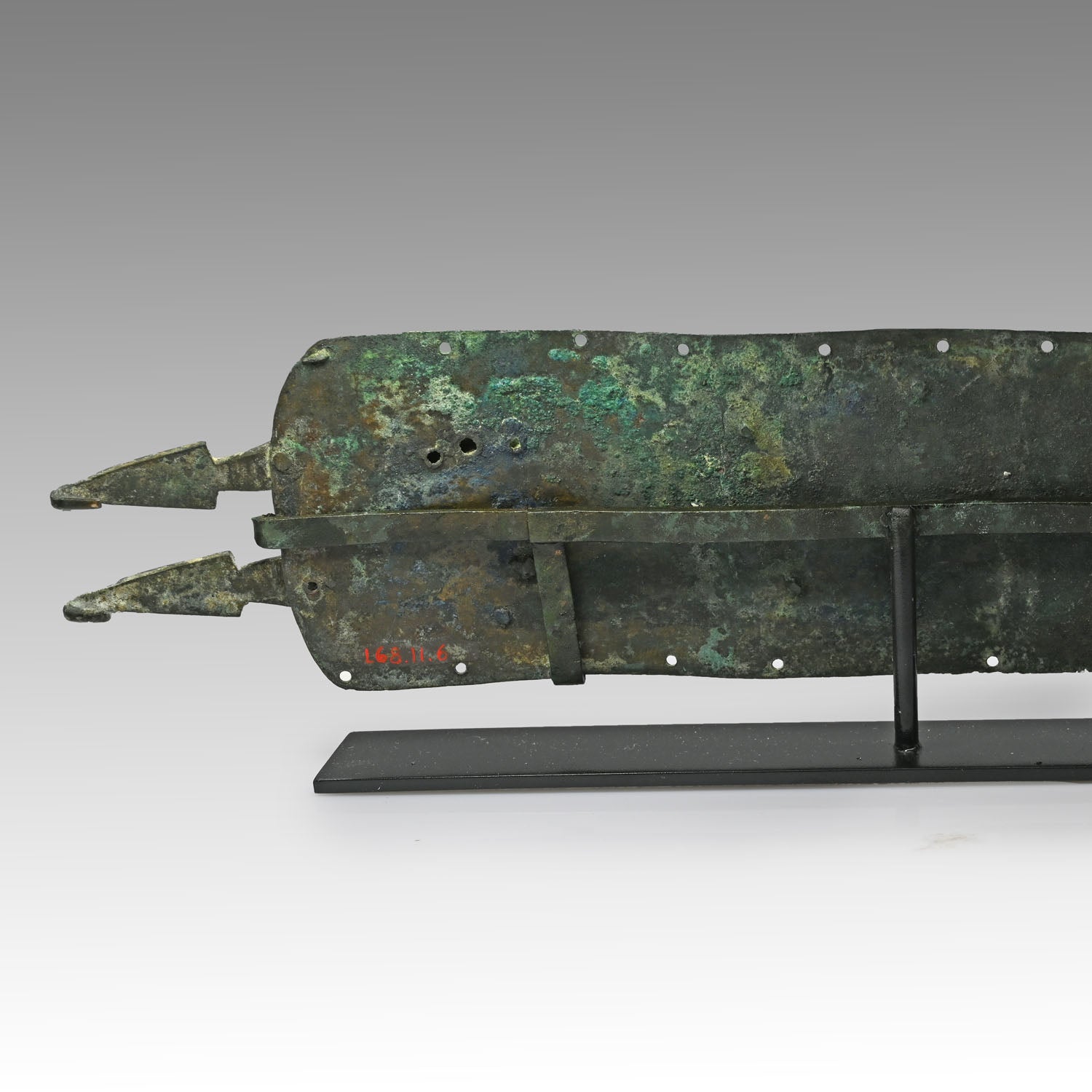
An exceptionally rare bronze fragmentary belt of a Samnite warrior, fashioned from a broad hammered sheet of bronze and retaining an elaborate assemblage of applied decorative elements. The surviving section is gently curved and pierced along the upper and lower margins with regularly spaced perforations allowing it to be sewn to a leather or cloth backing for greater comfort. Unlike most surviving Samnite belts, which rely primarily on repoussé decoration, this example is distinguished by its use of separately cast and applied bronze elements, a far more complex and labor-intensive technique.
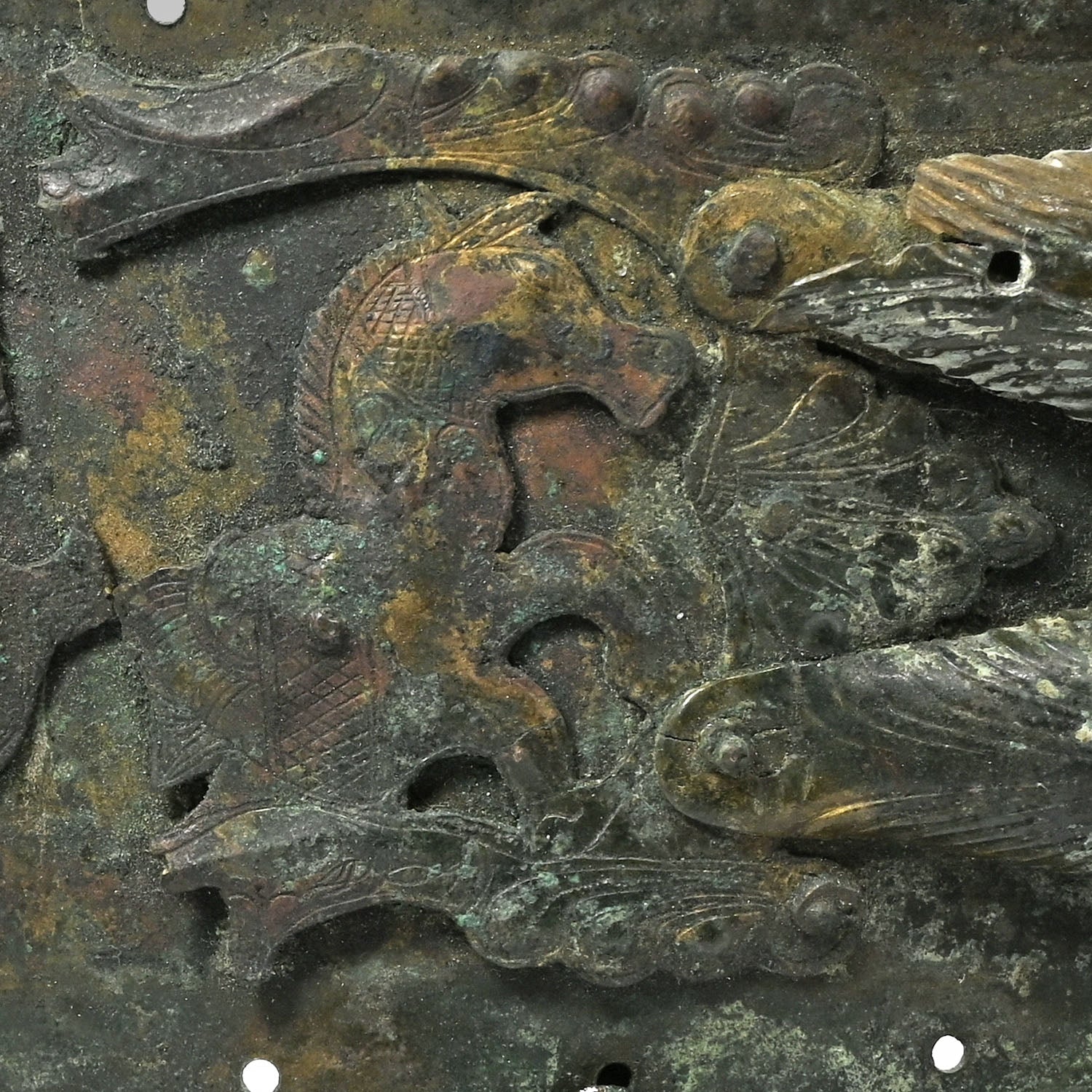
The surviving fragment retains a pair of repoussé tapered hooks, that are fastened to the belt by means of riveted attachment plates. To the left of the fastening hooks is an applied bronze hippocamp emerging from adynamic arrangement of curling tendrils, wave-like volutes, and billowing forms suggestive of sea foam. Cast separately and riveted to the belt surface, the creature is depicted with the forequarters of a horse, complete with a prominent eye, open mouth, and carefully incised mane, while its lower body transforms into a coiled serpent tail that merges into the surrounding marine ornament. The sea foam is rendered as a series of curling volutes and flowing tendrils that create a sense of movement across the composition. The use of a separately cast and applied decoration is particularly noteworthy, adding depth and sculptural richness to the belt while reinforcing the maritime theme that unifies the decorative program.
Rare for both its decorative sophistication and method of manufacture, the belt represents an exceptional example of Samnite military equipment and the high level of artistic achievement attained by Italic bronze workers during the late Classical period. Its distinguished provenance from the collection of Iris Cornelia Love further enhances its historical significance.
Medium: Bronze
Dimensions: Length: 11 inches (27.94 cm), Width: 2 7/8 inches (7.3 cm)
Condition: Fragmentary as preserved, retaining approximately a third of the original belt length. The bronze surface displays a rich dark olive to brown patina with areas of lighter green cuprite and malachite encrustation consistent with long-term burial. The applied decorative elements remain mainly intact with losses in parts. Original perforations along the upper and lower margins remain clearly visible and well preserved. Surface wear, scattered corrosion pitting, minor bends, and encrustation are present throughout, commensurate with age and archaeological burial. Despite its fragmentary state, the belt preserves exceptional artistic and technical detail and remains an outstanding example of Samnite warrior equipment.
Provenance: From the Iris Cornelia Love Collection (1933-2020), New York, primarily formed in the 1950s-1970s. Iris Cornelia Love (19332020) was an American archaeologist, art historian, and collector, best known for her research on ancient Greek sculpture and her role in the rediscovery of the Temple of Aphrodite at Knidos. Educated at Smith College, the Institute of Fine Arts at New York University, and the University of Oxford, she conducted extensive fieldwork in Greece and Turkey and published influential studies on classical and Hellenistic art. A dynamic and often controversial figure, Love left a lasting legacy through her scholarship, discoveries, and distinguished collection of ancient art.
Wir versenden Dienstag bis Freitag mit FedEx und normalerweise noch am selben Tag, wenn Ihre Bestellung vor 14:00 Uhr eingeht. Innerhalb der kontinentalen USA sind Verpackung, Versand und Versicherung kostenlos. Je nach Größe und Bestimmungsort liegen die Lieferzeiten zwischen einem und fünf Werktagen.
Für Überseeversand berechnen wir einen kleinen Pauschalbetrag, der Verpackung, die Erstellung aller Zollpapiere, Versicherung und Frachtkosten gemäß allen US-amerikanischen und internationalen Zollbestimmungen umfasst. Überseeversand erfolgt entweder mit USPS Priority Mail oder FedEx, aber kontaktieren Sie uns, wenn Sie eine Versandpräferenz haben. Internationale Kunden sind für alle Zölle und Steuern verantwortlich.
Sands of Time gewährt eine lebenslange, bedingungslose Garantie auf die Echtheit und Herkunft. Jedem Objekt, das Sie von uns erwerben, liegt ein Echtheitszertifikat bei, das Kultur, Herkunft und Alter angibt.
Darüber hinaus führen wir eine Due Diligence durch, um sicherzustellen, dass der Gegenstand nach unserem besten Wissen nicht illegal aus einer Ausgrabungsstätte, einem Baudenkmal, einer öffentlichen Einrichtung oder einem Privatbesitz erworben wurde. Wo immer möglich, wird auf bestehende Sammlungen oder Veröffentlichungen verwiesen. Wo immer möglich, wird auf bestehende Sammlungen oder Veröffentlichungen verwiesen.
Optionen auswählen


