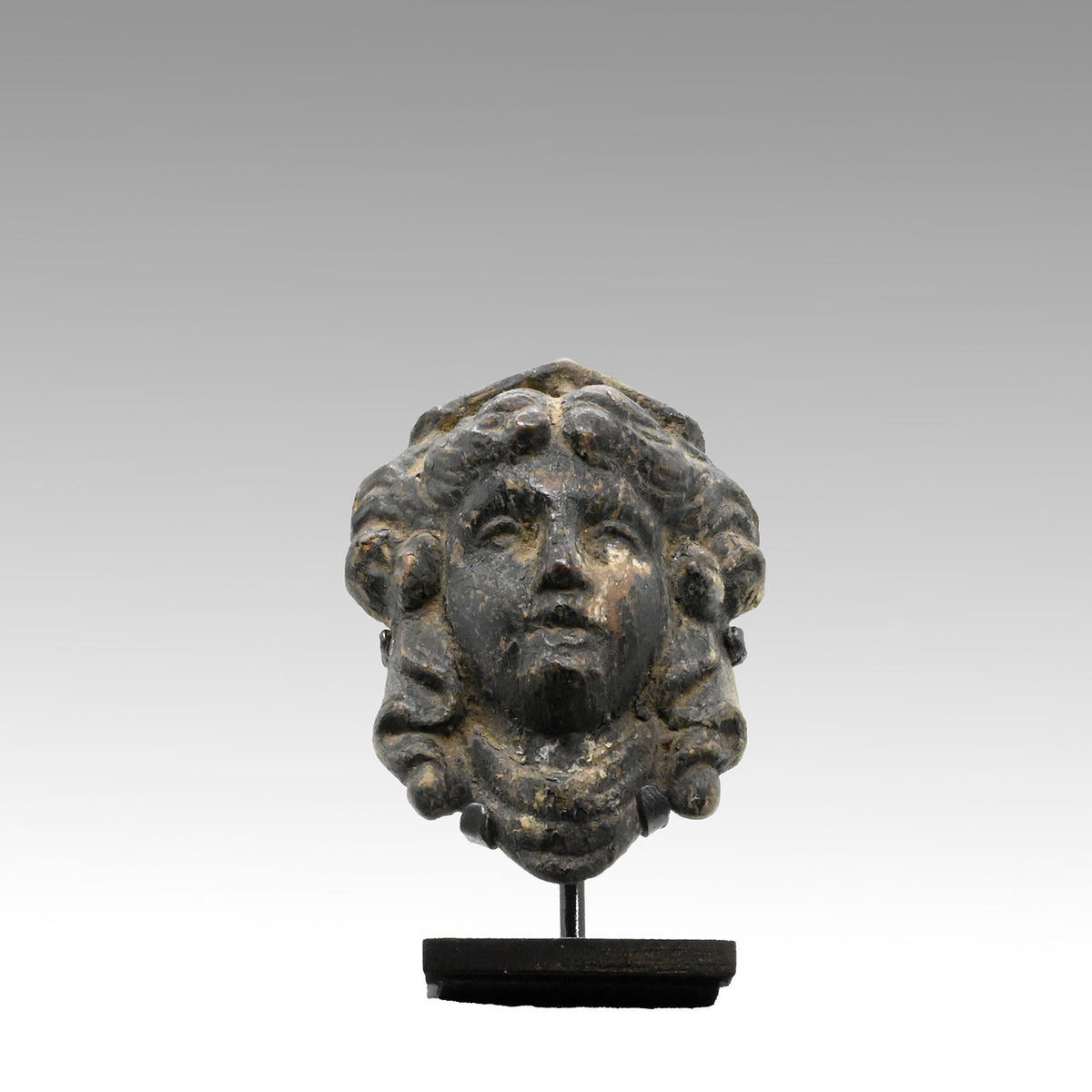
Roman Carved Wood Chariot Fitting Depicting Dionysus, Roman Imperial Period, ca. 1st - 2nd century CE
Dieser Artikel qualifiziert sich für kostenlosen Versand innerhalb der USA und eine pauschale Gebühr von 75 US-Dollar für den internationalen Versand.
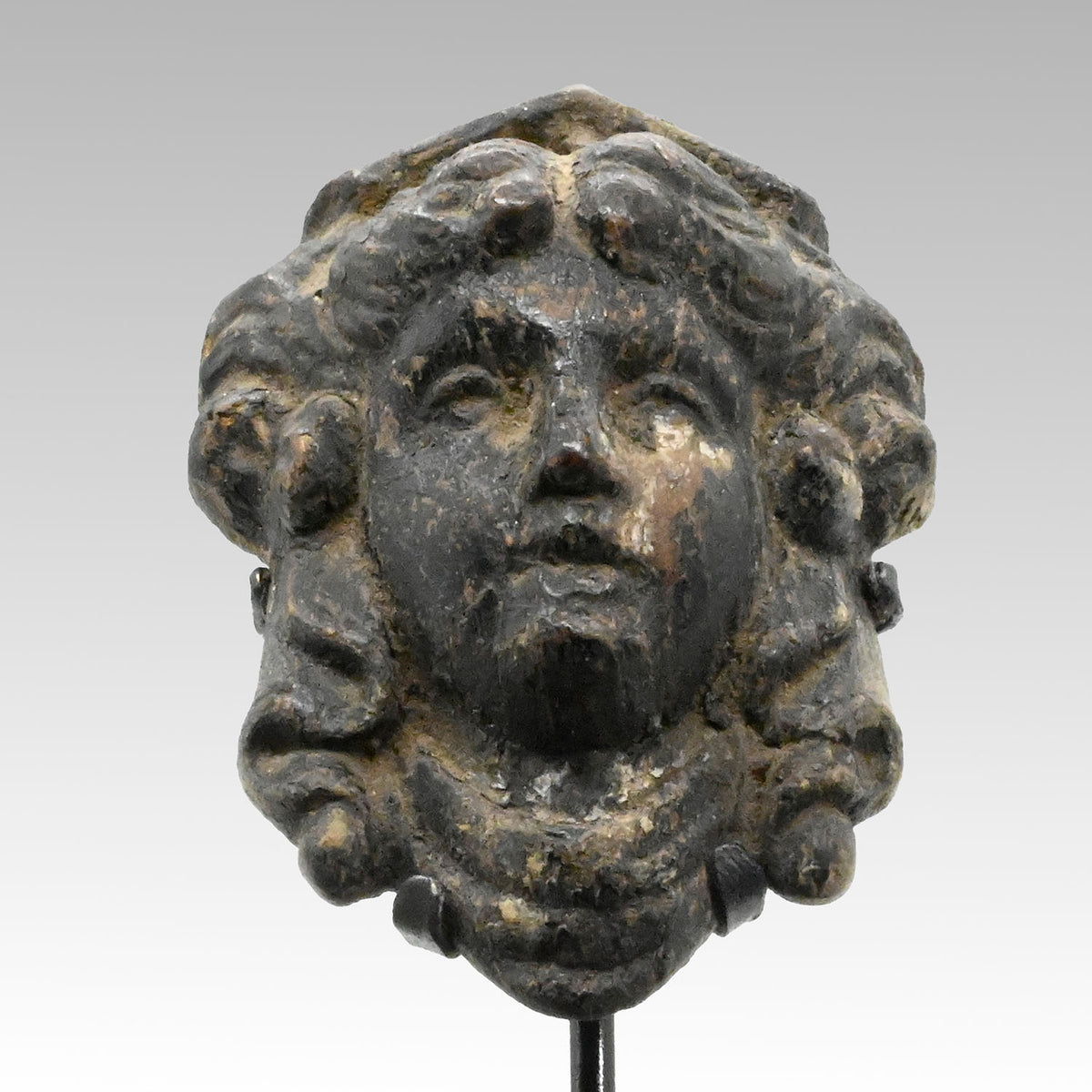
An rare Roman carved wooden chariot fitting depicting the youthful god Dionysus (Bacchus), the god of wine, fertility, and revelry. The deity is portrayed with a full, rounded face, softly modeled features, slightly parted lips, and abundant curling hair arranged in thick locks across the forehead and cascading along either side of the face. Small horn-like projections emerge from the surrounding curls, recalling the god's association with the bull, a symbol of his divine power and regenerative nature. The deeply carved hair and expressive facial features give the small head a striking sculptural presence.
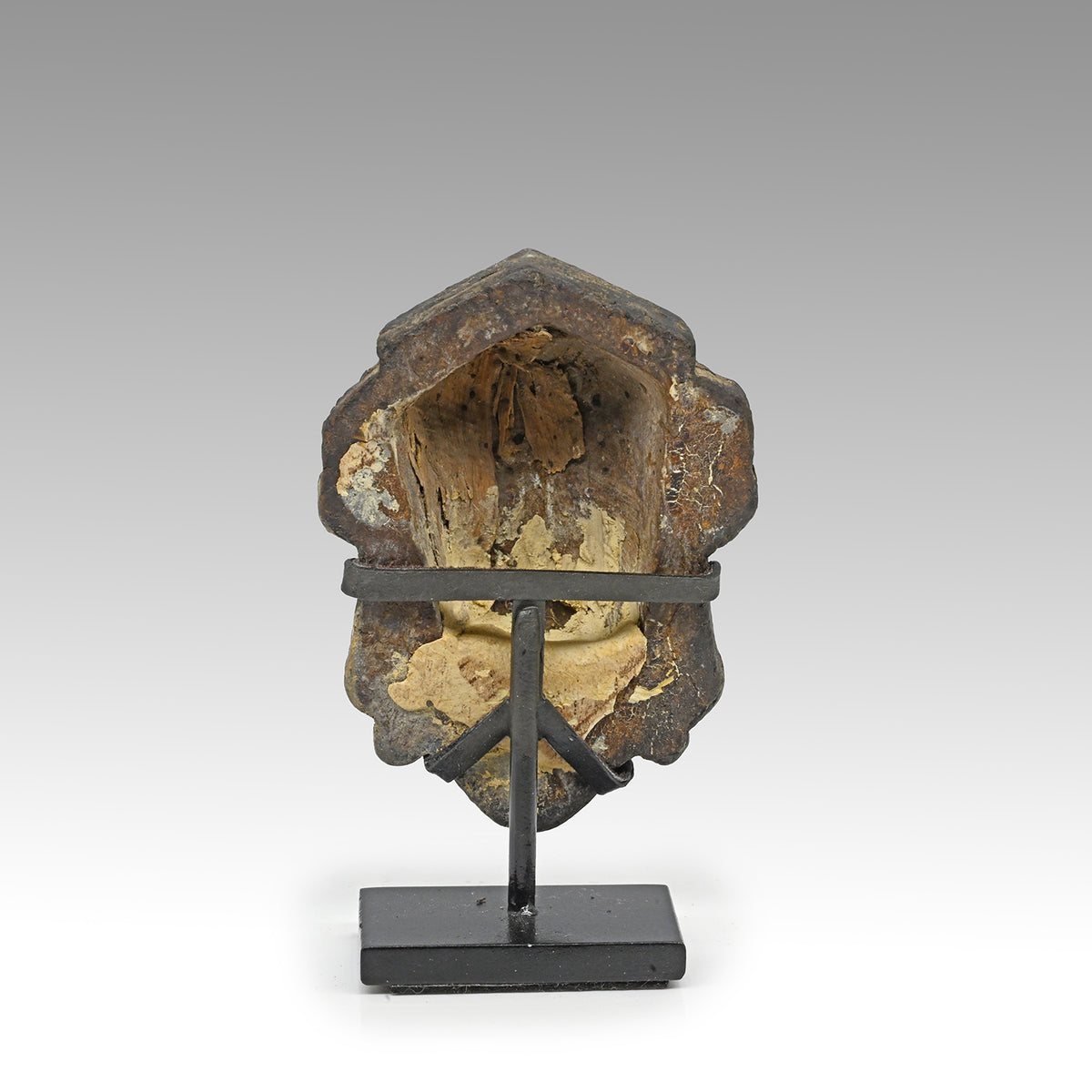
Originally serving as a decorative wooden chariot fitting, the head was carved with a deeply recessed reverse, apparently designed to fit over the end of a wooden structural element. Its compact scale, finely modeled features, and elaborate curling hair reflect the care devoted to ornamental details in Roman craftsmanship. Dionysiac imagery was widely employed in Roman decorative arts, where the god was associated with vitality, abundance, and divine protection. The survival of such a rare carved wooden fitting from antiquity makes this a particularly interesting example of Roman decorative art.
Medium: Wood
Dimensions: Height: 2 5/8 inches (6.6 cm)
Condition: Well preserved, with age-related surface wear, minor abrasions, and localized losses. The facial features and deeply carved curls remain well defined. Traces of a pale preparatory ground, possibly gesso, survive in areas of the face and hair, with possible remnants of original gilding. The recessed reverse exhibits some deterioration of the wood, with areas of exposed grain and residual surface deposits. Mounted for display.
Provenance: From the Iris Cornelia Love Collection (1933-2020), New York, primarily formed in the 1950s-1970s. Iris Cornelia Love was an American archaeologist, art historian, and collector, best known for her research on ancient Greek sculpture and her role in the rediscovery of the Temple of Aphrodite at Knidos. Educated at Smith College, the Institute of Fine Arts at New York University, and the University of Oxford, she conducted extensive fieldwork in Greece and Turkey and published influential studies on classical and Hellenistic art. A dynamic and often controversial figure, Love left a lasting legacy through her scholarship, discoveries, and distinguished collection of ancient art.
FRAGEN? Klicken Sie einfach auf den Tab „Kontakt“ auf der rechten Seite.
Wir versenden von Dienstag bis Freitag per Bodenkurier und in der Regel noch am selben Tag, wenn Ihre Bestellung vor 14 Uhr eingeht. Innerhalb der kontinentalen USA sind Verpackung, Versand und Versicherung kostenlos. Je nach Größe und Bestimmungsort liegen die Lieferzeiten zwischen einem und fünf Werktagen.
Für Überseeversand berechnen wir eine niedrige Pauschale, die Verpackung, die Erstellung aller Zollpapiere, Versicherung und Speditionsgebühren gemäß allen US-amerikanischen und internationalen Zollbestimmungen beinhaltet.
Internationale Sendungen werden per FedEx, DHL oder UPS International Priority verschickt. Bitte kontaktieren Sie uns, wenn Sie eine Versandpräferenz haben. Internationale Kunden sind für alle Zölle und Steuern verantwortlich.
Sands of Time gewährt eine lebenslange, bedingungslose Garantie auf die Echtheit und Herkunft. Jedem Objekt, das Sie von uns erwerben, liegt ein Echtheitszertifikat bei, das Kultur, Herkunft und Alter angibt.
Darüber hinaus führen wir eine Due Diligence durch, um sicherzustellen, dass der Gegenstand nach unserem besten Wissen nicht illegal aus einer Ausgrabungsstätte, einem Baudenkmal, einer öffentlichen Einrichtung oder einem Privatbesitz erworben wurde. Wo immer möglich, wird auf bestehende Sammlungen oder Veröffentlichungen verwiesen. Wo immer möglich, wird auf bestehende Sammlungen oder Veröffentlichungen verwiesen.
Optionen auswählen
Zuletzt angesehen
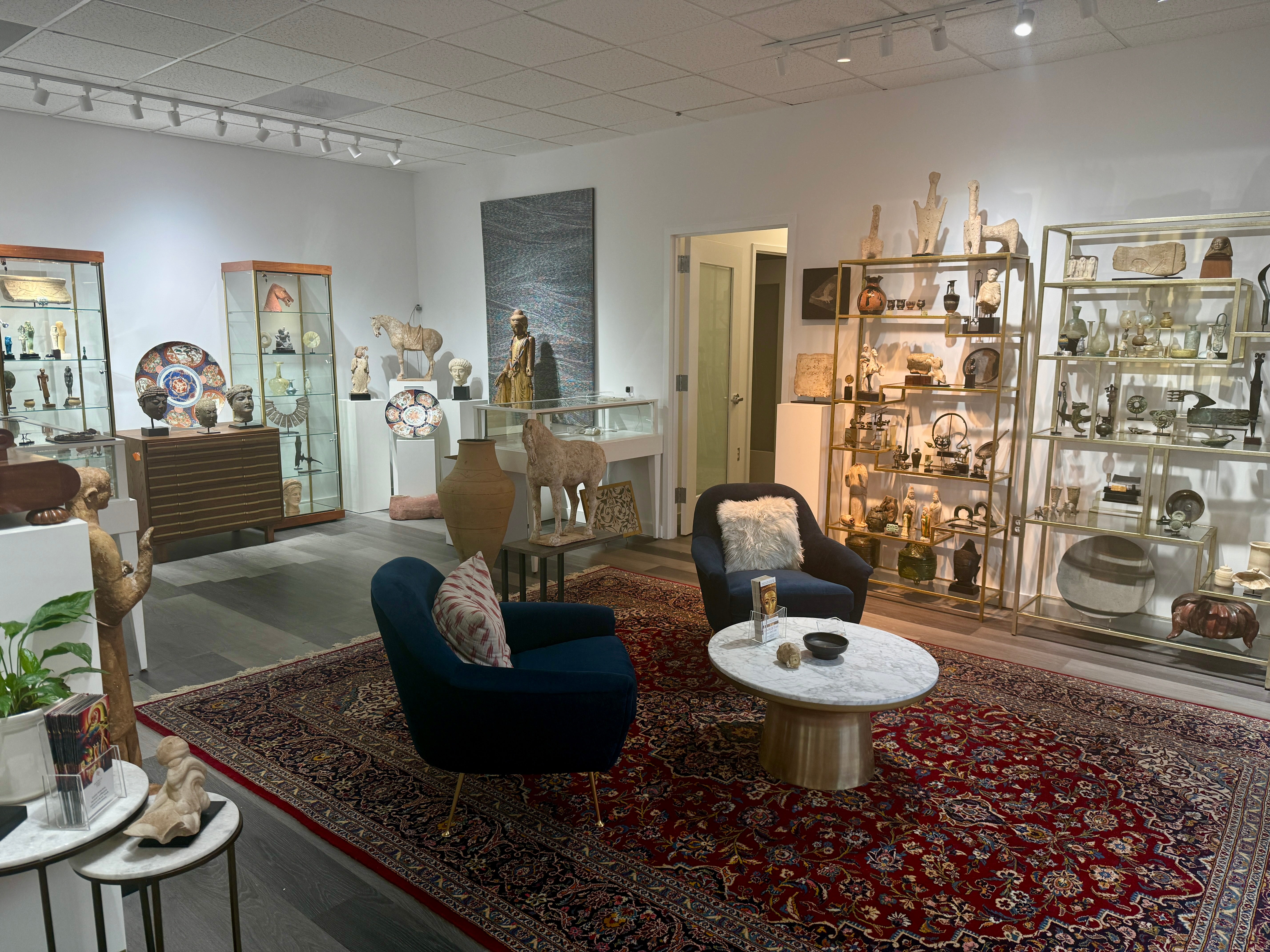
Come Visit Us!
1010 Wisconsin Ave NW, Suite 340
Washington DC. 20007
Tues - Fri, 10:00am - 6:00pm
Sat/Sun/Mon By appointment


