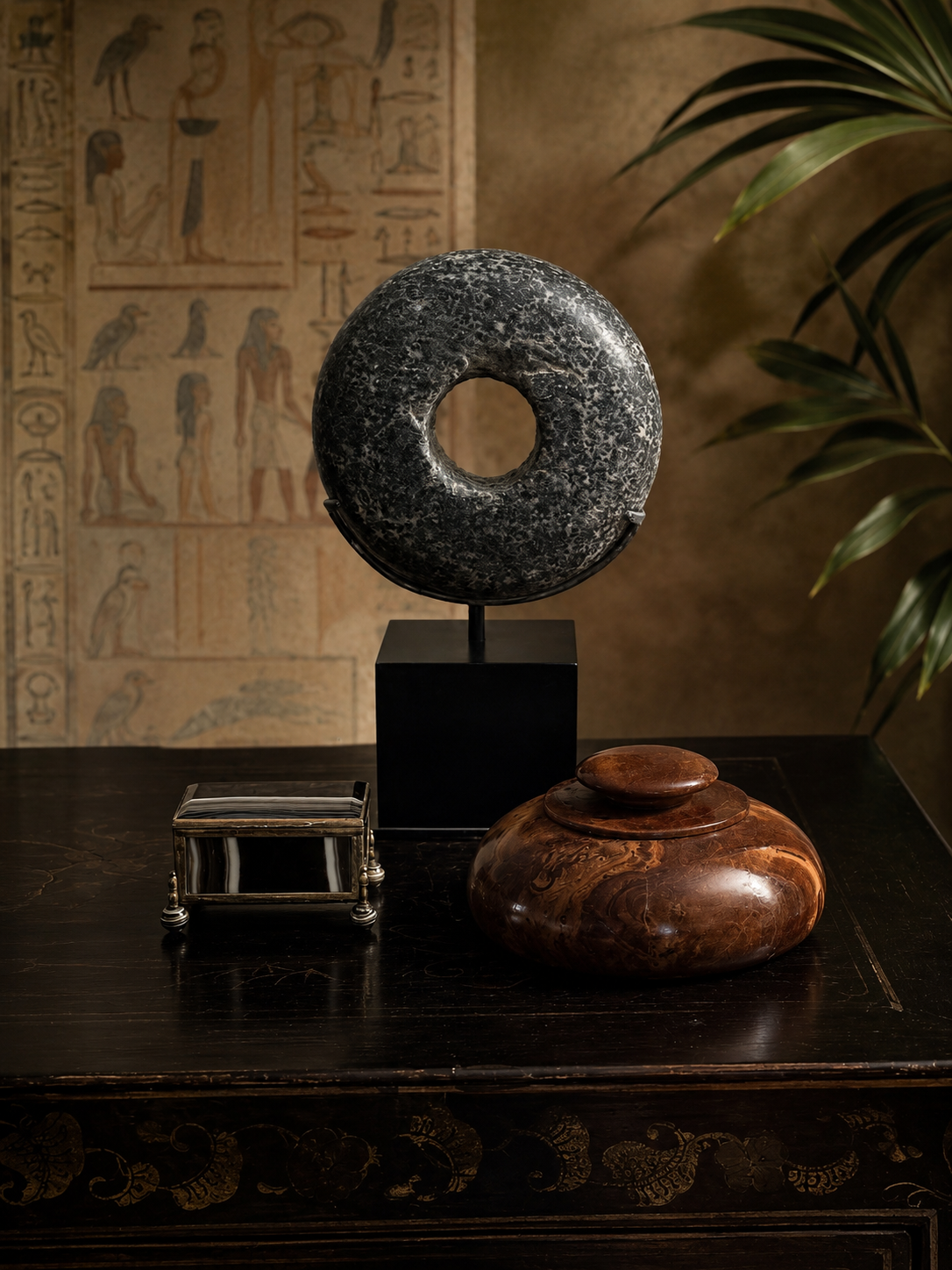
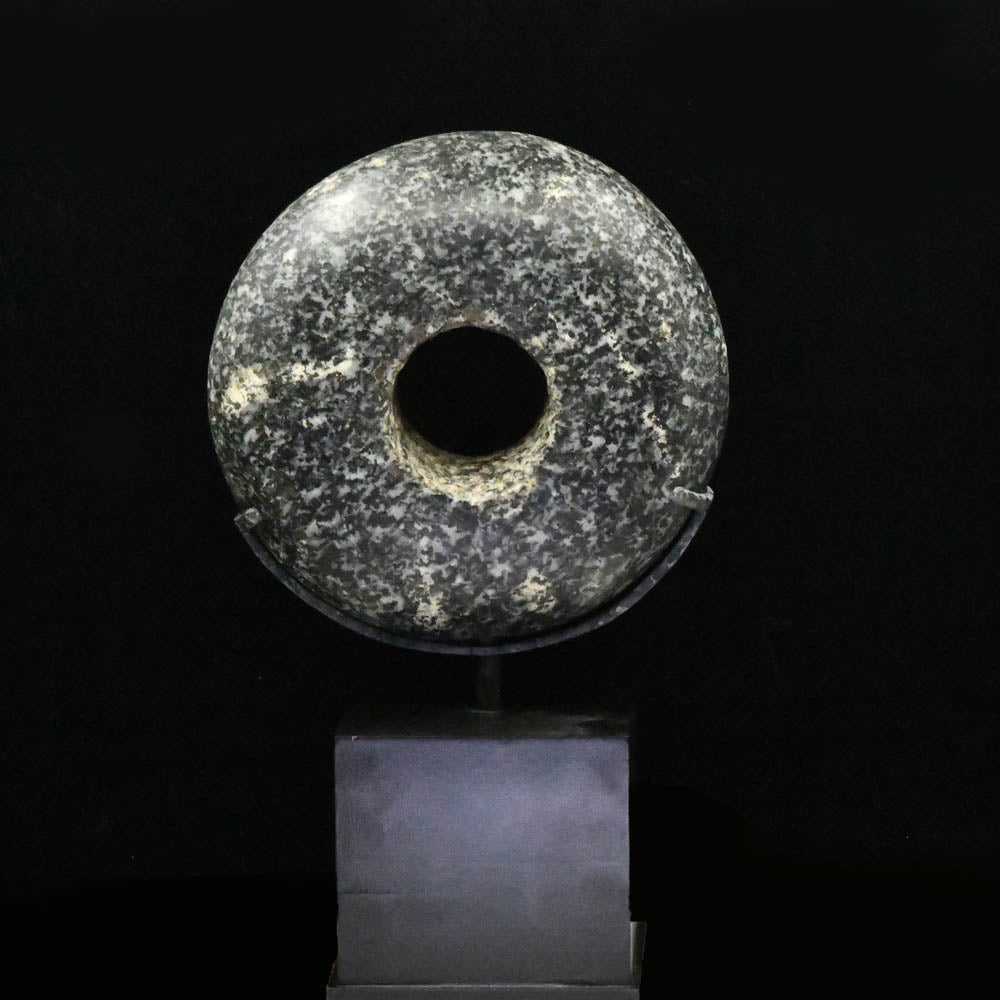
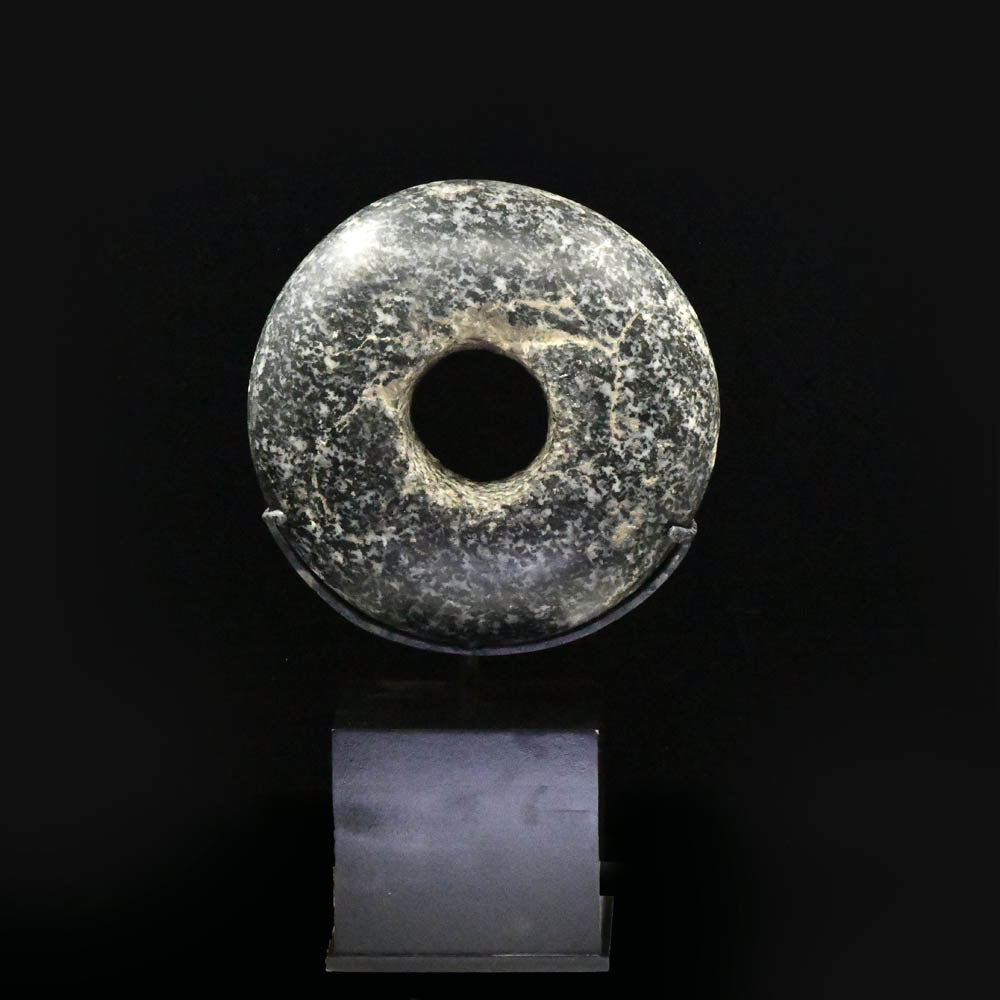
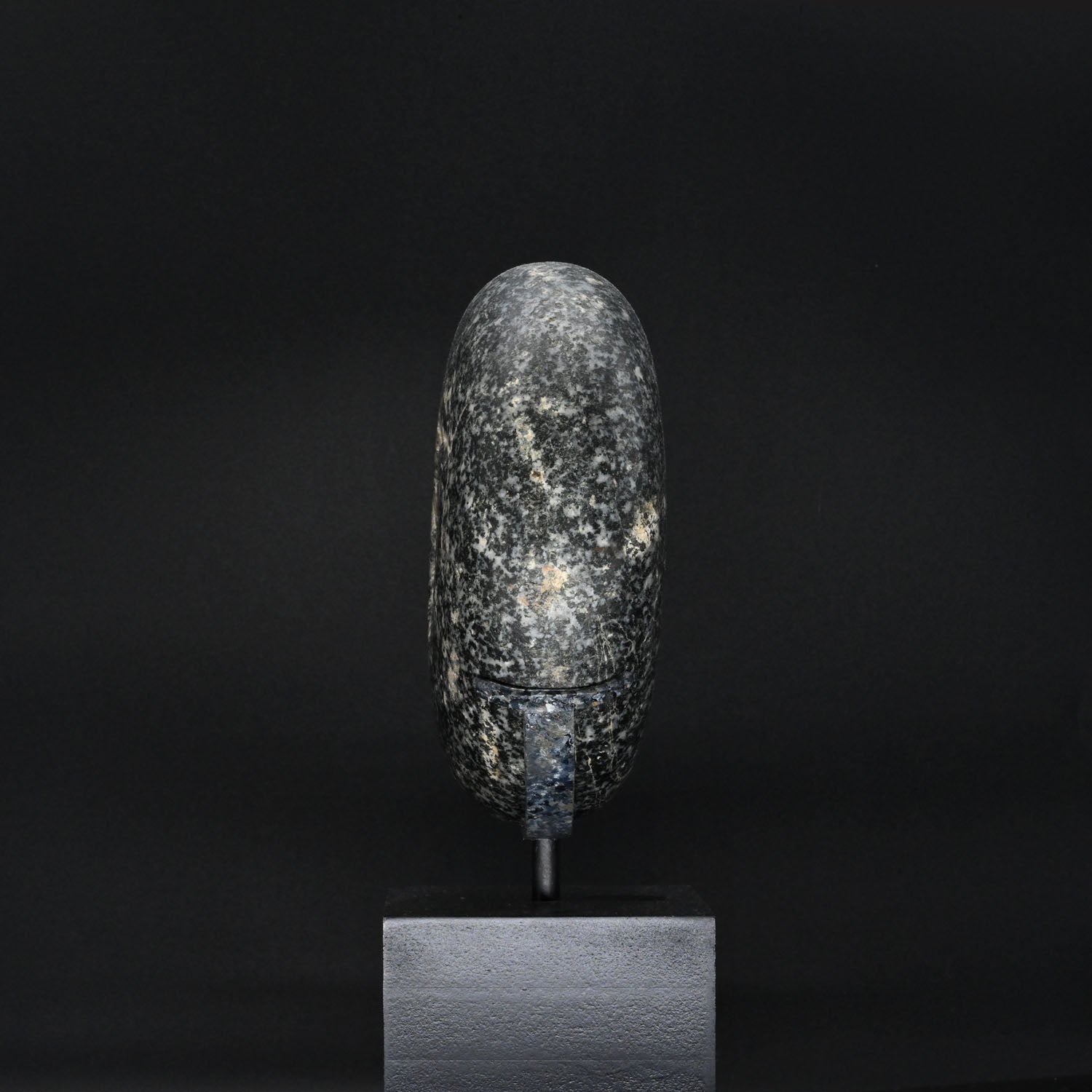
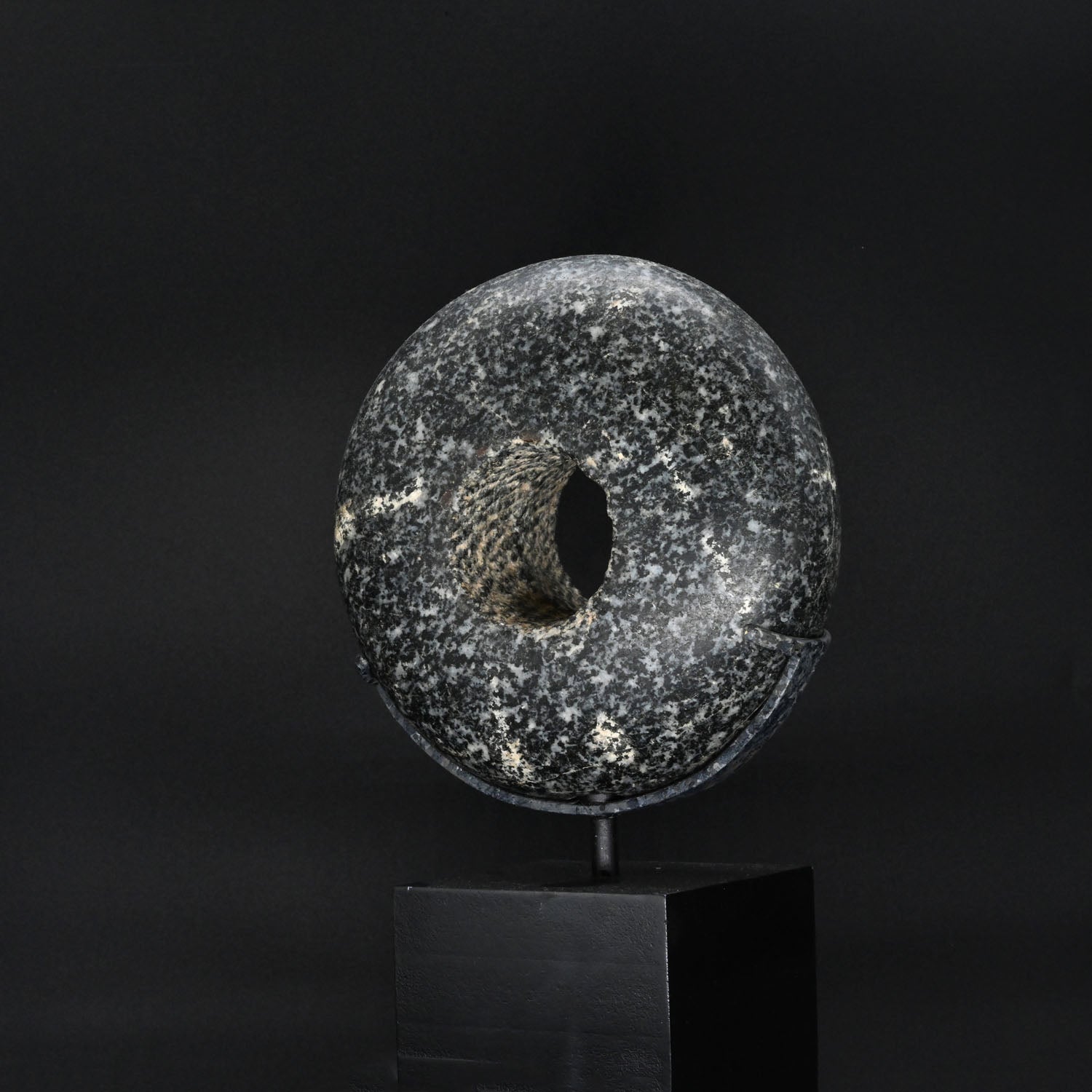
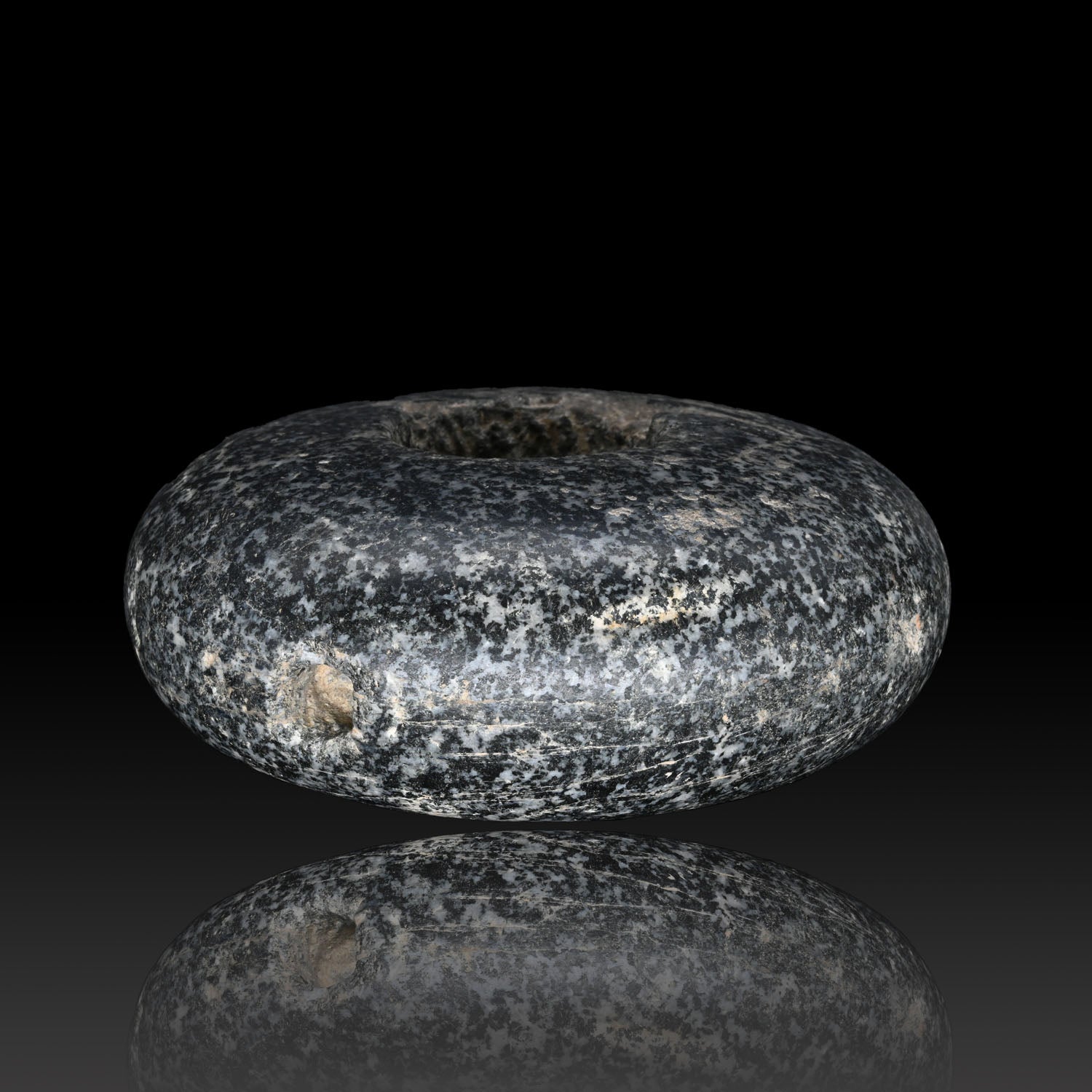
A Large Egyptian Diorite Rotary Grinding Stone, Old Kingdom, ca. 2543-1980 BCE
Dieser Artikel qualifiziert sich für kostenlosen Versand innerhalb der USA und eine pauschale Gebühr von 75 US-Dollar für den internationalen Versand.
This substantial rotary grinding stone is carved from speckled grano-diorite, one of the hardest and most durable stones employed by the ancient Egyptians. Ring-shaped in form, it features a broad central shaft hole and a smoothly rounded outer edge, while one side retains a small circular recess associated with its original operation. Objects of this type were essential tools in ancient Egyptian workshops and households, where they were used in the processing of grain, minerals, pigments, and other materials necessary for daily life.
The grinding stone is particularly noteworthy for its material. Diorite and grano-diorite were prized by Egyptian craftsmen for their durability but were exceptionally difficult to work. The same family of stone was selected for some of Egypt's finest royal sculpture, including masterpieces created during the age of the pyramid builders. The successful shaping of such a hard material required considerable skill and labor, making even utilitarian objects impressive demonstrations of ancient stone-working technology.
Unlike many surviving examples that show extensive wear, breakage, or repairs, this grinding stone remains intact and well-preserved. Its balanced proportions, attractive mottled surface, and pleasing geometric form give it a distinctly sculptural quality. Today it displays as an abstract work of ancient design while retaining its historical significance as a functional object from one of the most important periods of Egyptian civilization.
Tools and implements from the Old Kingdom are encountered far less frequently than scarabs, amulets, or later funerary objects. As such, this piece offers collectors an opportunity to acquire an authentic artifact directly connected to the practical and industrial life of Egypt during the era of the great pyramids.
Medium: Diorite
Dimensions: Diameter: 6 inches (15.2 cm)
Condition: Overall intact and in very good condition Presented on a museum quality custom mount.
Provenance: The John J. Slocum Collection. Mr. Slocum (1914-1997) collected most of his antiquities while serving as US cultural attache to Egypt in the 1960s. Later, he served as Assistant to the Director of The Smithsonian, was appointed by President Reagan to the Presidential Cultural Property Advisory Committee, and was a Trustee Emeritus of the Archaeological Institute of America. He was a well-respected scholar/collector, whose medieval crusader coins were sold in a single-owner sale at Sotheby's, London in 1997.
FRAGEN? Klicken Sie einfach auf den Tab „Kontakt“ auf der rechten Seite.
Wir versenden von Dienstag bis Freitag per Bodenkurier und in der Regel noch am selben Tag, wenn Ihre Bestellung vor 14 Uhr eingeht. Innerhalb der kontinentalen USA sind Verpackung, Versand und Versicherung kostenlos. Je nach Größe und Bestimmungsort liegen die Lieferzeiten zwischen einem und fünf Werktagen.
Für Überseeversand berechnen wir eine niedrige Pauschale, die Verpackung, die Erstellung aller Zollpapiere, Versicherung und Speditionsgebühren gemäß allen US-amerikanischen und internationalen Zollbestimmungen beinhaltet.
Internationale Sendungen werden per FedEx, DHL oder UPS International Priority verschickt. Bitte kontaktieren Sie uns, wenn Sie eine Versandpräferenz haben. Internationale Kunden sind für alle Zölle und Steuern verantwortlich.
Sands of Time gewährt eine lebenslange, bedingungslose Garantie auf die Echtheit und Herkunft. Jedem Objekt, das Sie von uns erwerben, liegt ein Echtheitszertifikat bei, das Kultur, Herkunft und Alter angibt.
Darüber hinaus führen wir eine Due Diligence durch, um sicherzustellen, dass der Gegenstand nach unserem besten Wissen nicht illegal aus einer Ausgrabungsstätte, einem Baudenkmal, einer öffentlichen Einrichtung oder einem Privatbesitz erworben wurde. Wo immer möglich, wird auf bestehende Sammlungen oder Veröffentlichungen verwiesen. Wo immer möglich, wird auf bestehende Sammlungen oder Veröffentlichungen verwiesen.
Optionen auswählen
Zuletzt angesehen

Come Visit Us!
1010 Wisconsin Ave NW, Suite 340
Washington DC. 20007
Tues - Fri, 10:00am - 6:00pm
Sat/Sun/Mon By appointment


