
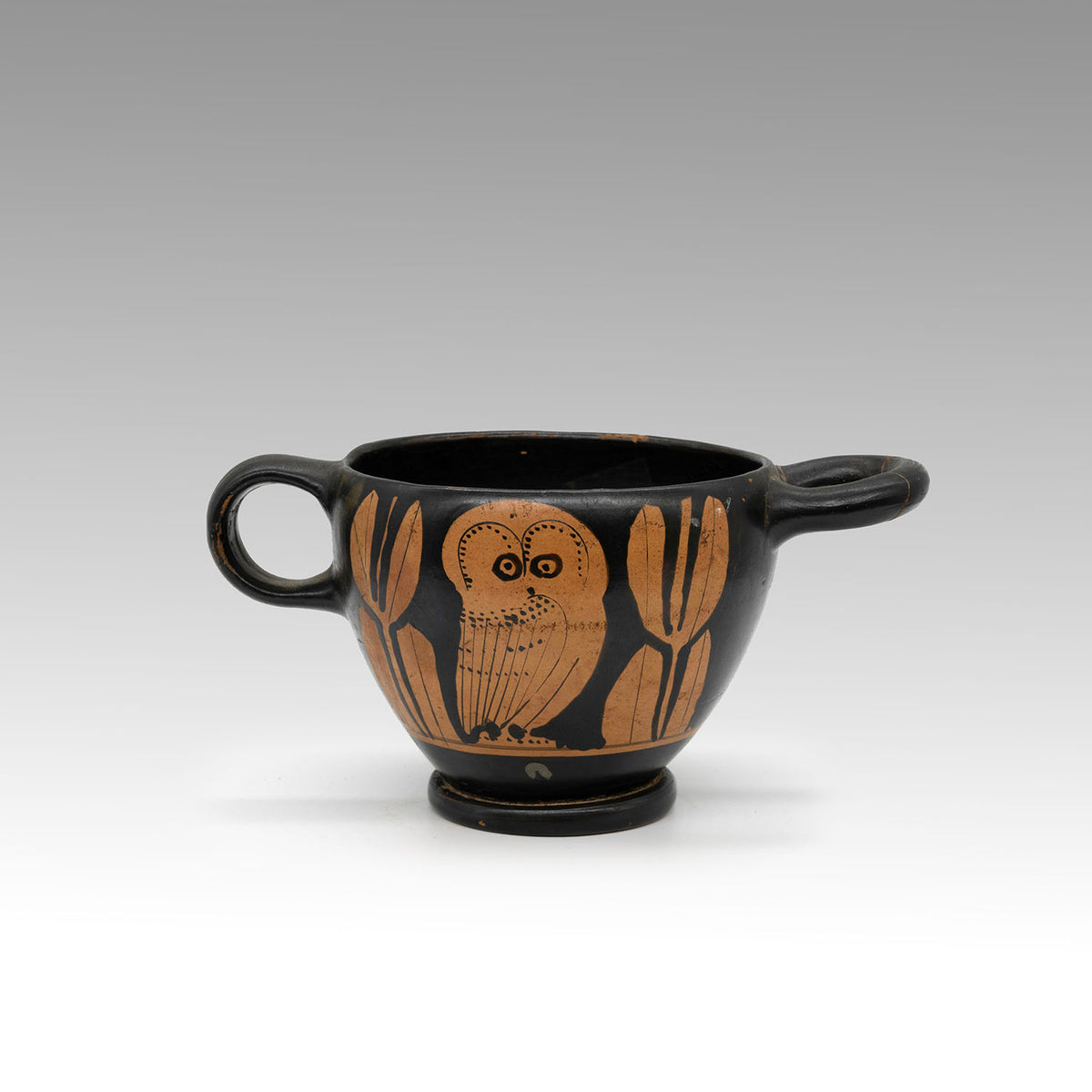
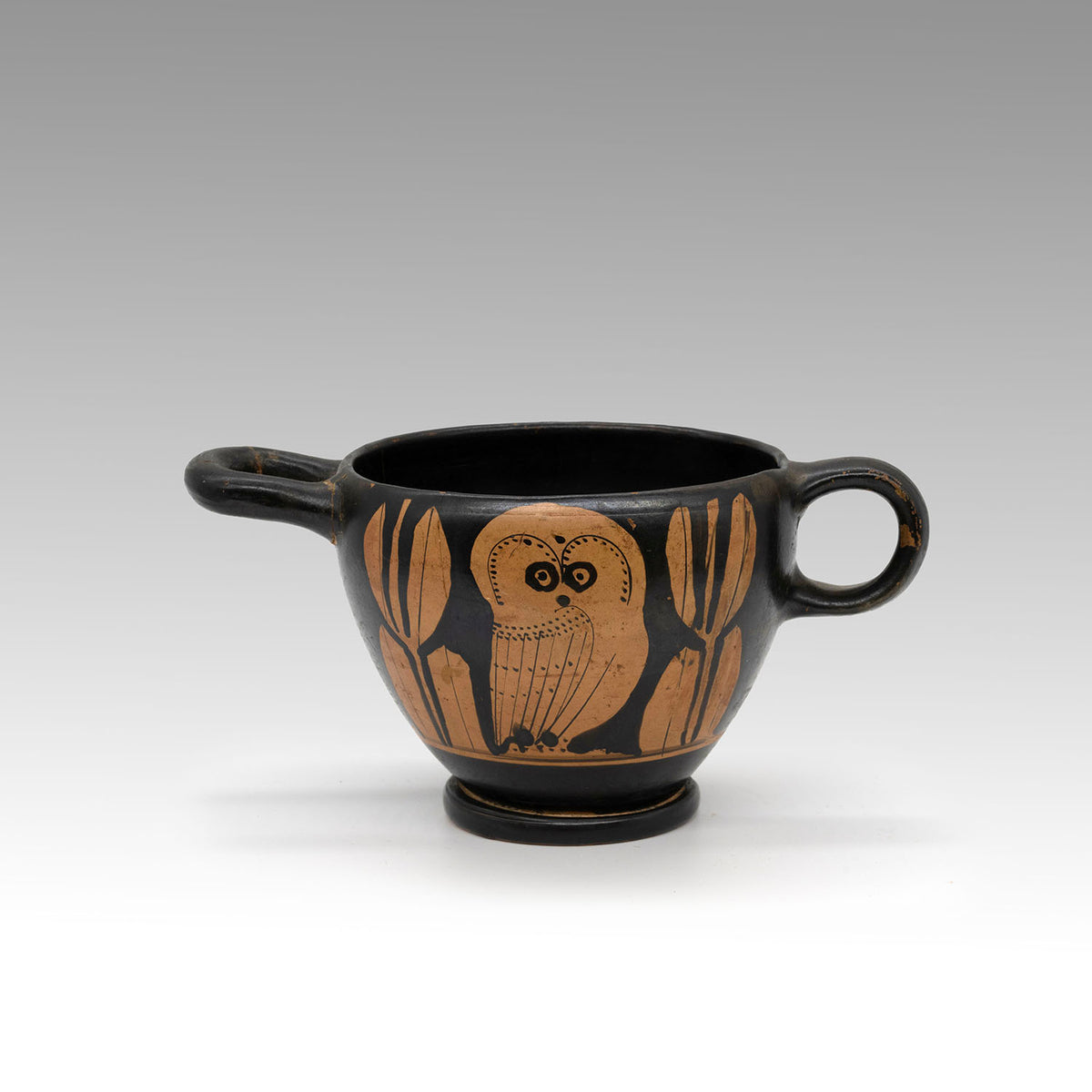
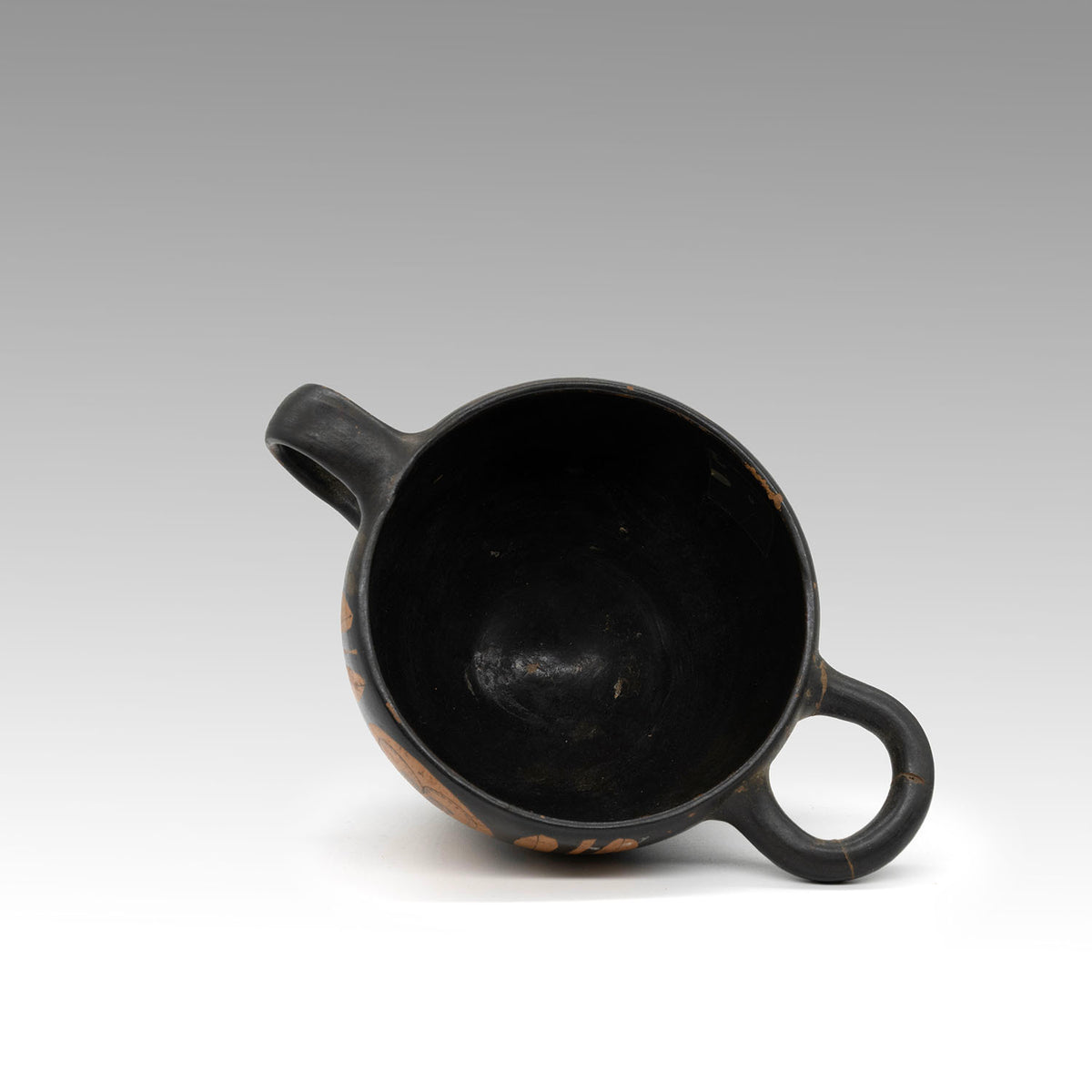
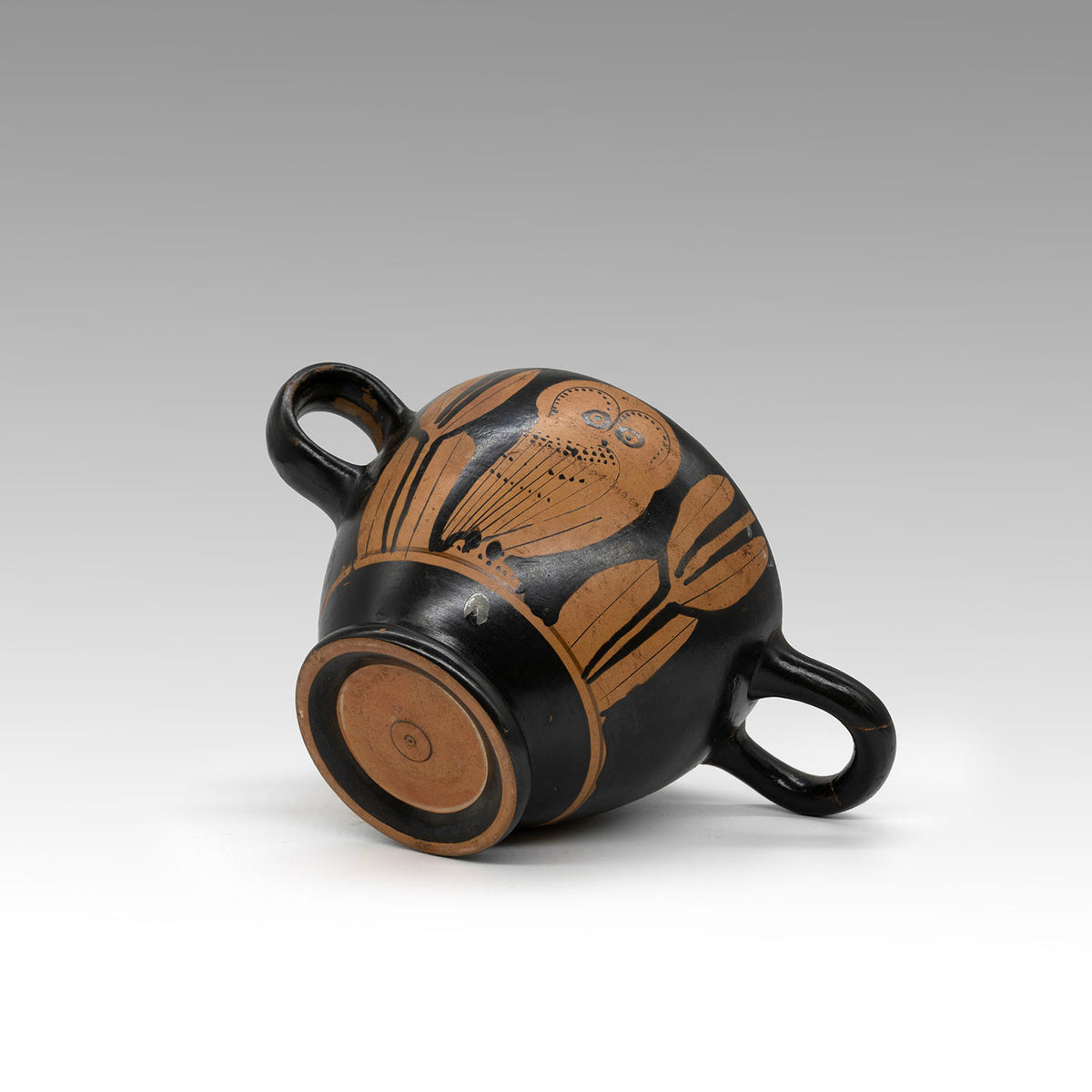
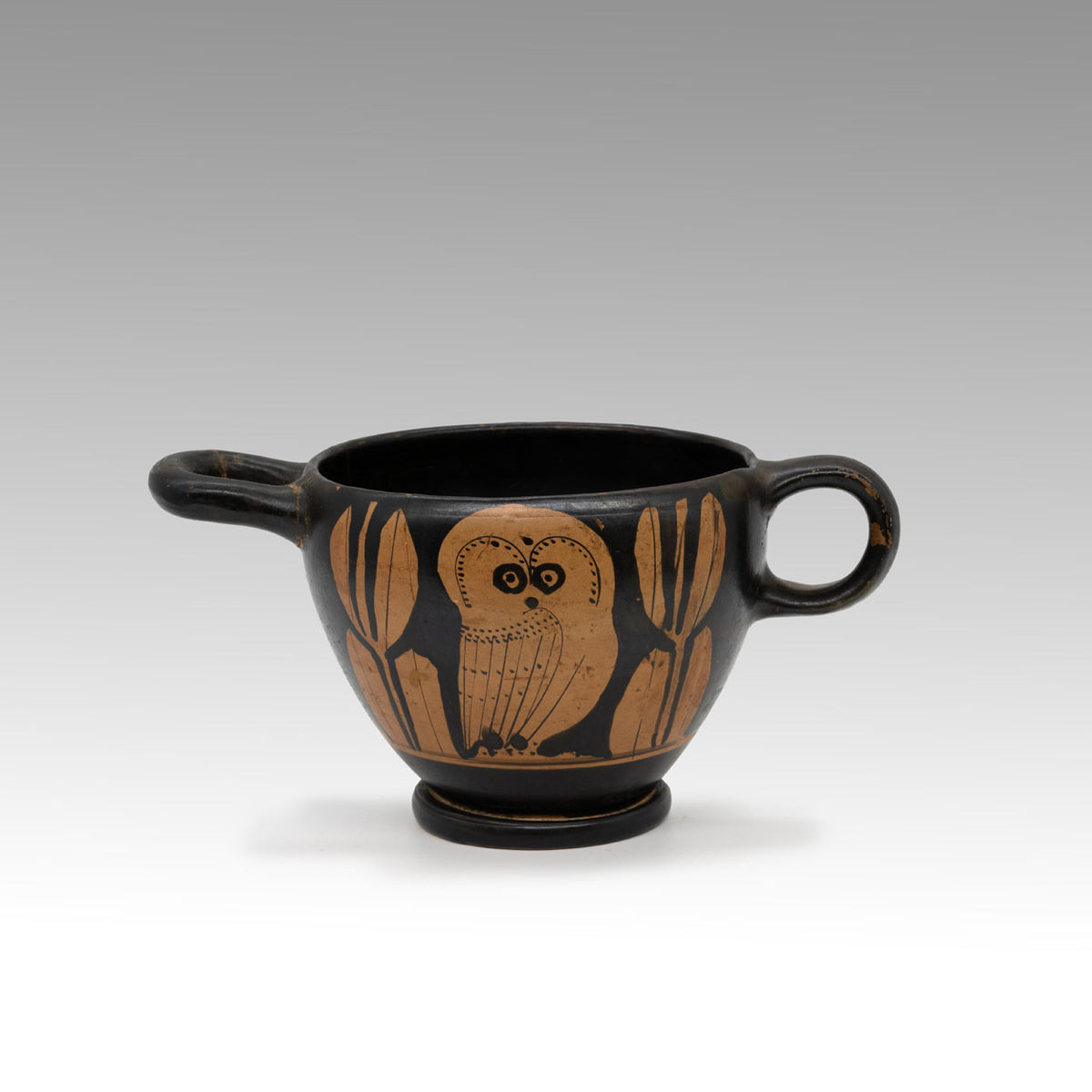
An Attic Red Figure Owl Skyphos, ca. 475 - 425 BCE
Dieses Objekt ist für den kostenlosen und schnellen weltweiten Versand qualifiziert.
During the fifth century BCE, Athens produced large numbers of red-figure drinking cups decorated on each side with an owl standing between two olive sprays. On this example, the owl’s body faces right, while its head turns fully toward the viewer. The upright olive branches follow the curve of the vessel, filling the spaces on either side of the bird. A narrow reserved line runs beneath the decoration, encircling the cup and providing a groundline for the composition. The owls are similar but show small differences in the painted details. Each has large circular eyes framed by curved, dotted outlines, giving the face its distinctive alert expression. Fine lines and rows of dots define the feathers of the folded wings. The birds and olive sprays are reserved in the natural orange clay against the black glaze, which also covers the interior, handles, and foot.
This cup belongs to the form classified by Beazley as Type B, distinguished by its curved sides and combination of one horizontal and one vertical handle. Often called a "glaux", the Greek word for owl, the form takes its name from an ancient inscription beneath an owl cup in Berlin, thought to have been a potter’s or shopkeeper’s notation. Beazley and Magi suggested that the shape itself resembled an owl, with the vertical handle representing the head and the horizontal handle the tail. The owl and olive branches had particular significance in Athens. The owl was the companion and emblem of Athena, the city’s patron goddess, and became a symbol of Athens itself. Its appearance on Athenian silver coins, which circulated throughout the Greek world and beyond, made the association widely familiar. The expression “owls to Athens” was much like the English “coals to Newcastle,” referring to bringing something to a place already well supplied with it.
The olive tree was also closely associated with Athena. According to tradition, she planted her sacred olive on the Acropolis during her contest with Poseidon for possession of Attica. Herodotus records that, after the Persians burned the Acropolis in 480 BCE, the surviving stump produced a new shoot the following day. The tree thus became a fitting symbol of the city’s survival and renewal. The owl and olive sprays therefore bring together the goddess, her sacred tree, and the identity of her city. Their presence on a drinking vessel reflects the close relationship between religious imagery and everyday life in classical Athens.
Medium: Clay
Dimensions: Height: 3 inches (7.5 cm), Width: 6 inches (15.24 cm)
Condition: The horizontal handle rejoined, otherwise to cup is intact and in very good condition overall. A lovely example.
Provenance: Private collection of William S. Dietrich II (1938-2010), PA acquired in the 1980s.
Wir versenden Dienstag bis Freitag mit FedEx und normalerweise noch am selben Tag, wenn Ihre Bestellung vor 14:00 Uhr eingeht. Innerhalb der kontinentalen USA sind Verpackung, Versand und Versicherung kostenlos. Je nach Größe und Bestimmungsort liegen die Lieferzeiten zwischen einem und fünf Werktagen.
Für Überseeversand berechnen wir einen kleinen Pauschalbetrag, der Verpackung, die Erstellung aller Zollpapiere, Versicherung und Frachtkosten gemäß allen US-amerikanischen und internationalen Zollbestimmungen umfasst. Überseeversand erfolgt entweder mit USPS Priority Mail oder FedEx, aber kontaktieren Sie uns, wenn Sie eine Versandpräferenz haben. Internationale Kunden sind für alle Zölle und Steuern verantwortlich.
Sands of Time gewährt eine lebenslange, bedingungslose Garantie auf die Echtheit und Herkunft. Jedem Objekt, das Sie von uns erwerben, liegt ein Echtheitszertifikat bei, das Kultur, Herkunft und Alter angibt.
Darüber hinaus führen wir eine Due Diligence durch, um sicherzustellen, dass der Gegenstand nach unserem besten Wissen nicht illegal aus einer Ausgrabungsstätte, einem Baudenkmal, einer öffentlichen Einrichtung oder einem Privatbesitz erworben wurde. Wo immer möglich, wird auf bestehende Sammlungen oder Veröffentlichungen verwiesen. Wo immer möglich, wird auf bestehende Sammlungen oder Veröffentlichungen verwiesen.
Optionen auswählen
Zuletzt angesehen
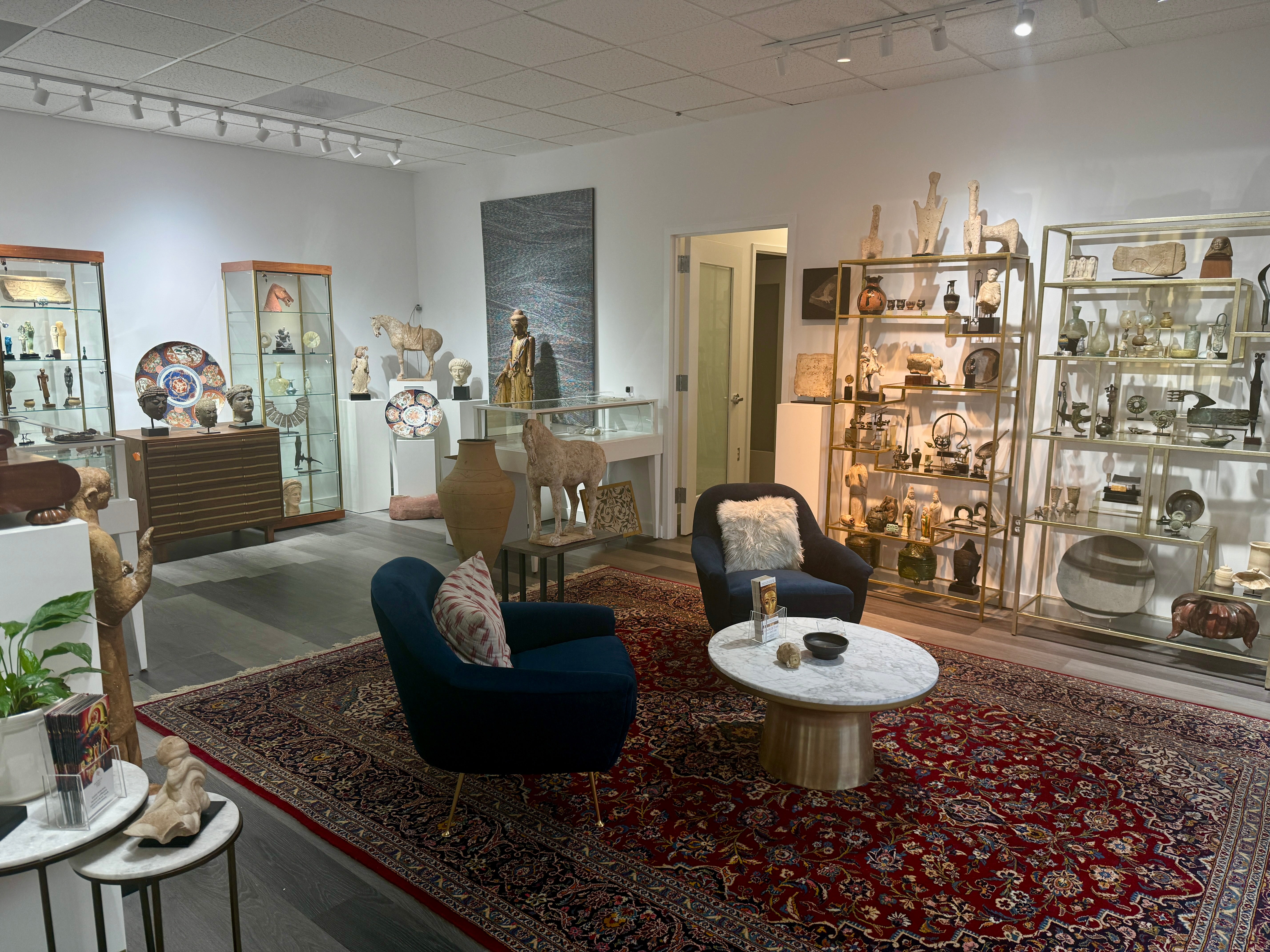
Come Visit Us!
1010 Wisconsin Ave NW, Suite 340
Washington DC. 20007
Tues - Fri, 10:00am - 6:00pm
Sat/Sun/Mon By appointment


