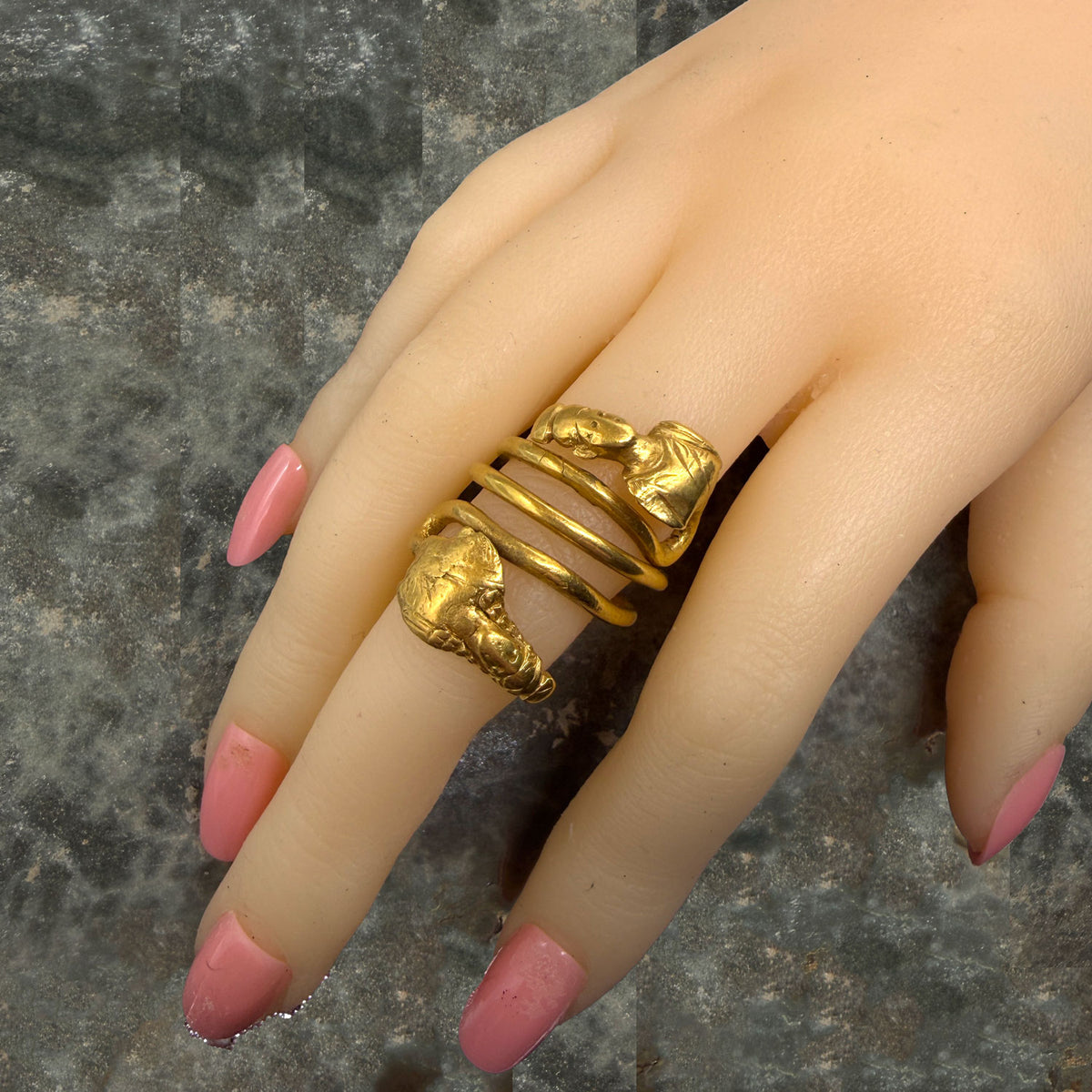
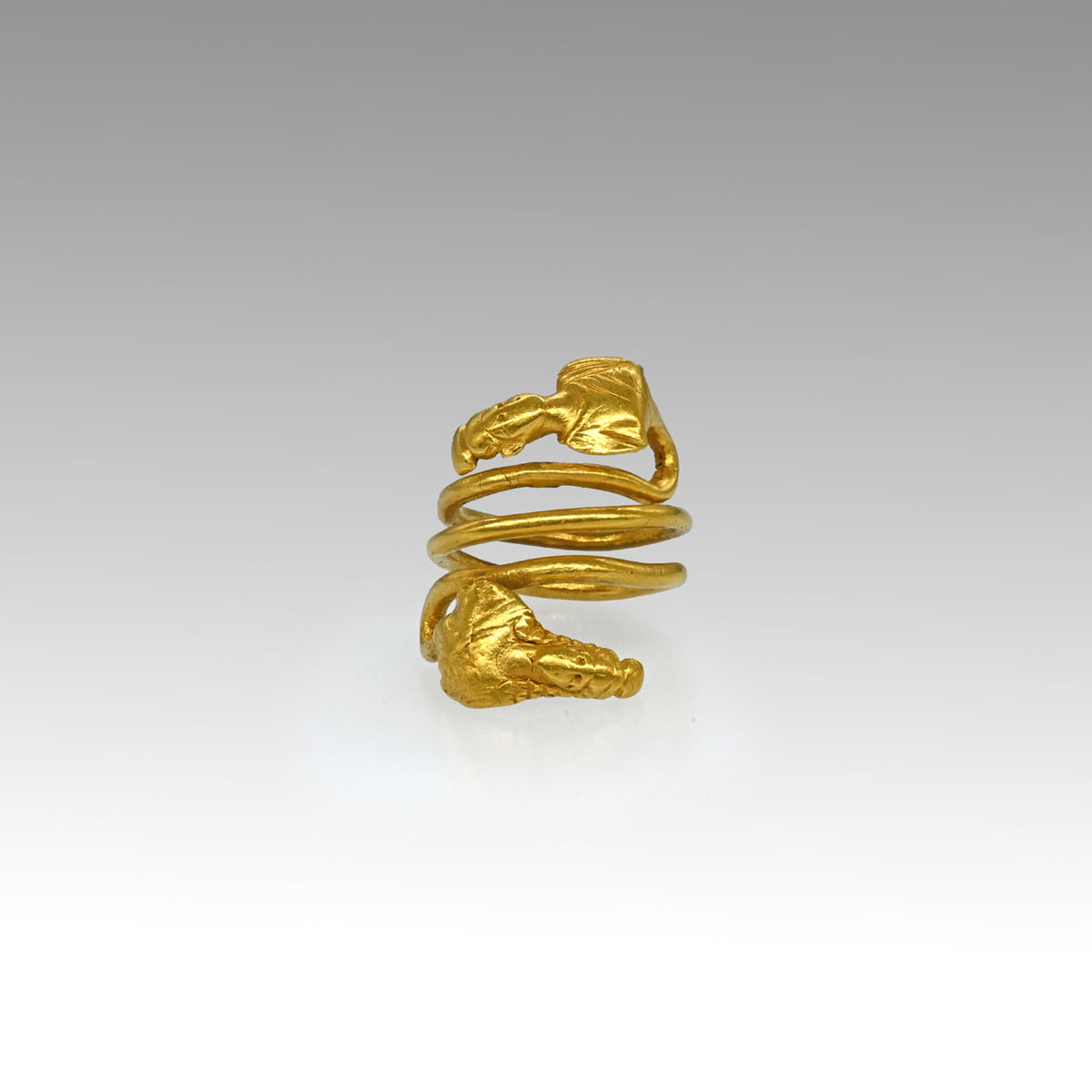
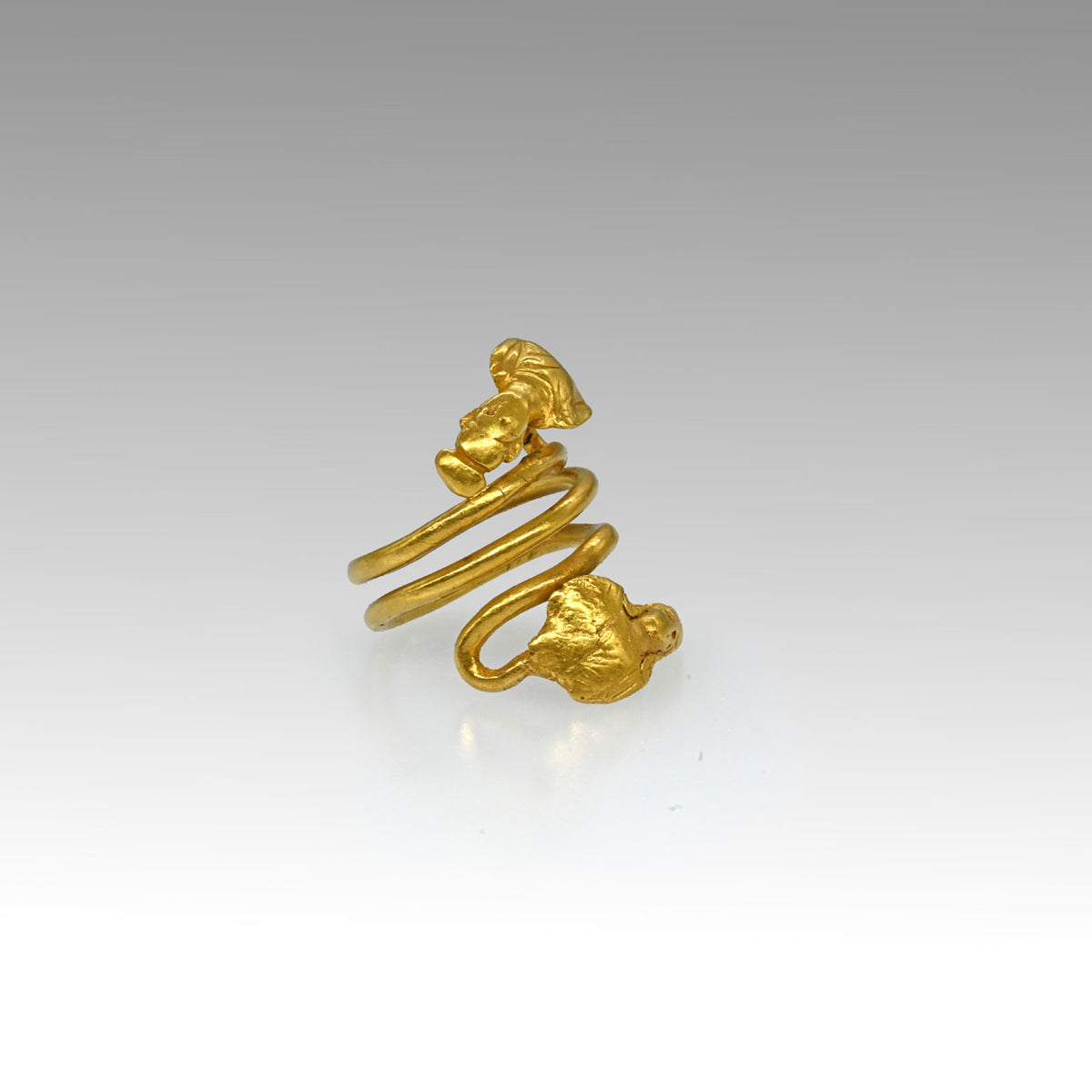
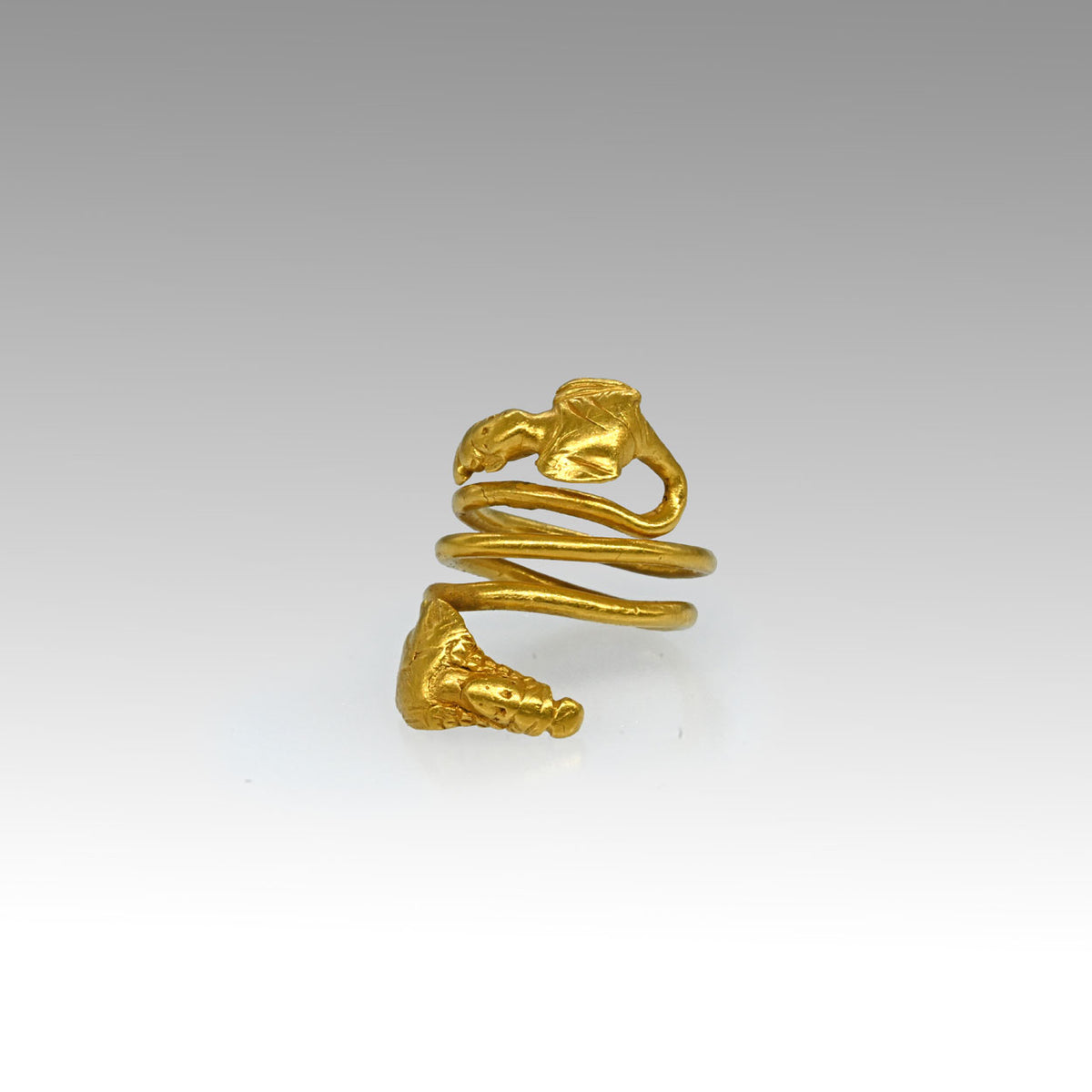
A Published Egypto-Roman Gold Spiral Snake Ring with Isis and Ptah Terminals, Roman Imperial Period, ca. 1st century CE
Dieser Artikel qualifiziert sich für kostenlosen Versand innerhalb der USA und eine pauschale Gebühr von 75 US-Dollar für den internationalen Versand.
A rare Egypto-Roman gold spiral snake ring, formed from a continuous length of high karat thick, rounded gold wire coiled three times to encircle the finger, terminating in opposing busts of Egyptian deities, probably Isis and Ptah. Each terminal is modelled in high relief, depicting the head and upper torso of a deity. The female bust, probably representing Isis, wears an elaborate headdress, while the opposing male bust, tentatively identified as Ptah, is distinguished by a close-fitting skullcap, a characteristic attribute of the god. Both figures have carefully delineated facial features, with incised details defining their headdresses and garments.
The serpent held considerable religious significance in both Egyptian and Roman cultures, where it was associated with protection, regeneration, fertility, and divine power. Snake rings were particularly popular during the Hellenistic and Roman periods, their sinuous forms lending themselves naturally to jewellery designed to coil around the finger or wrist. The combination of a serpentine body with anthropomorphic divine terminals is particularly unusual, reflecting the blending of Egyptian religious imagery with Roman jewellery traditions.
Following the Roman conquest of Egypt in 30 BCE, the worship of Egyptian deities, particularly Isis, spread throughout the Roman world. Jewellery incorporating their images often served both decorative and amuletic purposes. The present ring is a distinctive example of this cultural exchange, combining the protective symbolism of the serpent with the imagery of Egyptian divinities.
Published: Jack Ogden and Barbara Deppert-Lippitz, "A Golden Past: Jewelry from the Ancient World" (1990) p. 6, no. 2.
For related example see: The British Museum, inv. no. 1926,0407.12 and Marshall, FH, Catalogue of the Finger Rings Greek, Etruscan & Roman in the Department of Antiquities, British Museum (London, 1907), no. 241
Medium: Gold
Dimensions: US ring size 5½ (UK=K 1/2, DE=17, CH=10, FR=50.6, EU=50.6, JP=10). Length: 1 1/8 inches (2.85 cm)
Condition: Intact and in very good condition, with minor surface wear consistent with use and a small modern repair to the hoop. Catalog note: EDX analysis of the gold revealed a composition of approximately 97.04% gold and 2.96% silver, equivalent to approximately 23.3 karats, with no copper detected. This high degree of purity is consistent with other good-quality early Romano-Egyptian goldwork.
Provenance: Private London collection, previously in a distinguished New York private collection assembled between 1975 and 1995. Documented and authenticated in the early 1990s by Dr. Jack Ogden and Barbara Deppert-Lippitz, leading specialists in ancient jewelry.
FRAGEN? Klicken Sie einfach auf den Tab „Kontakt“ auf der rechten Seite.
Wir versenden von Dienstag bis Freitag per Bodenkurier und in der Regel noch am selben Tag, wenn Ihre Bestellung vor 14 Uhr eingeht. Innerhalb der kontinentalen USA sind Verpackung, Versand und Versicherung kostenlos. Je nach Größe und Bestimmungsort liegen die Lieferzeiten zwischen einem und fünf Werktagen.
Für Überseeversand berechnen wir eine niedrige Pauschale, die Verpackung, die Erstellung aller Zollpapiere, Versicherung und Speditionsgebühren gemäß allen US-amerikanischen und internationalen Zollbestimmungen beinhaltet.
Internationale Sendungen werden per FedEx, DHL oder UPS International Priority verschickt. Bitte kontaktieren Sie uns, wenn Sie eine Versandpräferenz haben. Internationale Kunden sind für alle Zölle und Steuern verantwortlich.
Sands of Time gewährt eine lebenslange, bedingungslose Garantie auf die Echtheit und Herkunft. Jedem Objekt, das Sie von uns erwerben, liegt ein Echtheitszertifikat bei, das Kultur, Herkunft und Alter angibt.
Darüber hinaus führen wir eine Due Diligence durch, um sicherzustellen, dass der Gegenstand nach unserem besten Wissen nicht illegal aus einer Ausgrabungsstätte, einem Baudenkmal, einer öffentlichen Einrichtung oder einem Privatbesitz erworben wurde. Wo immer möglich, wird auf bestehende Sammlungen oder Veröffentlichungen verwiesen. Wo immer möglich, wird auf bestehende Sammlungen oder Veröffentlichungen verwiesen.
Optionen auswählen
Zuletzt angesehen

Come Visit Us!
1010 Wisconsin Ave NW, Suite 340
Washington DC. 20007
Tues - Fri, 10:00am - 6:00pm
Sat/Sun/Mon By appointment


