
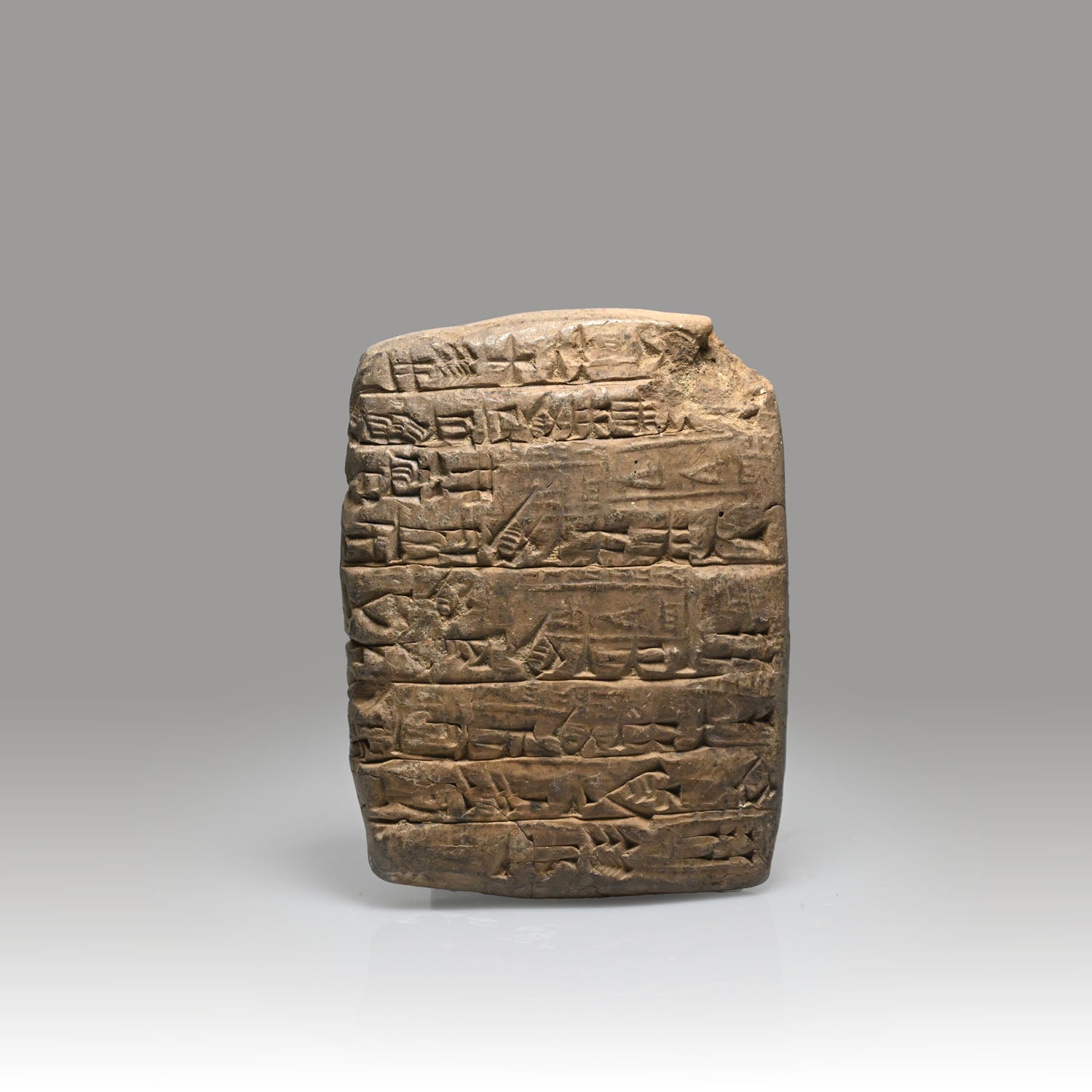
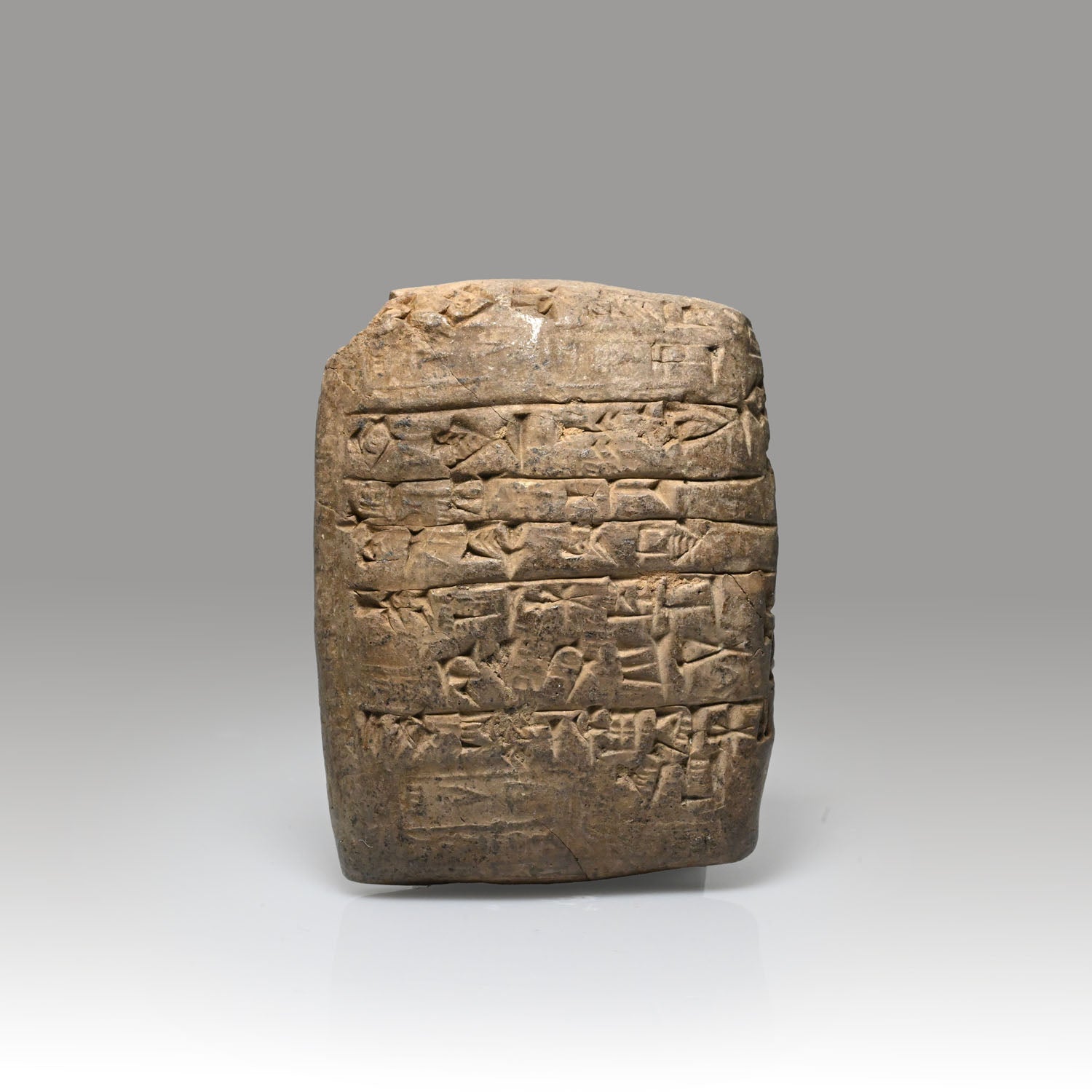
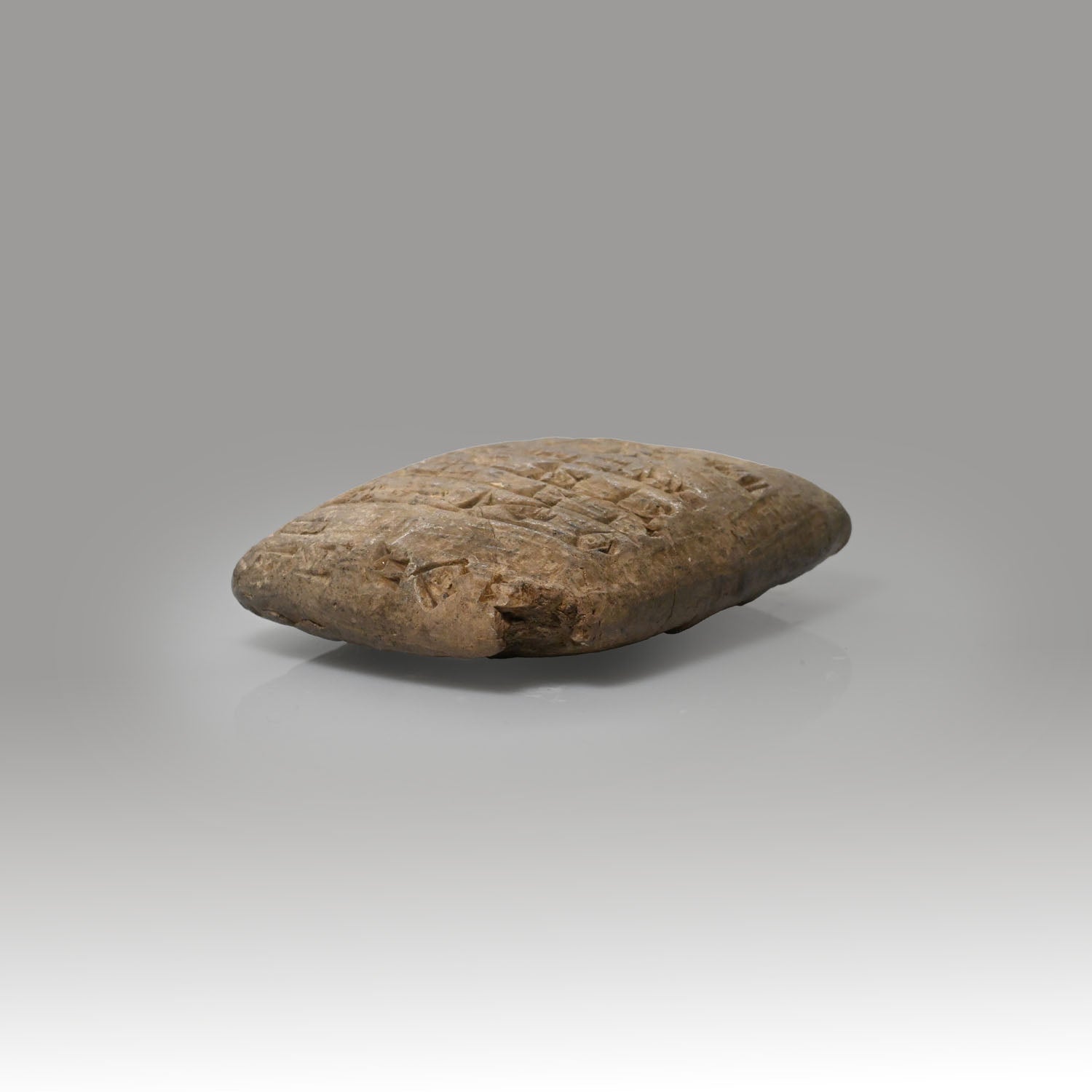
A Mesopotamian Clay Cuneiform Tablet, ca. 2000 BCE
This object qualifies for free USA shipping and a flat rate fee of $75 if shipping internationally.
An administrative clay cuneiform tablet with nine clear registers of script on both sides and traces of a seal roll.
The cuneiform script is one of the earliest known forms of written expression. Created by the Sumerians around 3000 BCE (with predecessors dating to the late 4th-millennium Uruk IV period), cuneiform writing began as a system of pictographs. Over time, the pictorial representations became simplified and more abstract.
Cuneiforms were written on clay tablets, on which symbols were drawn with a blunt reed called a stylus. The name cuneiform is derived from two Latin words: cuneus, meaning "wedge," and forma, meaning "shape."
This picture language, similar to but more abstract than Egyptian hieroglyphics, eventually developed into a syllabic alphabet under the Semites (Assyrians and Babylonians) who eventually came to dominate the area. It was adapted for the writing of the Akkadian, Elamite, Hittite (and Luwian), Hurrian (and Urartian) languages, and it inspired the Old Persian and Ugaritic national alphabets. Cuneiform was succeeded by Aramaic script, which in turn was replaced by Arabic in the 7th century CE.
Medium: Terracotta
Dimensions: Length: 2 1/4 inches (5.7 cm), Width: 1 7/8 inches (4.76 cm)
Condition: Loss to one corner, otherwise intact and in good condition.
Provenance: Victor Pafundi (1949 - 2018) private collection, Florida, acquired from the English trade in 2004.
QUESTIONS? Just click the Contact Us tab on your right.
We ship Tuesday to Friday with FedEx and usually same day if your order is received before 2pm. Within the continental USA, packing, shipping and insurance is free. Depending on size and destination, delivery times range from one to five business days.
For overseas shipments we charge a small flat rate which includes packing, preparation of all customs paperwork, insurance and carrier fees in compliance with all USA and International customs requirements.
Overseas shipments are sent via FedEx, DHL, or UPS International Priority, so contact us if you have a shipping preference. International customers are responsible for all duties and taxes.
Sands of Time provides a lifetime, unconditional guarantee of authenticity and provenance. Every object you purchase from us is accompanied by a Certificate of Authenticity, stating culture, provenance, and age.
Furthermore, we conduct due diligence to ensure the item, to the best of our knowledge, has not been illegally obtained from an excavation, architectural monument, public institution, or private property. Wherever possible, reference is made to existing collections or publications.Wherever possible, reference is made to existing collections or publications.
Choose options
Recently viewed

COME VISIT US!
1002 Wisconsin Ave NW
Washington DC. 20007
Tues - Fri, 10:00am - 6:00pm
Sat/Sun/Mon By appointment
A trusted source for collectors, curators, and connoisseurs for over 30 years.


