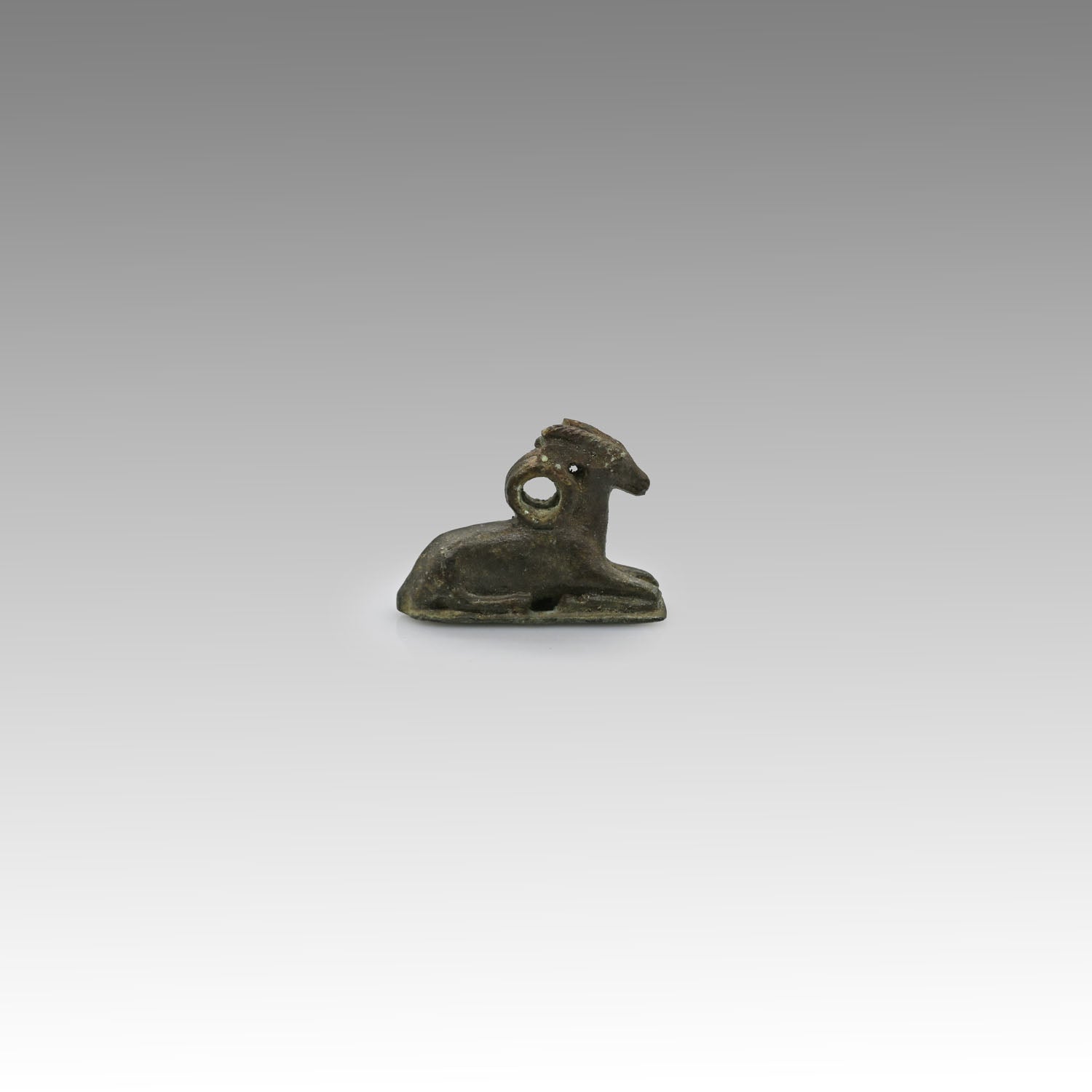
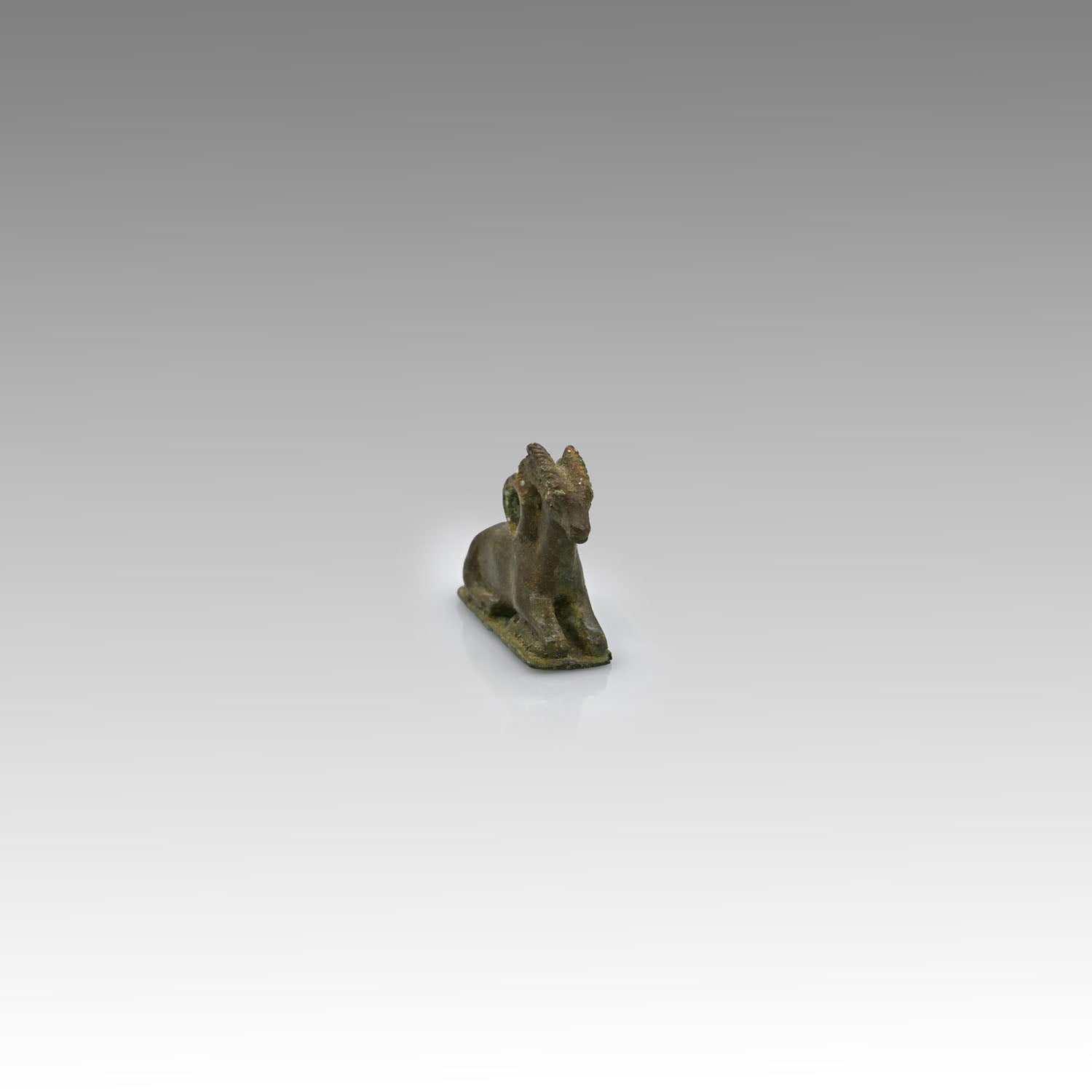
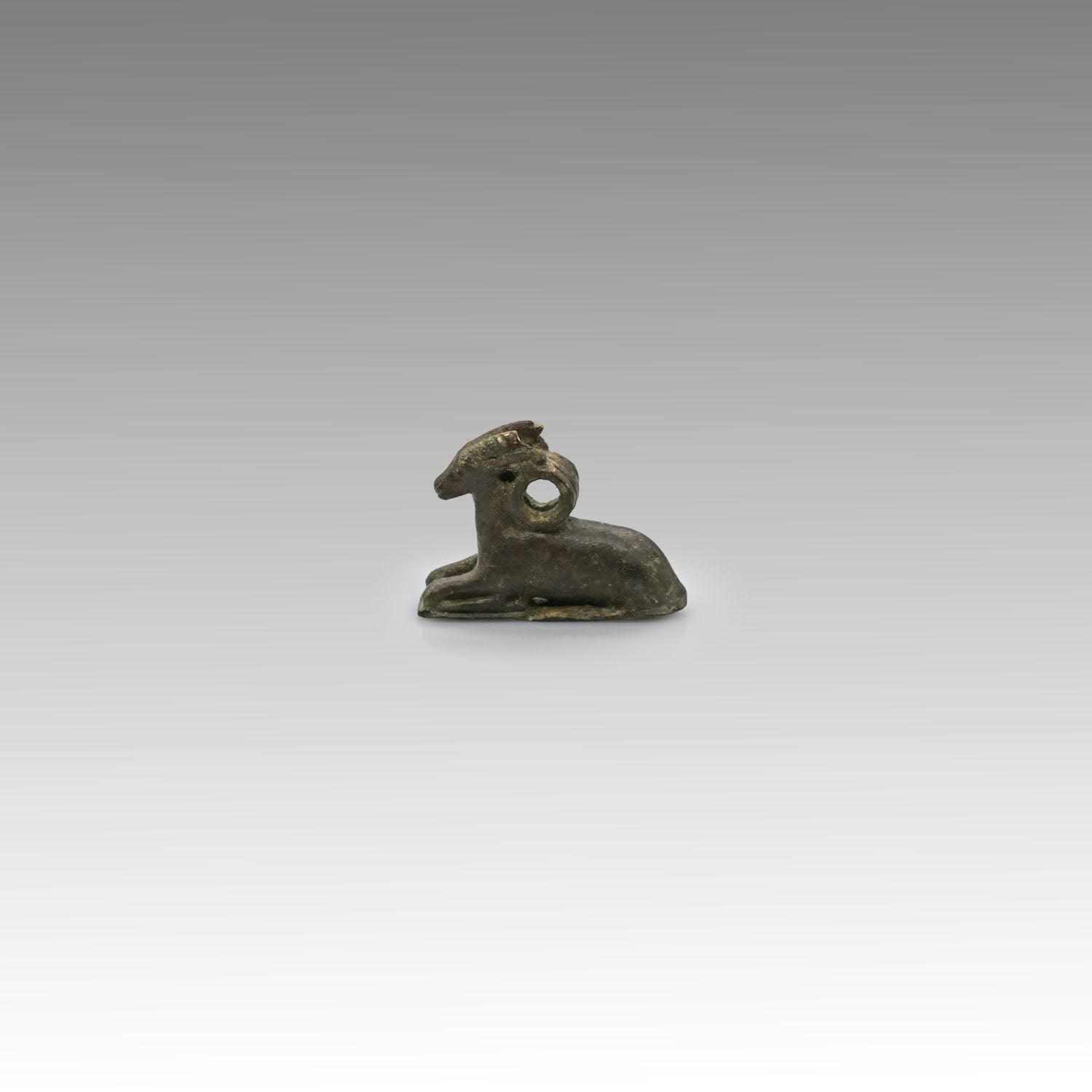
An Egyptian Bronze Weight in the form of a Ram, New Kingdom, Amarna Period , 18th Dynasty, ca 1352 - 1336 BCE
This object qualifies for free USA shipping and a flat rate fee of $75 if shipping internationally.
Finely cast in the form of a recumbent ram with elegantly curved horns, the animal shown resting upon an integral rectangular base. The compact body is carefully modeled with gently sloping shoulders, folded forelegs, and a sensitively rendered head with elongated muzzle and alert expression. Traces of the original dark olive and brown surface patina remain throughout.
Animal-form weights occupied an important role in the economic life of ancient Egypt, reflecting the close relationship between livestock, agriculture, and systems of value. Since cattle, sheep, goats, and other domesticated animals symbolized prosperity and wealth, it was natural that official weights should take their forms. During the New Kingdom, bronze examples such as the present piece were typically hollow cast and adjusted internally, often with lead, to achieve the desired standard weight.
Weights in the form of bulls and rams are especially associated with the Eighteenth Dynasty and the Amarna Period. Their production appears to have declined by the later Nineteenth Dynasty, when stone and glass examples became preferred due to the tendency of bronze to corrode and alter in mass over time. Comparable examples are illustrated in the Museum of Fine Arts, Boston exhibition catalogue Egypt’s Golden Age: The Art of Living in the New Kingdom, pp. 61–62, no. 33.
Reference: Freed, Rita E., et al. Egypt’s Golden Age: The Art of Living in the New Kingdom, 1558–1085 B.C.: Catalogue of the Exhibition. Boston: Museum of Fine Arts, Boston, 1982. ISBN 0-87846-207-4.
Medium: Bronze
Dimensions: Length: 1 3/8 inches (3.06 cm)
Condition: Small losses to the tips of both horns; otherwise intact and in very good condition overall, with attractive ancient surface patina.
Provenance: Nora Scott (1905 – 1994), Curator of Egyptian Art at the Metropolitan Museum of Art, (retired 1972), and acquired from the Metropolitan Museum of Art by deaccession. Gifted to L. Virginia Burton (1918–2009) Associate Curator of Egyptian Art at the Metropolitan Museum of Art (retired 1977), and then by descent.
QUESTIONS? Just click the Contact Us tab on your right.
We ship Tuesday to Friday via ground courier and usually same-day if your order is received before 2pm. Within the continental USA, packing, shipping, and insurance are free. Depending on size and destination, delivery times range from one to five business days.
For overseas shipments, we charge a low flat rate that includes packing, preparation of all customs paperwork, insurance, and carrier fees, in compliance with all U.S. and International customs requirements.
Overseas shipments are sent via FedEx, DHL, or UPS International Priority, so contact us if you have a shipping preference. International customers are responsible for all duties and taxes.
Sands of Time provides a lifetime, unconditional guarantee of authenticity and provenance. Every object you purchase from us is accompanied by a Certificate of Authenticity, stating culture, provenance, and age.
Furthermore, we conduct due diligence to ensure the item, to the best of our knowledge, has not been illegally obtained from an excavation, architectural monument, public institution, or private property. Wherever possible, reference is made to existing collections or publications.Wherever possible, reference is made to existing collections or publications.
Choose options
Recently viewed
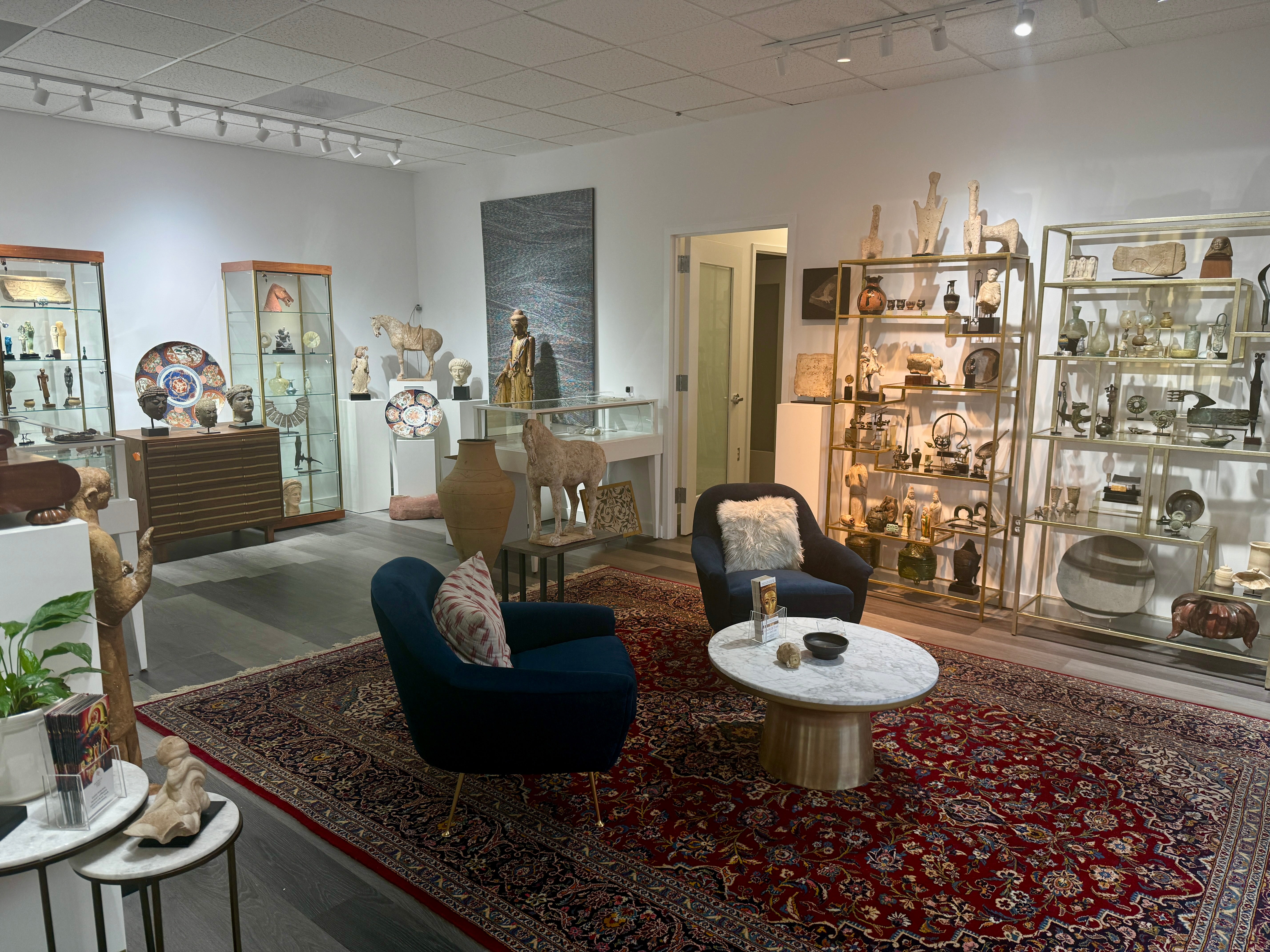
Come Visit Us!
1010 Wisconsin Ave NW, Suite 340
Washington DC. 20007
Tues - Fri, 10:00am - 6:00pm
Sat/Sun/Mon By appointment


