

A Royal Egyptian Frog Scaraboid with the Prenomen of Amenhotep III, New Kingdom, 18th - 19th Dynasty, ca 1550-1290 BCE
This object qualifies for free USA shipping and a flat rate fee of $75 if shipping internationally.
This finely modeled frog scaraboid, carved in steatite and finished with a lustrous green glaze, is modeled in a compact crouching pose atop an oval base incised with a royal inscription. The underside bears the prenomen of the pharaoh Amenhotep III, reading Nebmaatre, whereby the seated figure of Maat holds a flail rather than the customary ankh. The object combines the formal qualities of a scaraboid seal with the symbolic potency of the frog, creating a hybrid amuletic form both personal and political in meaning.
The frog occupied a significant place in ancient Egyptian belief, closely tied to fertility, rebirth, and the cyclical renewal brought by the Nile inundation. As recorded by Pliny the Elder, Egyptians understood frogs as emerging spontaneously from the fertile mud, a natural phenomenon that informed their symbolic association with creation and new life. From the New Kingdom onward, the frog hieroglyph also served as a visual pun meaning “to live again,” frequently appended to the names of the deceased as a blessing for rebirth. At the same time, frog amulets were worn by the living, particularly women, as devices promoting fertility and renewal. This dual function, both funerary and protective, persisted into later periods, including the Coptic era.
The addition of royal titulary elevates this example beyond a typical amulet. By incorporating the name of Amenhotep III, the object connects personal regeneration with the enduring authority and divine sanction of kingship.
Bibliography: Andrews, C. (1998). Amulets of Ancient Egypt, p. 63
Medium: Glazed Steatite
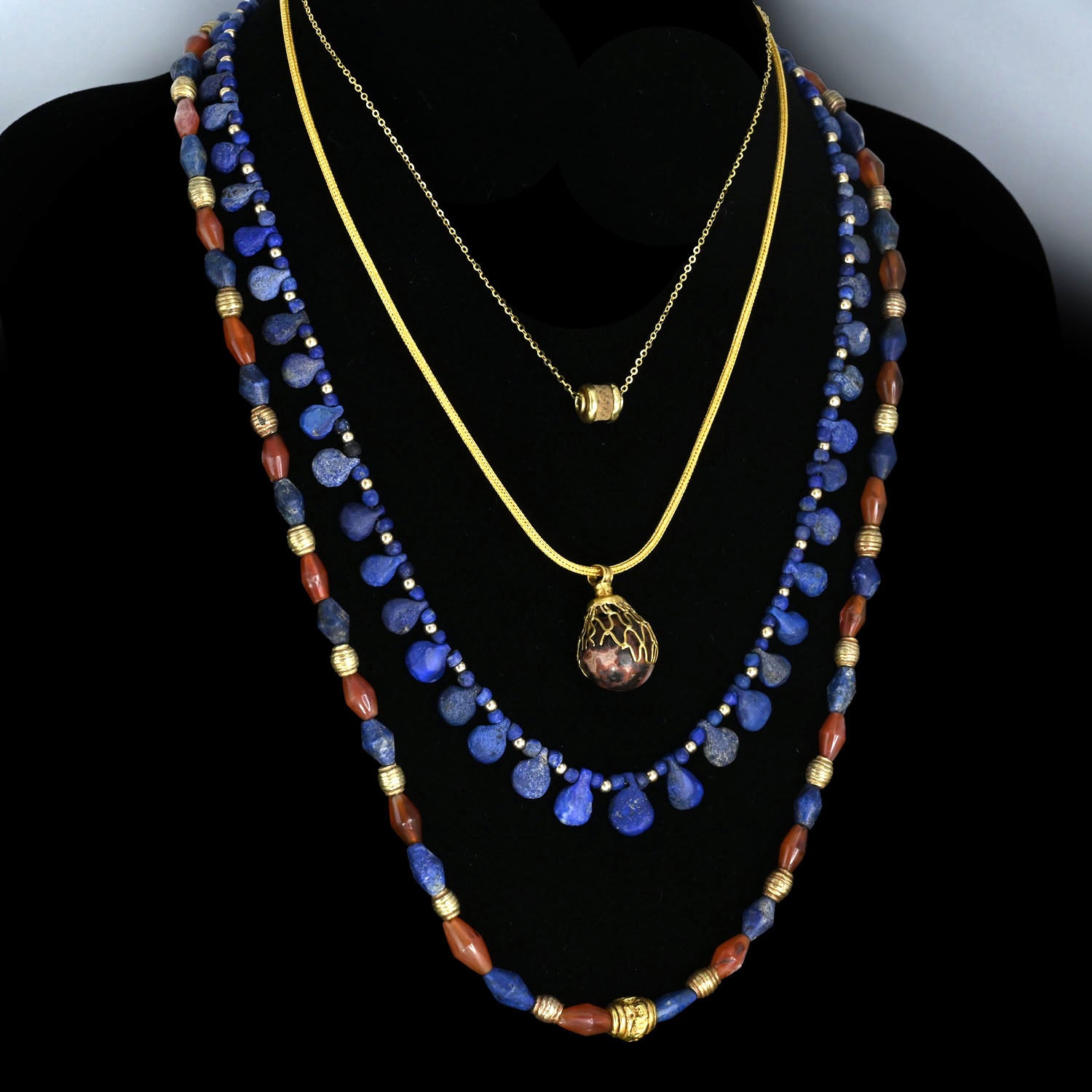
Dimensions: Scarab length: 5/8" (2 cm). Strung on an adjustable 18-inch gold chain of 18K yellow gold.
Condition: Well preserved, with minor surface wear consistent with age. The glaze remains stable and the inscription clearly legible. A lovely example.
Provenance: Dr. Nora Scott (July 14, 1905 – April 4, 1994), Curator of Egyptian Art at the Metropolitan Museum of Art (retired 1972), and acquired from the Metropolitan Museum of Art by deaccession. Gifted to L. Virginia Burton (1918–2009) Associate Curator of Egyptian Art at the Metropolitan Museum of Art (retired 1977), and thereafter by descent.
QUESTIONS? Just click the Contact Us tab on your right.
We ship Tuesday to Friday via ground courier and usually same-day if your order is received before 2pm. Within the continental USA, packing, shipping, and insurance are free. Depending on size and destination, delivery times range from one to five business days.
For overseas shipments, we charge a low flat rate that includes packing, preparation of all customs paperwork, insurance, and carrier fees, in compliance with all U.S. and International customs requirements.
Overseas shipments are sent via FedEx, DHL, or UPS International Priority, so contact us if you have a shipping preference. International customers are responsible for all duties and taxes.
Sands of Time provides a lifetime, unconditional guarantee of authenticity and provenance. Every object you purchase from us is accompanied by a Certificate of Authenticity, stating culture, provenance, and age.
Furthermore, we conduct due diligence to ensure the item, to the best of our knowledge, has not been illegally obtained from an excavation, architectural monument, public institution, or private property. Wherever possible, reference is made to existing collections or publications.Wherever possible, reference is made to existing collections or publications.
选择选项


