

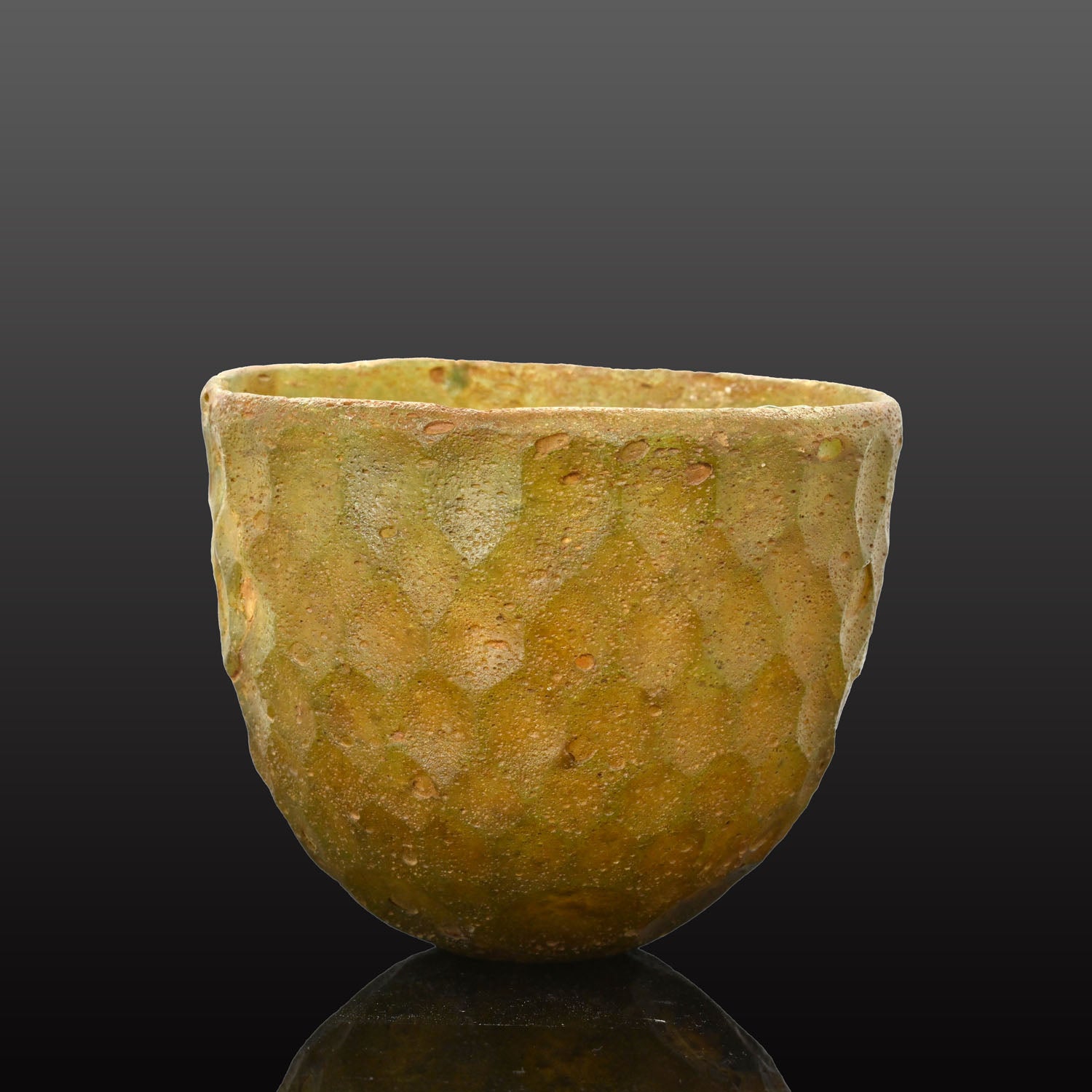
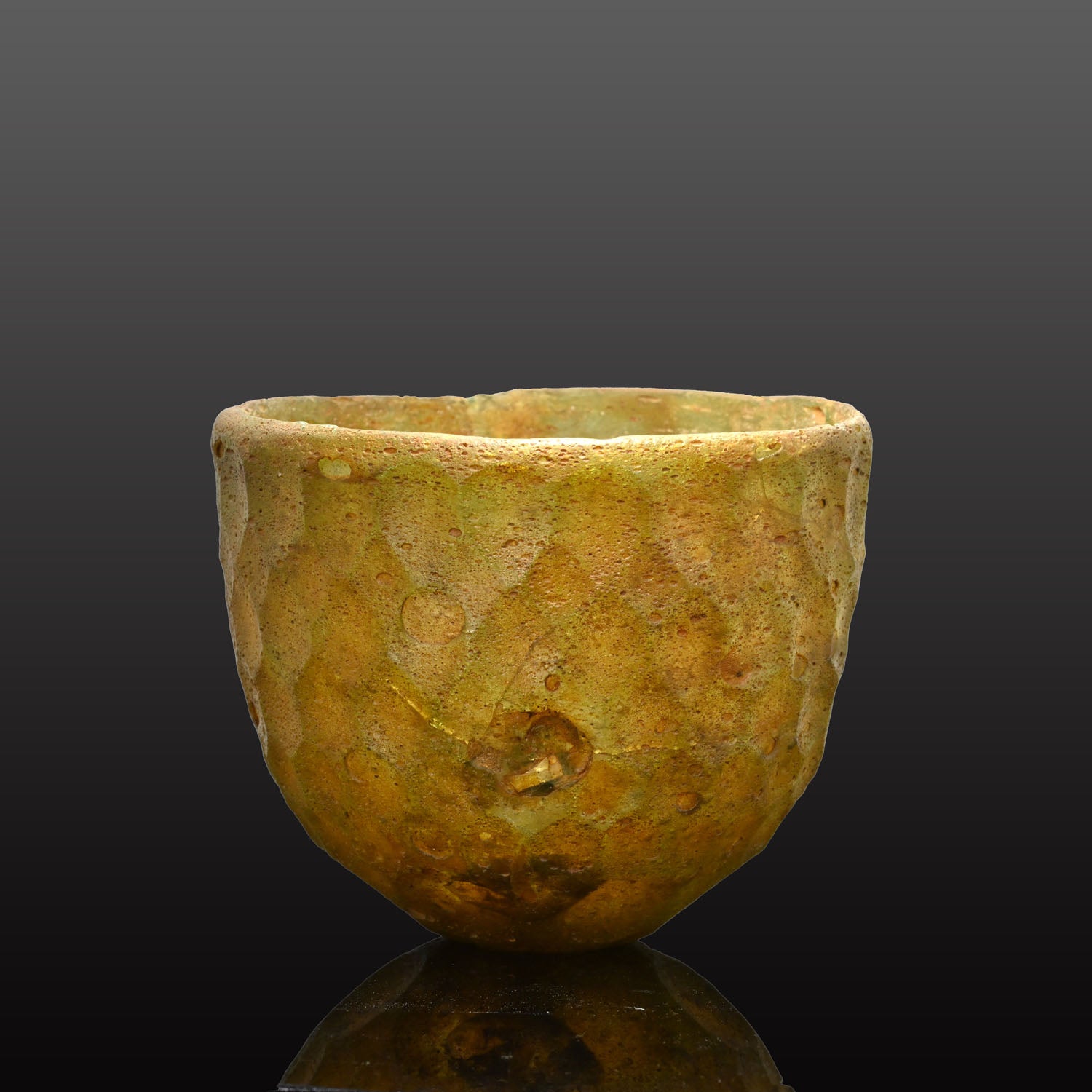
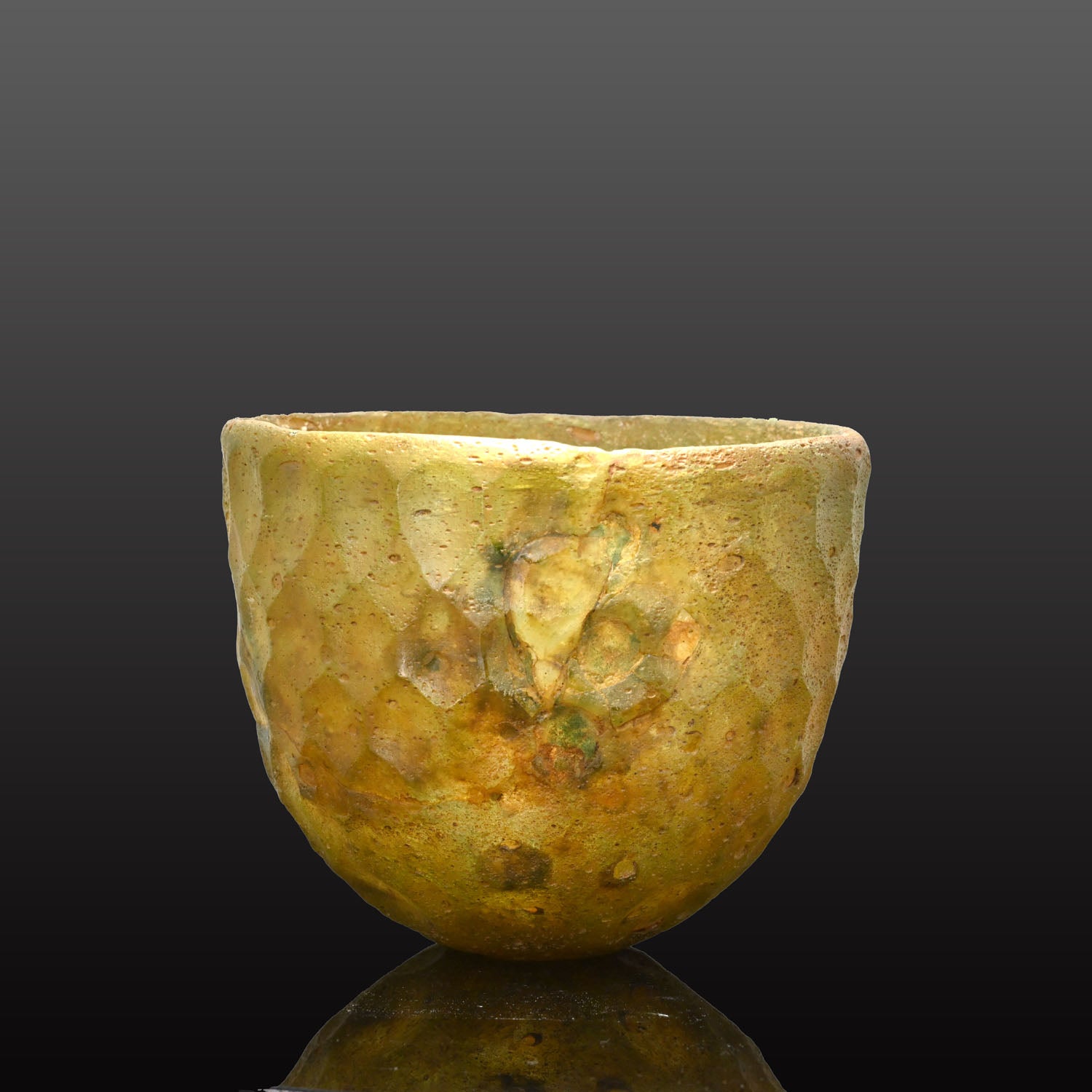
A Sasanian Green Cut-Glass Bowl with Hexagonal Facets, ca. 5th - 6th century CE
This object qualifies for free USA shipping and a flat rate fee of $75 if shipping internationally.
This compact, translucent green bowl is decorated with a field of wheel-cut hexagonal facets arranged in a honeycomb pattern, a hallmark of Sasanian luxury glass. The cutting, executed after forming, creates a lively play of light across the surface and emphasizes the clarity and color of the glass. The interior is plain, allowing the exterior faceting to read crisply in profile and in hand. The green hue, typical of Sasanian glass, likely derives from iron present in the silica source, sometimes enhanced intentionally to achieve a richer tone.
Background: Glassmaking flourished under the Sasanian Empire (224–651 CE), whose artisans advanced and popularized faceted and relief-cut decoration on thick-walled vessels. While the Romans had developed both blown and cut-glass traditions, Sasanian workshops made cut glass a signature courtly aesthetic, favoring geometric motifs such as roundels, lozenges, and hexagons. These vessels were valued at home and widely traded abroad; Sasanian glass has been found from Mesopotamia and the Iranian plateau to the Caucasus, the Levant, Central Asia, and as far east as China and Japan, attesting to its prestige across Silk Road networks. The honeycomb of contiguous hexagons on this bowl represents one of the most recognizable Sasanian cut-glass schemes. The pattern’s regularity and depth require precise wheel work and controlled wall thickness, suggesting production in a well-equipped workshop serving elite clientele. Such bowls likely functioned in courtly dining and ritualized drinking, where their weight, cool touch, and scintillating surfaces enhanced the sensory experience.
The Sasanian taste for facet cutting persisted into the early Islamic period, influencing glass produced in Mesopotamia and Iran for centuries thereafter.
Comparanda and further reading: - David Whitehouse, Ancient Glass in The Corning Museum of Glass, Vol. 2 (2001), entries on Sasanian facet-cut vessels. - Prudence O. Harper et al., The Royal Hunter: Art of the Sasanian Empire (Metropolitan Museum of Art, 1978), discussions of luxury craft traditions. - Jens Kröger, Nishapur: Glass of the Early Islamic Period (Metropolitan Museum of Art, 1995), for the continuation of Sasanian cutting techniques in early Islamic glass.
Medium: Glass, wheel-cut decoration
Dimensions: Diameter: 4 1/4 in (10.8 cm), Height: 3 1/2 in (8.9 cm)
Condition: Professionally repaired from a few pieces with minor surface wear consistent with age, otherwise complete and in good condition overall.
Provenance: Henry Anavian Family Collection NYC, acquired in the 1980s and then by descent.
QUESTIONS? Just click the Contact Us tab on your right.
We ship Tuesday to Friday with FedEx and usually same day if your order is received before 2pm. Within the continental USA, packing, shipping and insurance is free. Depending on size and destination, delivery times range from one to five business days.
For overseas shipments we charge a small flat rate which includes packing, preparation of all customs paperwork, insurance and carrier fees in compliance with all USA and International customs requirements.
Overseas shipments are sent via FedEx, DHL, or UPS International Priority, so contact us if you have a shipping preference. International customers are responsible for all duties and taxes.
Sands of Time provides a lifetime, unconditional guarantee of authenticity and provenance. Every object you purchase from us is accompanied by a Certificate of Authenticity, stating culture, provenance, and age.
Furthermore, we conduct due diligence to ensure the item, to the best of our knowledge, has not been illegally obtained from an excavation, architectural monument, public institution, or private property. Wherever possible, reference is made to existing collections or publications.Wherever possible, reference is made to existing collections or publications.
选择选项
Recently viewed

COME VISIT US!
1002 Wisconsin Ave NW
Washington DC. 20007
Tues - Fri, 10:00am - 6:00pm
Sat/Sun/Mon By appointment
A trusted source for collectors, curators, and connoisseurs for over 30 years.


