
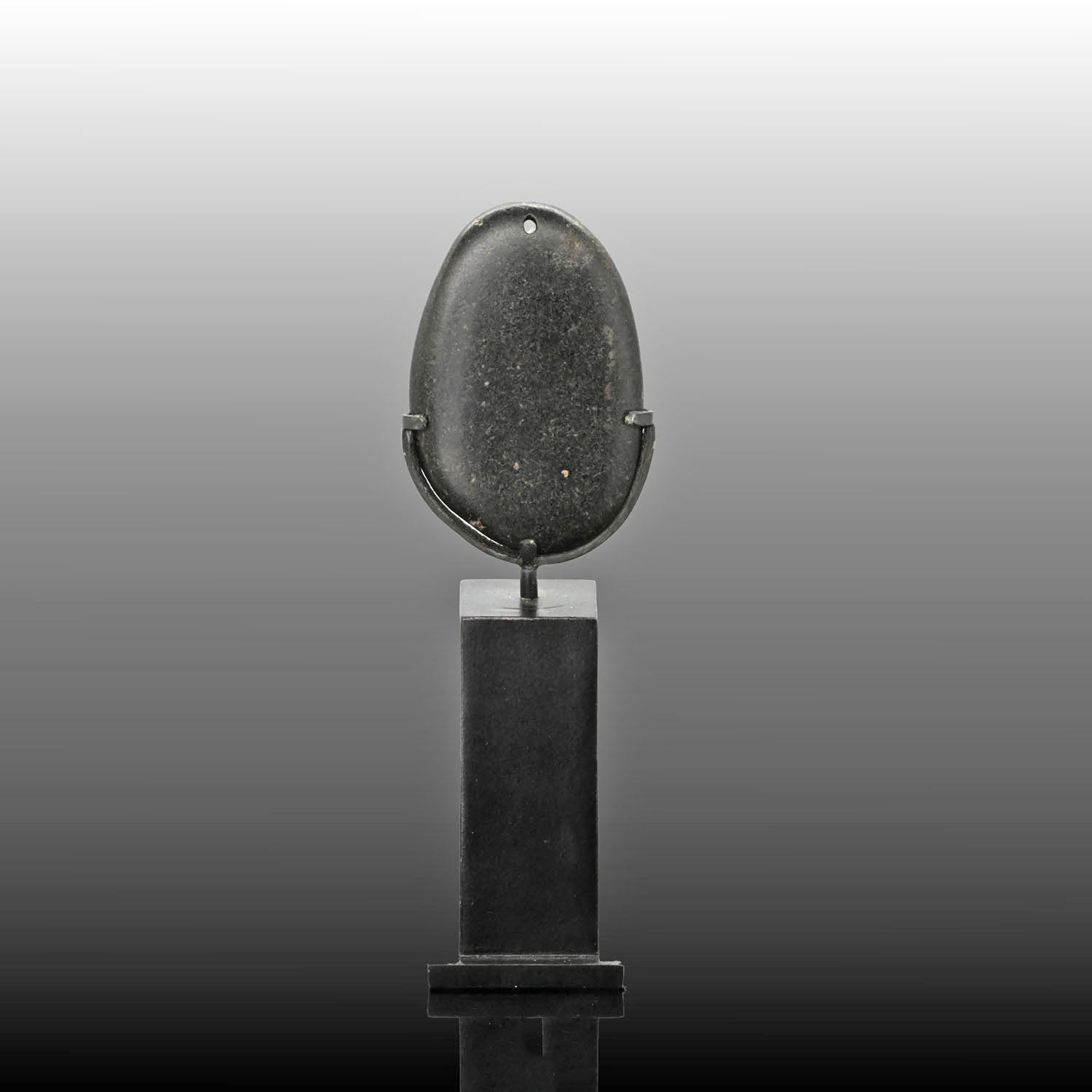
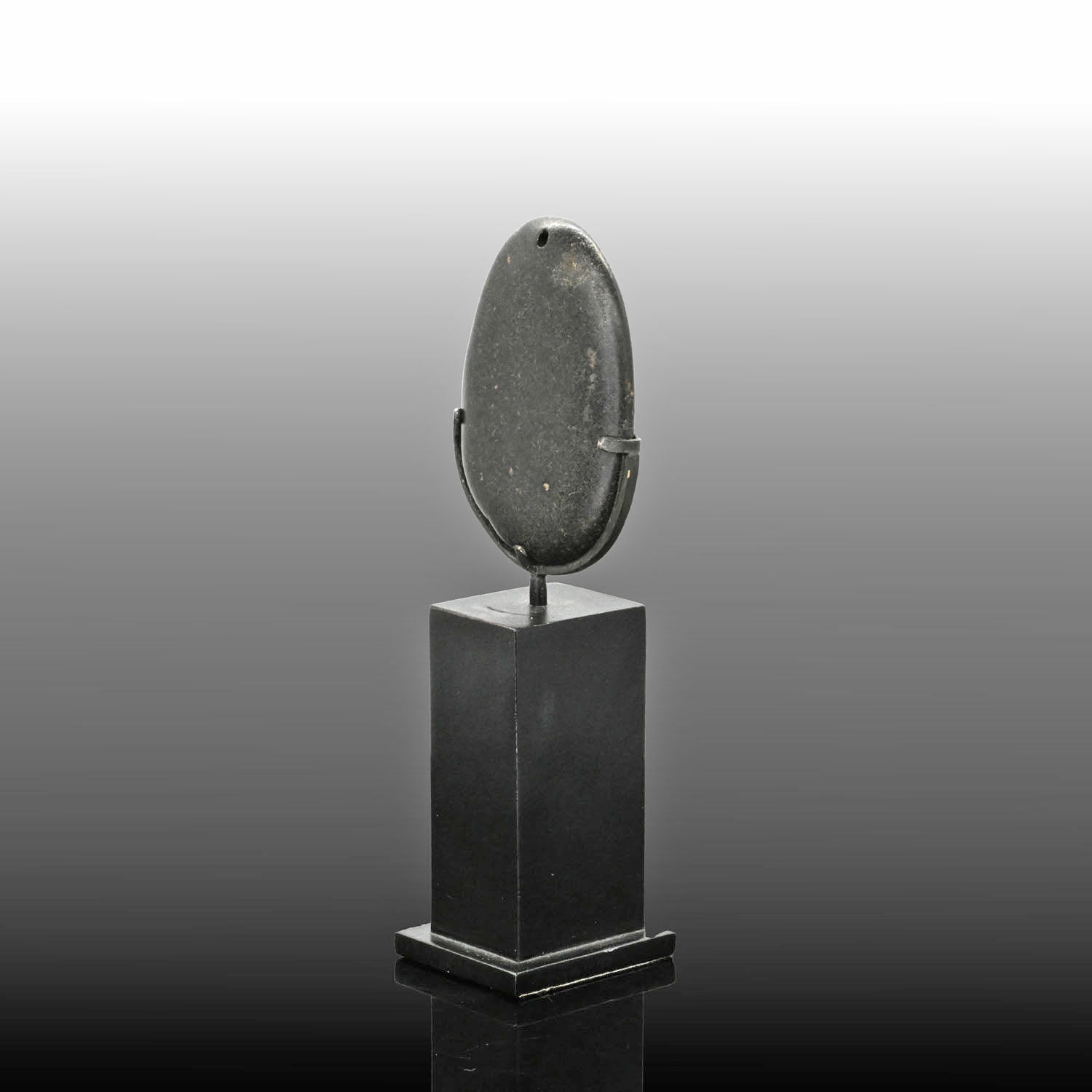
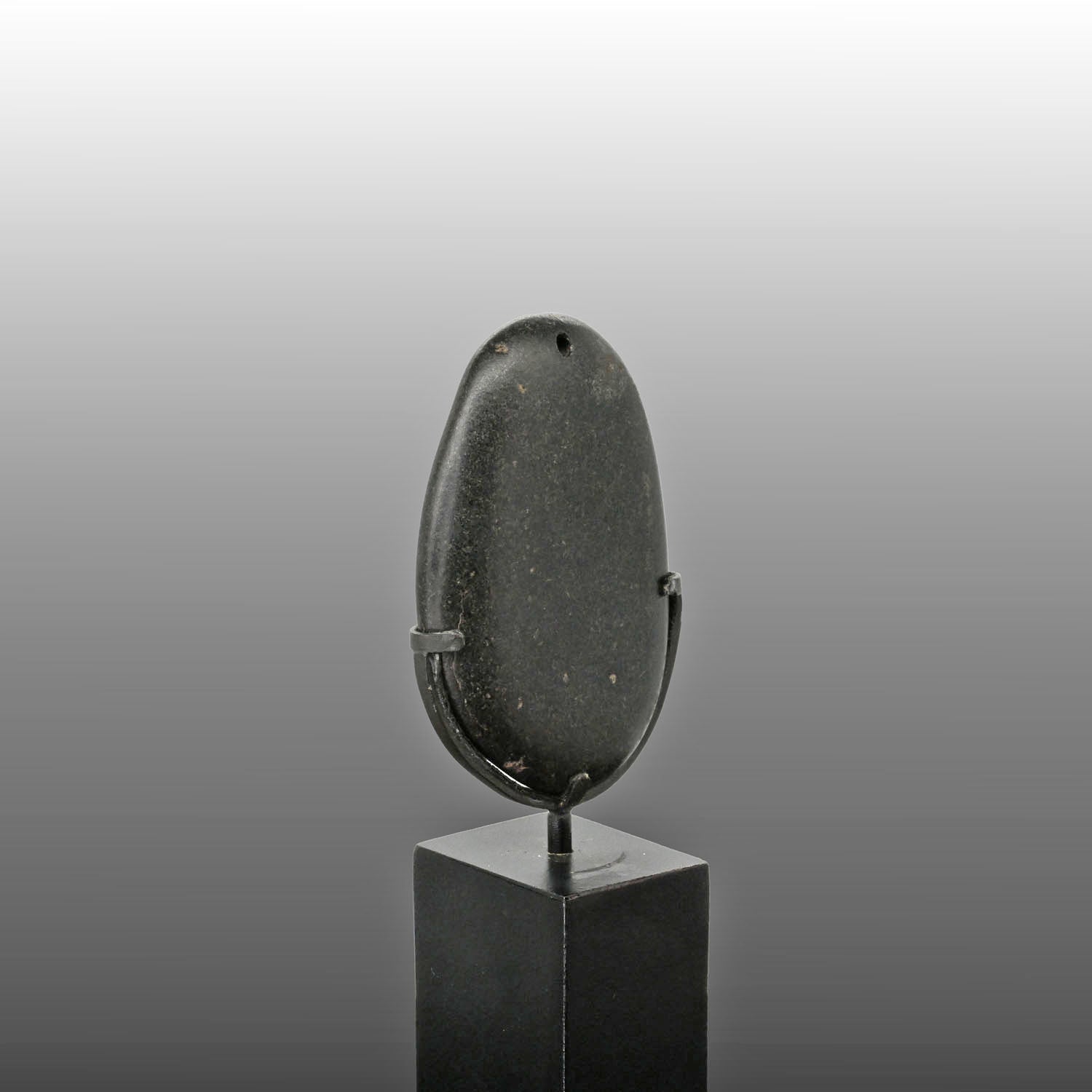
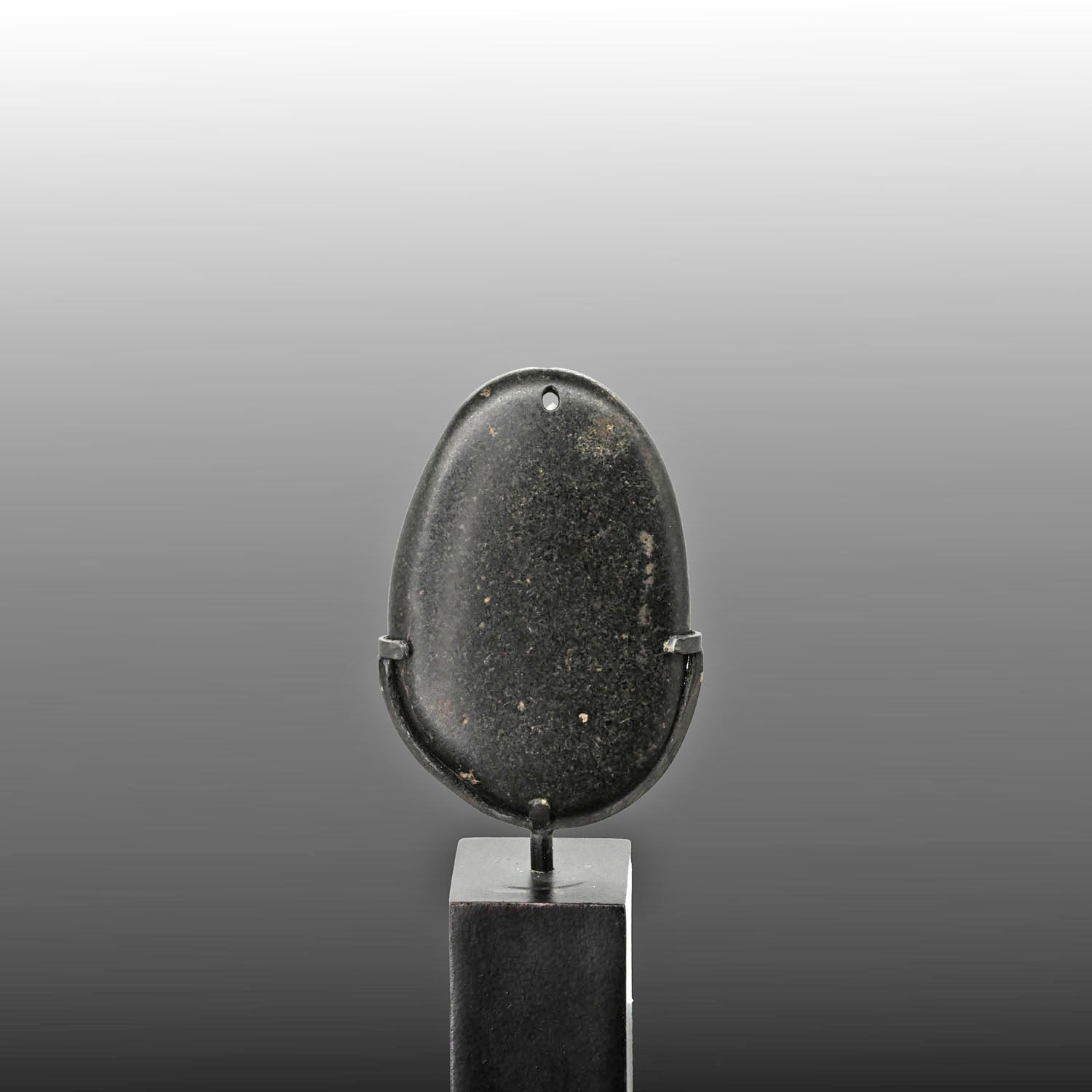
A rare Egyptian Pre-Dynastic Basalt Amuletic Pendant, Pre Dynastic Period, ca. 3800 - 3300 BCE
This object qualifies for free and fast worldwide shipping.
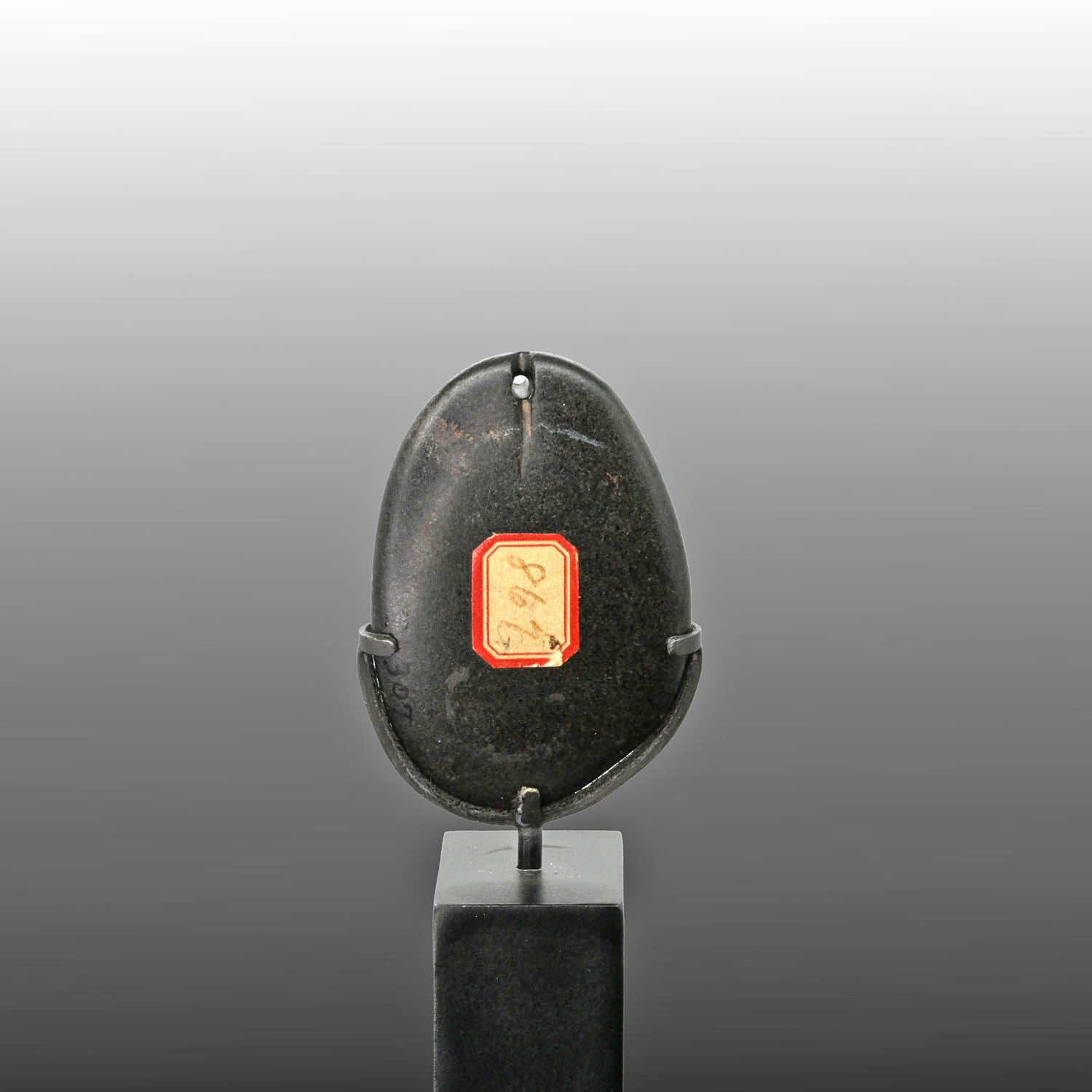
A thin, carefully worked pendant carved from dense black basalt, presenting an elegant oval profile with a subtle convex curvature. The form tapers gently toward the pierced end, creating a slight asymmetry that suggests intentional orientation when worn. The perforation is small and neatly drilled, with soft rounding from wear consistent with repeated suspension rather than a purely symbolic or funerary piercing. The edges are smoothly finished and gently rounded, indicating careful shaping and prolonged handling.
The basalt surface is finely grained and dark, with minute natural inclusions visible under light that lend quiet visual depth to the otherwise restrained surface. The convex face is subtly domed, catching light across its center, while the reverse appears flatter, reinforcing the impression that the pendant was designed to sit comfortably against the body. A short vertical incision on the convex face interrupts the smooth surface in a deliberate yet minimal manner, likely conveying symbolic significance rather than serving a decorative function. The scale, material, and refinement of the object closely align with late Pre-Dynastic personal ornaments associated with bodily adornment and ritual display.
Comparable examples have been interpreted as forehead pendants, worn suspended against the skin or hairline, possibly as markers of identity, status, or participation in ceremonial practices, as discussed by Joan C. Payne in Catalogue of the PreDynastic Egyptian Collection in the Ashmolean Museum, pp. 217–218, fig. 73, where similar basalt pendants are identified as forehead ornaments, worn suspended against the skin or hairline. The choice of basalt, a visually striking and technically demanding material to work using Pre-Dynastic tools, further supports a symbolic or ceremonial function. Together, the controlled simplicity of form, evidence of wear, and material choice place this pendant firmly within the early tradition of meaningful personal objects that bridge adornment, identity, and ritual practice at the dawn of Egyptian civilization.
Reference: Payne, Joan C., Catalogue of the PreDynastic Egyptian Collection in the Ashmolean Museum, (1993) Oxford, pg 217-218, fig.73. and W.M. Flinders Petrie, Amulets, London, 1914, pl. XVI, 130 n-q.
Medium: Basalt
Dimensions: Height: 2 1/2 inches (6.5 cm)
Condition: Intact and in excellent condition. Museum accession number 59.307 applied in black pigment near edge, on same face a sticker with the number 867 applied. Presented on a museum-quality custom mount.
Provenance: Robert de Rustafjaell (1859-1943) collection, acquired prior to 1909. The Heckscher Museum of Art, Long Island, New York (museum acc. no. 59.307 on the pendant), 1913-2012. with Sands of Time, Washington DC. Private collection, New York, acquired from the above 5 December 2013.
We ship Tuesday to Friday with FedEx and usually same day if your order is received before 2pm. Within the continental USA, packing, shipping and insurance is free. Depending on size and destination, delivery times range from one to five business days.
For overseas shipments we charge a small flat rate which includes packing, preparation of all customs paperwork, insurance and carrier fees in compliance with all USA and International customs requirements. Overseas shipments are sent using either USPS Priority Mail or FedEx but contact us if you have a shipping preference. International customers are responsible for all duties and taxes.
Sands of Time provides a lifetime, unconditional guarantee of authenticity and provenance. Every object you purchase from us is accompanied by a Certificate of Authenticity, stating culture, provenance, and age.
Furthermore, we conduct due diligence to ensure the item, to the best of our knowledge, has not been illegally obtained from an excavation, architectural monument, public institution, or private property. Wherever possible, reference is made to existing collections or publications.Wherever possible, reference is made to existing collections or publications.
Choose options


