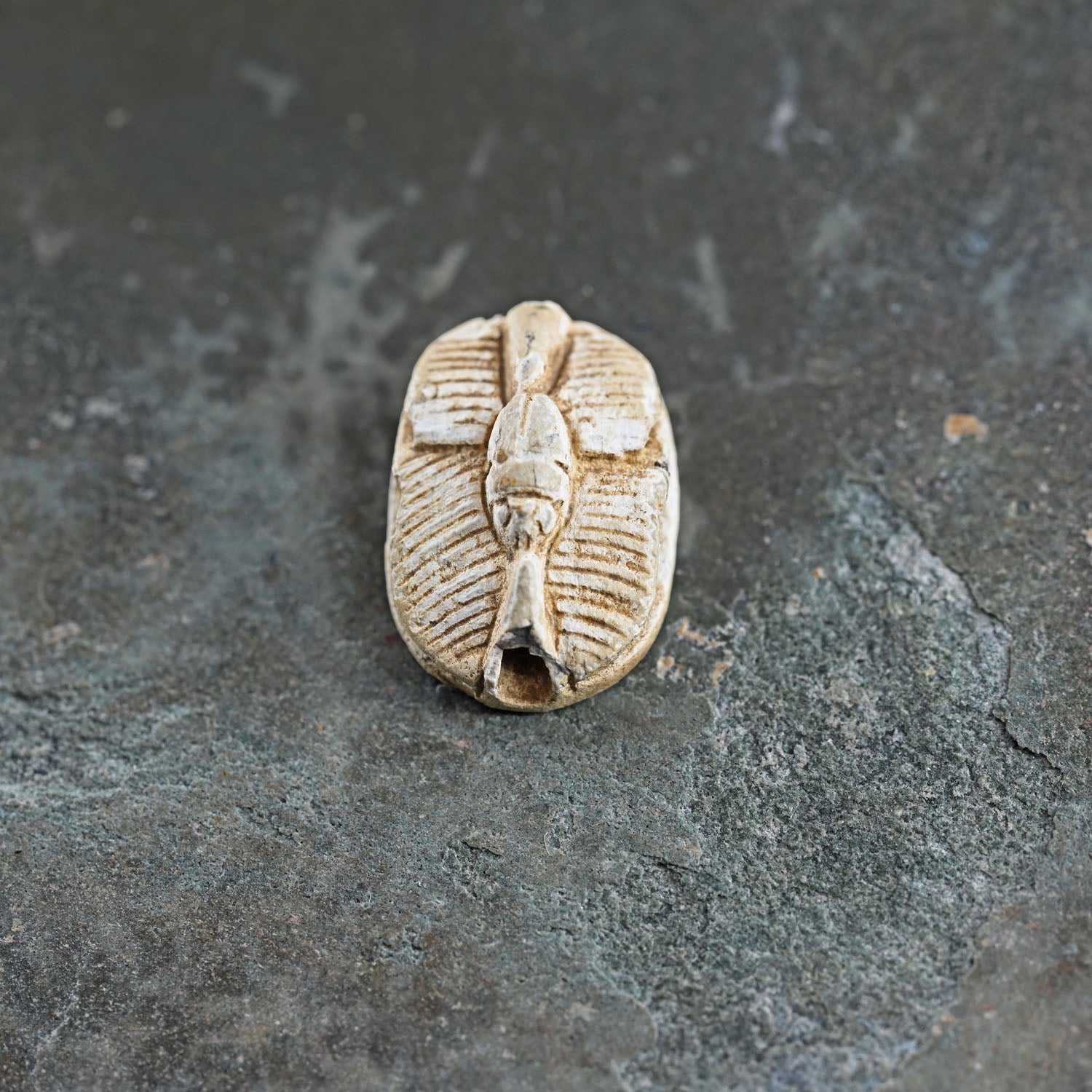
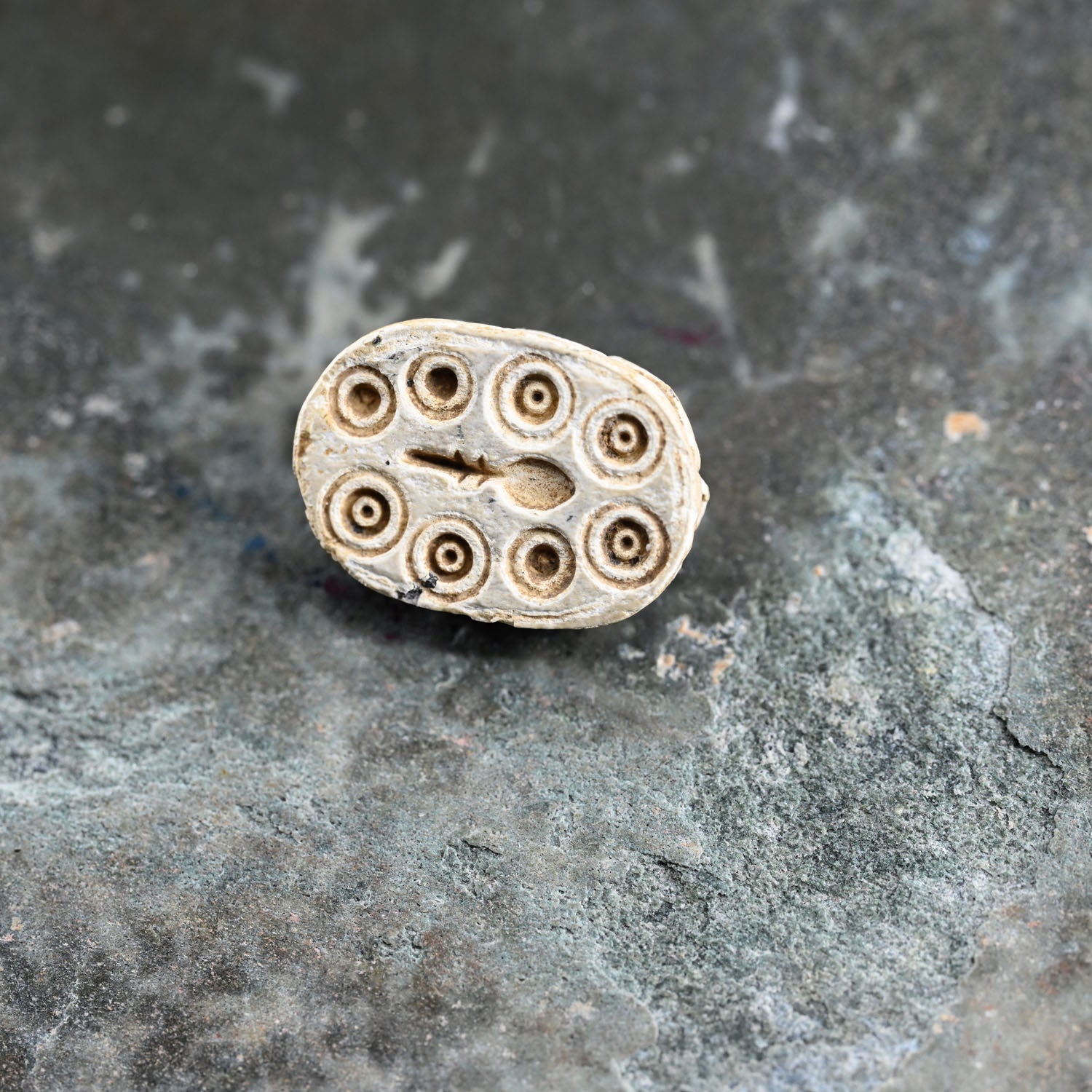
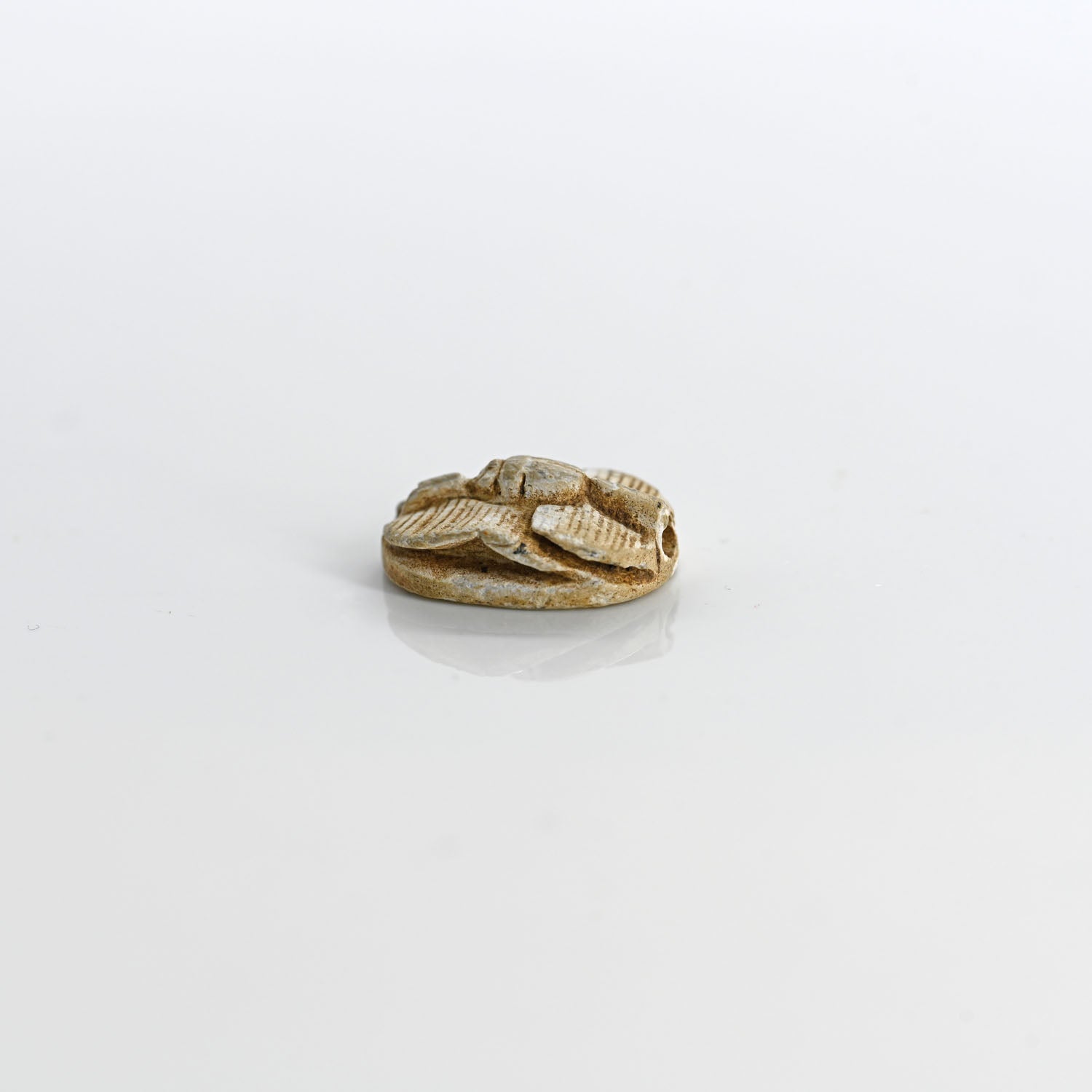
An Egyptian Steatite Design Scarab, Hyksos Period, ca. 1759 - 1539 BCE
Cet article est admissible à la livraison gratuite aux États-Unis et à des frais fixes de 75 $ pour l'expédition internationale.
The flat scarb is depicted naturalistically with legs folded at the sides, a longitudal ridge with a miniature scarab centered down the back. The underside is depicted with a central nefer symbol, surrounded by a ring of eight deeply-incided concentric circles.
The Hyksos Period was a time of complex cultural interaction in the Nile Delta when local Egyptian traditions mixed with Levantine influences. Scarabs were among the most popular amulets in everyday and funerary life, worn on cords, set into rings, or laid in tombs. Steatite was commonly used because it took a fine polish and accepted a brightly colored glaze, often blue or green, which imitated faience. The decorative, non-hieroglyphic underside design here—a symmetrical cross with stepped linear fillings—is typical of “design” scarabs produced for personal use rather than as official seals, and it reflects the geometric tastes of the period as well as economical production for a broad market.
Medium: Steatite
Dimensions: Length: 5/8 inch (1.5 cm)
Condition: Minor loss to the suspension hole, otherwise the scarab is intact and in excellent condition.
Provenance: Nora Scott (1905 – 1994), Curator of Egyptian Art at the Metropolitan Museum of Art, (retired 1972), and acquired from the Metropolitan Museum of Art by deaccession. Gifted to L. Virginia Burton (1918–2009) Associate Curator of Egyptian Art at the Metropolitan Museum of Art (retired 1977), and then by descent.
DES QUESTIONS? Cliquez simplement sur l'onglet Nous contacter à votre droite.
Nous expédions du mardi au vendredi par transporteur terrestre et généralement le jour même si votre commande est reçue avant 14h. Aux États-Unis continentaux, l'emballage, l'expédition et l'assurance sont gratuits. Selon la taille et la destination, les délais de livraison varient de un à cinq jours ouvrables.
Pour les envois à l'étranger, nous facturons un faible taux forfaitaire qui comprend l'emballage, la préparation de tous les documents douaniers, l'assurance et les frais de transport, en conformité avec toutes les exigences douanières américaines et internationales.
Les envois à l'étranger sont envoyés via FedEx, DHL ou UPS International Priority, veuillez donc nous contacter si vous avez une préférence en matière d'expédition. Les clients internationaux sont responsables de tous les droits et taxes.
Sands of Time offre une garantie d'authenticité et de provenance inconditionnelle à vie. Chaque objet que vous achetez chez nous est accompagné d'un certificat d'authenticité, indiquant sa culture, sa provenance et son âge.
De plus, nous faisons preuve de diligence raisonnable pour nous assurer que l'objet, à notre connaissance, n'a pas été obtenu illégalement d'une fouille, d'un monument architectural, d'une institution publique ou d'une propriété privée. Dans la mesure du possible, il est fait référence aux collections ou publications existantes.Dans la mesure du possible, il est fait référence aux collections ou publications existantes.
Choisir les options


