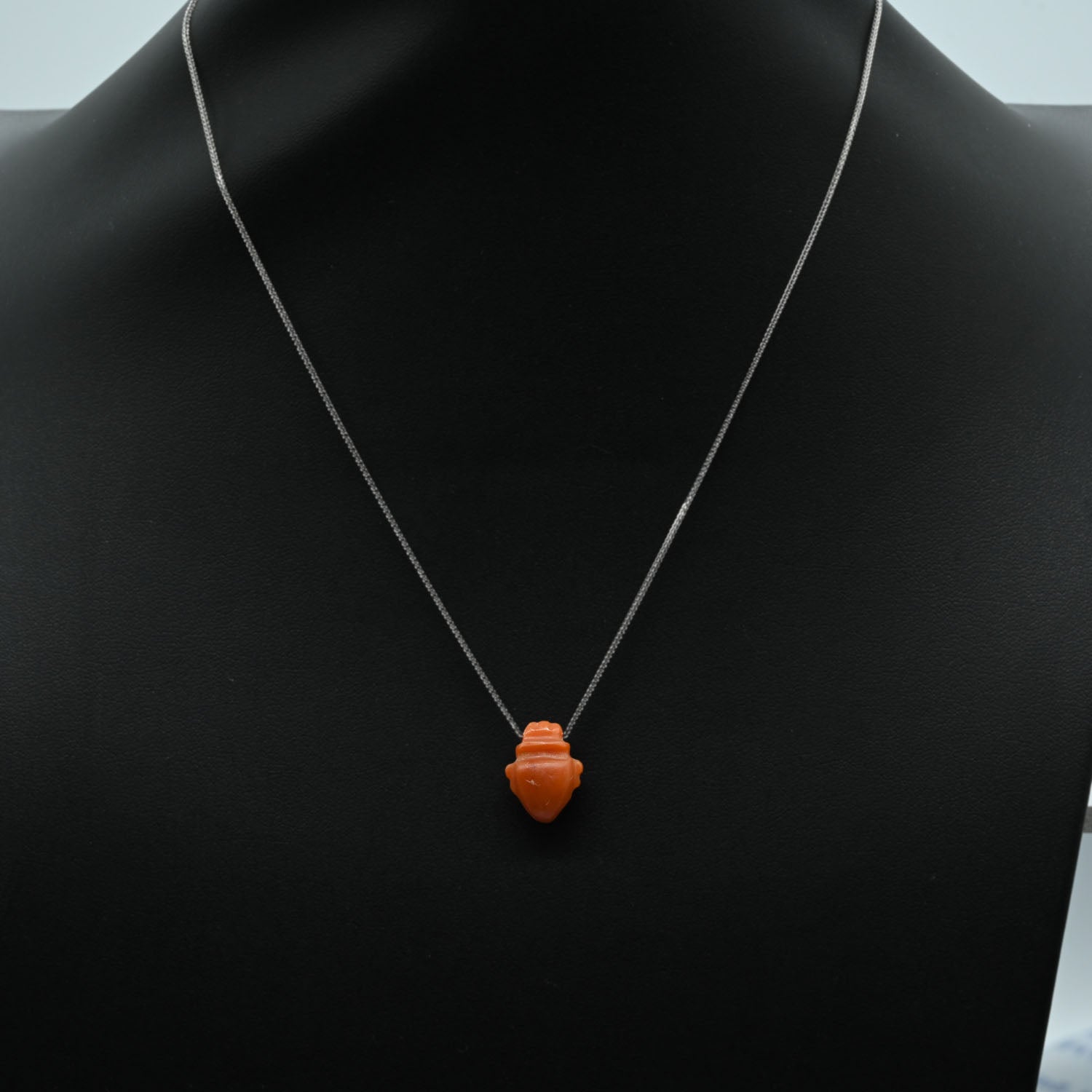
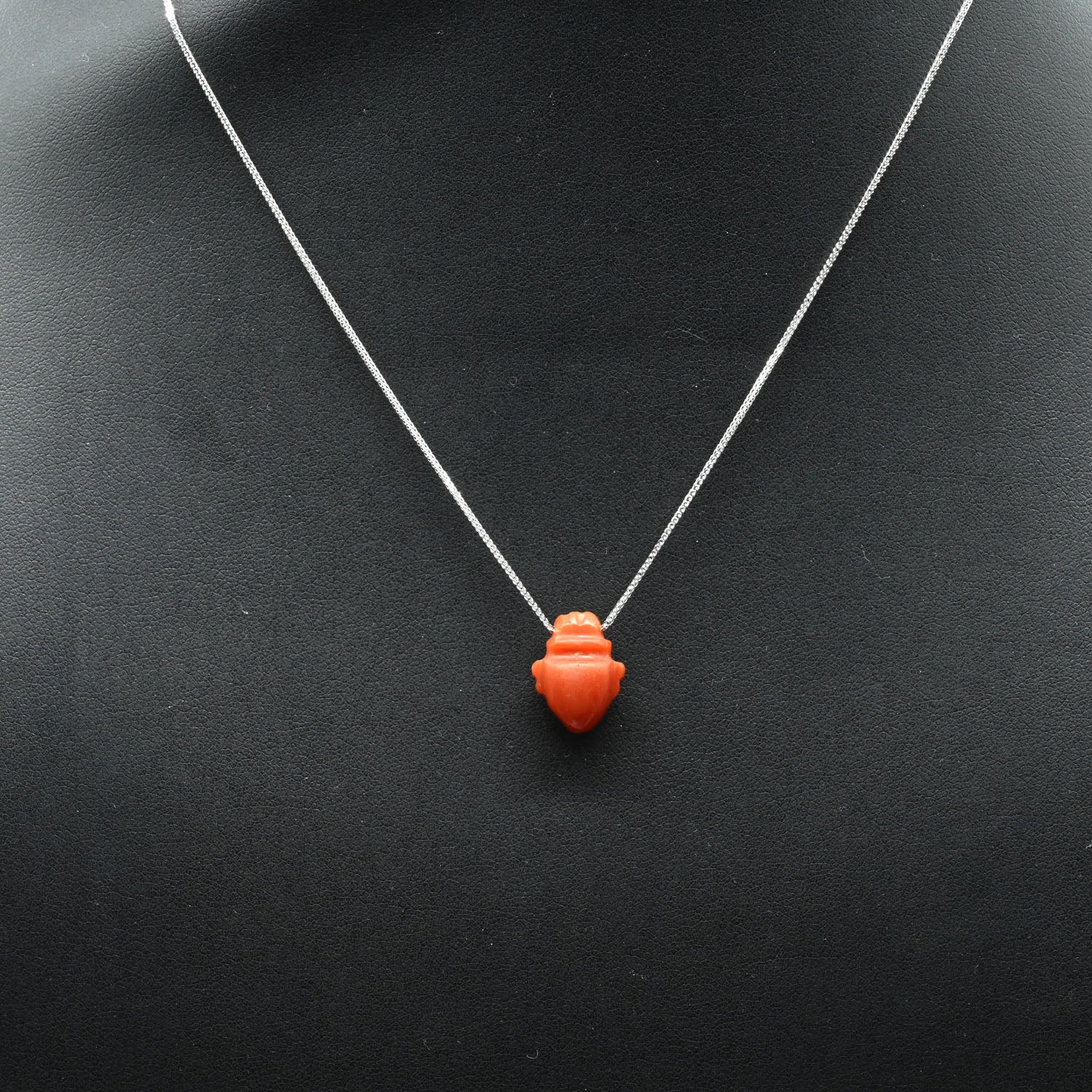
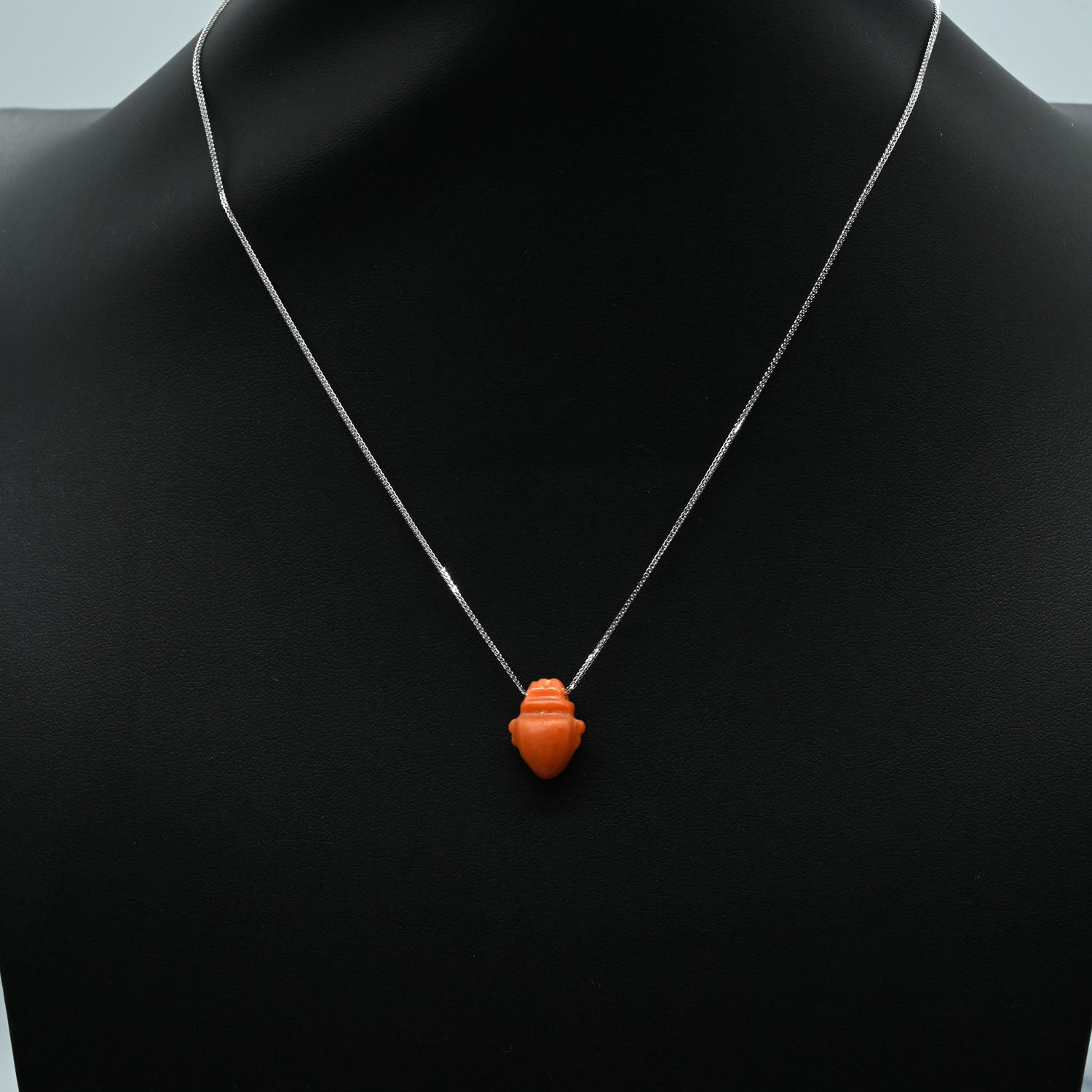
An Egyptian Carnelian Heart Amulet, New Kingdom, ca. 1550 - 1295 BCE
Cet article est admissible à la livraison gratuite aux États-Unis et à des frais fixes de 75 $ pour l'expédition internationale.
Among the most important protective amulets of ancient Egypt, heart amulets were closely associated with life, memory, and the eternal survival of the individual. The Egyptians regarded the heart, rather than the brain, as the seat of intelligence, emotion, character, and conscience. It was believed to preserve the essence of a person's identity and would ultimately bear witness to their deeds in the afterlife.
This finely carved amulet is fashioned from vibrant carnelian, a material prized throughout Egyptian history for its rich red-orange color and its symbolic association with vitality, solar power, and regeneration. The amulet is modeled in the form of a heart, with a carefully defined pointed lower section and a lobed upper portion reflecting the stylized shape employed by Egyptian craftsmen for more than a millennium.
Heart amulets became especially popular during the New Kingdom and were frequently placed among the wrappings of mummies or suspended around the neck as personal protective ornaments. Their purpose was both practical and spiritual: to preserve the heart for eternity and to ensure that it would not testify against its owner during the Judgment of the Dead before Osiris. Chapter 30B of the Book of the Dead contains a famous spell specifically intended to prevent the heart from speaking unfavorably during this final judgment.
The choice of carnelian further enhanced the amulet's protective qualities. Egyptian texts associated the stone with the life-giving energy of the sun and with the regenerative powers necessary for rebirth in the next world. As a result, heart amulets carved from carnelian were regarded as particularly potent symbols of eternal life.
cf: Andrews, Carol "Amulets of Ancient Egypt," 1994. p. 72-73
Medium: Carnelian
Dimensions: Height: 7/8 inch (2.1 cm) Set as a pendant with adjustable 18-inch chain of 18K white gold.
Condition: The amulet is finely preserved, retaining its well-defined contours and attractive reddish-orange coloration. Minor surface wear and light abrasions consistent with age and ancient use are present. No visible cracks, repairs, or restorations. Drilled longitudinally for suspension and currently mounted as a pendant. The surface exhibits a smooth, well-polished finish with only minimal signs of handling. Overall, an exceptionally well-preserved example.
Provenance: Nora Scott (1905 – 1994), Curator of Egyptian Art at the Metropolitan Museum of Art, (retired 1972), and acquired from the Metropolitan Museum of Art by deaccession. Gifted to L. Virginia Burton (1918–2009) Associate Curator of Egyptian Art at the Metropolitan Museum of Art (retired 1977), and then by descent.
DES QUESTIONS? Cliquez simplement sur l'onglet Nous contacter à votre droite.
Nous expédions du mardi au vendredi par transporteur terrestre et généralement le jour même si votre commande est reçue avant 14h. Aux États-Unis continentaux, l'emballage, l'expédition et l'assurance sont gratuits. Selon la taille et la destination, les délais de livraison varient de un à cinq jours ouvrables.
Pour les envois à l'étranger, nous facturons un faible taux forfaitaire qui comprend l'emballage, la préparation de tous les documents douaniers, l'assurance et les frais de transport, en conformité avec toutes les exigences douanières américaines et internationales.
Les envois à l'étranger sont envoyés via FedEx, DHL ou UPS International Priority, veuillez donc nous contacter si vous avez une préférence en matière d'expédition. Les clients internationaux sont responsables de tous les droits et taxes.
Sands of Time offre une garantie d'authenticité et de provenance inconditionnelle à vie. Chaque objet que vous achetez chez nous est accompagné d'un certificat d'authenticité, indiquant sa culture, sa provenance et son âge.
De plus, nous faisons preuve de diligence raisonnable pour nous assurer que l'objet, à notre connaissance, n'a pas été obtenu illégalement d'une fouille, d'un monument architectural, d'une institution publique ou d'une propriété privée. Dans la mesure du possible, il est fait référence aux collections ou publications existantes.Dans la mesure du possible, il est fait référence aux collections ou publications existantes.
Choisir les options
Derniers affichages

Come Visit Us!
1010 Wisconsin Ave NW, Suite 340
Washington DC. 20007
Tues - Fri, 10:00am - 6:00pm
Sat/Sun/Mon By appointment


