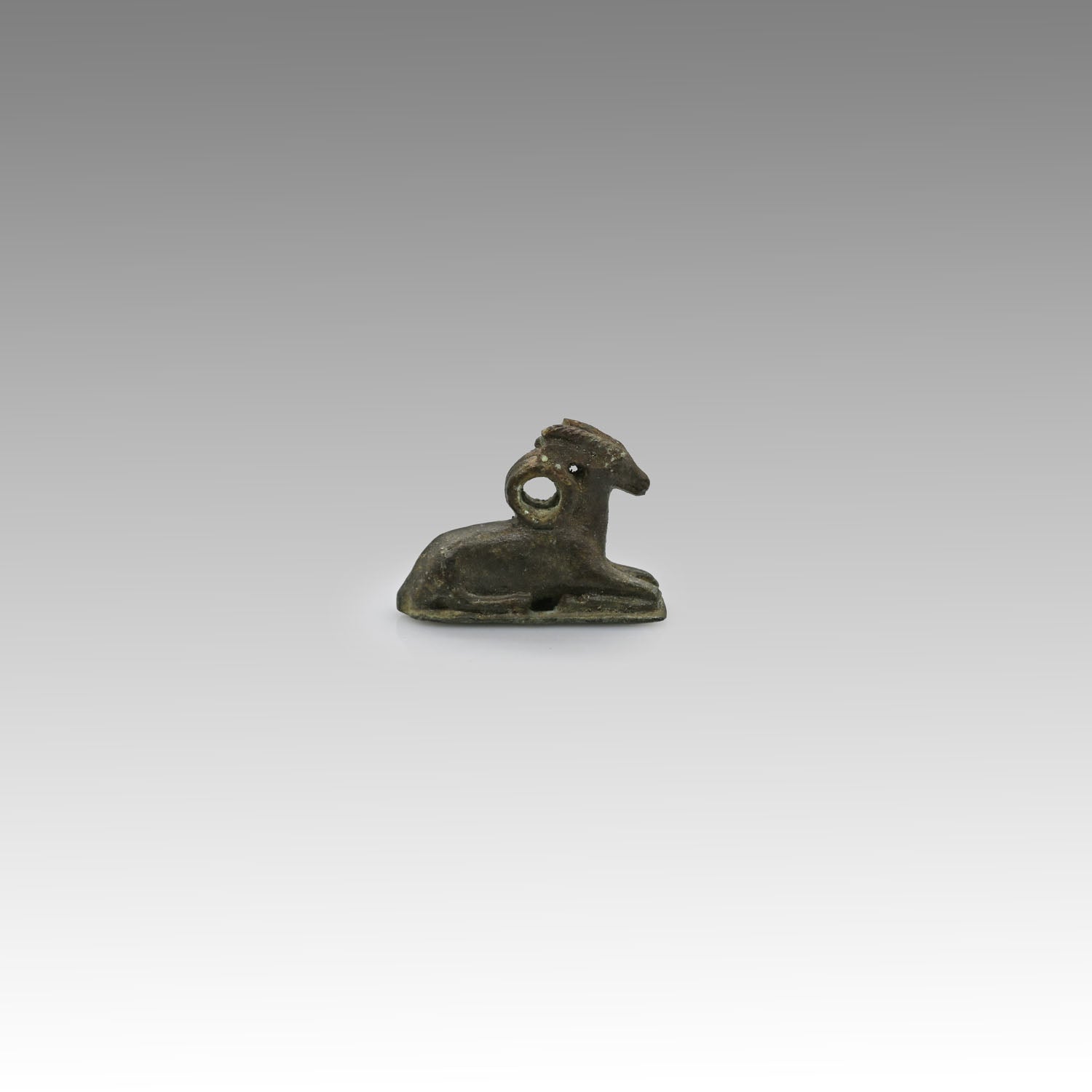
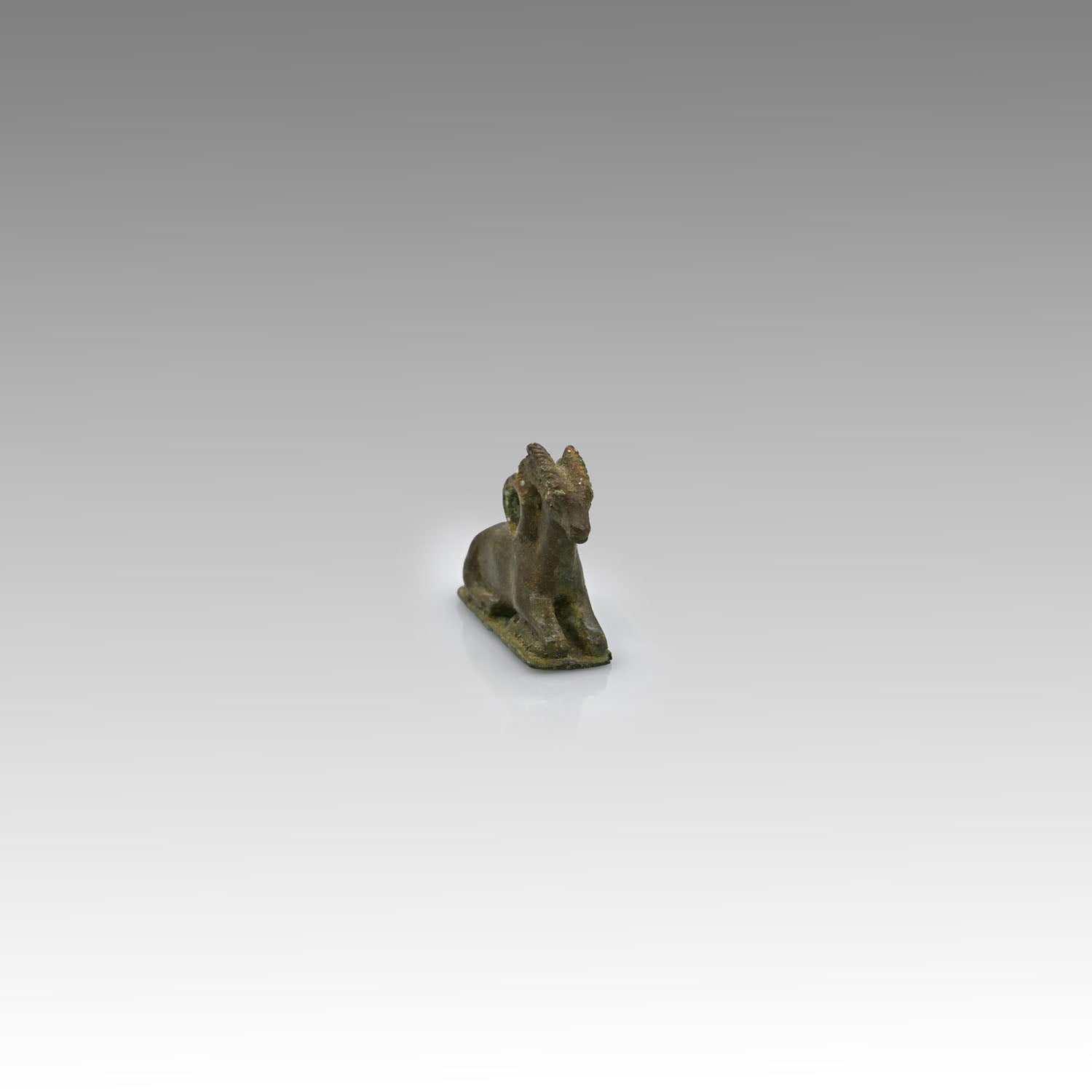
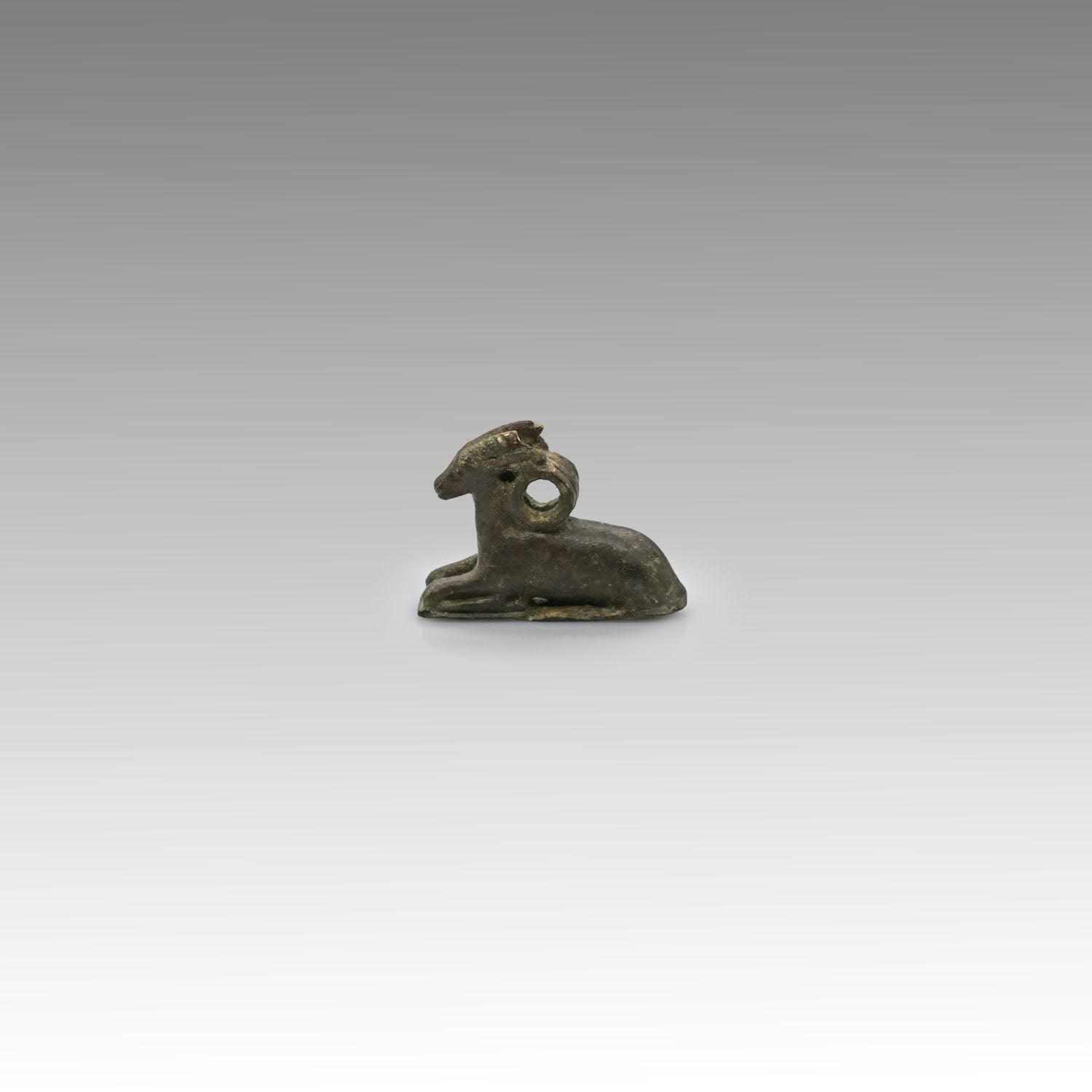
An Egyptian Bronze Weight in the form of a Ram, New Kingdom, Amarna Period , 18th Dynasty, ca 1352 - 1336 BCE
Cet article est admissible à la livraison gratuite aux États-Unis et à des frais fixes de 75 $ pour l'expédition internationale.
Finely cast in the form of a recumbent ram with elegantly curved horns, the animal shown resting upon an integral rectangular base. The compact body is carefully modeled with gently sloping shoulders, folded forelegs, and a sensitively rendered head with elongated muzzle and alert expression. Traces of the original dark olive and brown surface patina remain throughout.
Animal-form weights occupied an important role in the economic life of ancient Egypt, reflecting the close relationship between livestock, agriculture, and systems of value. Since cattle, sheep, goats, and other domesticated animals symbolized prosperity and wealth, it was natural that official weights should take their forms. During the New Kingdom, bronze examples such as the present piece were typically hollow cast and adjusted internally, often with lead, to achieve the desired standard weight.
Weights in the form of bulls and rams are especially associated with the Eighteenth Dynasty and the Amarna Period. Their production appears to have declined by the later Nineteenth Dynasty, when stone and glass examples became preferred due to the tendency of bronze to corrode and alter in mass over time. Comparable examples are illustrated in the Museum of Fine Arts, Boston exhibition catalogue Egypt’s Golden Age: The Art of Living in the New Kingdom, pp. 61–62, no. 33.
Reference: Freed, Rita E., et al. Egypt’s Golden Age: The Art of Living in the New Kingdom, 1558–1085 B.C.: Catalogue of the Exhibition. Boston: Museum of Fine Arts, Boston, 1982. ISBN 0-87846-207-4.
Medium: Bronze
Dimensions: Length: 1 3/8 inches (3.06 cm)
Condition: Small losses to the tips of both horns; otherwise intact and in very good condition overall, with attractive ancient surface patina.
Provenance: Nora Scott (1905 – 1994), Curator of Egyptian Art at the Metropolitan Museum of Art, (retired 1972), and acquired from the Metropolitan Museum of Art by deaccession. Gifted to L. Virginia Burton (1918–2009) Associate Curator of Egyptian Art at the Metropolitan Museum of Art (retired 1977), and then by descent.
DES QUESTIONS? Cliquez simplement sur l'onglet Nous contacter à votre droite.
Nous expédions du mardi au vendredi par transporteur terrestre et généralement le jour même si votre commande est reçue avant 14h. Aux États-Unis continentaux, l'emballage, l'expédition et l'assurance sont gratuits. Selon la taille et la destination, les délais de livraison varient de un à cinq jours ouvrables.
Pour les envois à l'étranger, nous facturons un faible taux forfaitaire qui comprend l'emballage, la préparation de tous les documents douaniers, l'assurance et les frais de transport, en conformité avec toutes les exigences douanières américaines et internationales.
Les envois à l'étranger sont envoyés via FedEx, DHL ou UPS International Priority, veuillez donc nous contacter si vous avez une préférence en matière d'expédition. Les clients internationaux sont responsables de tous les droits et taxes.
Sands of Time offre une garantie d'authenticité et de provenance inconditionnelle à vie. Chaque objet que vous achetez chez nous est accompagné d'un certificat d'authenticité, indiquant sa culture, sa provenance et son âge.
De plus, nous faisons preuve de diligence raisonnable pour nous assurer que l'objet, à notre connaissance, n'a pas été obtenu illégalement d'une fouille, d'un monument architectural, d'une institution publique ou d'une propriété privée. Dans la mesure du possible, il est fait référence aux collections ou publications existantes.Dans la mesure du possible, il est fait référence aux collections ou publications existantes.
Choisir les options
Derniers affichages
Come Visit Us!
1010 Wisconsin Ave NW, Suite 340
Washington DC. 20007
Tues - Fri, 10:00am - 6:00pm
Sat/Sun/Mon By appointment


