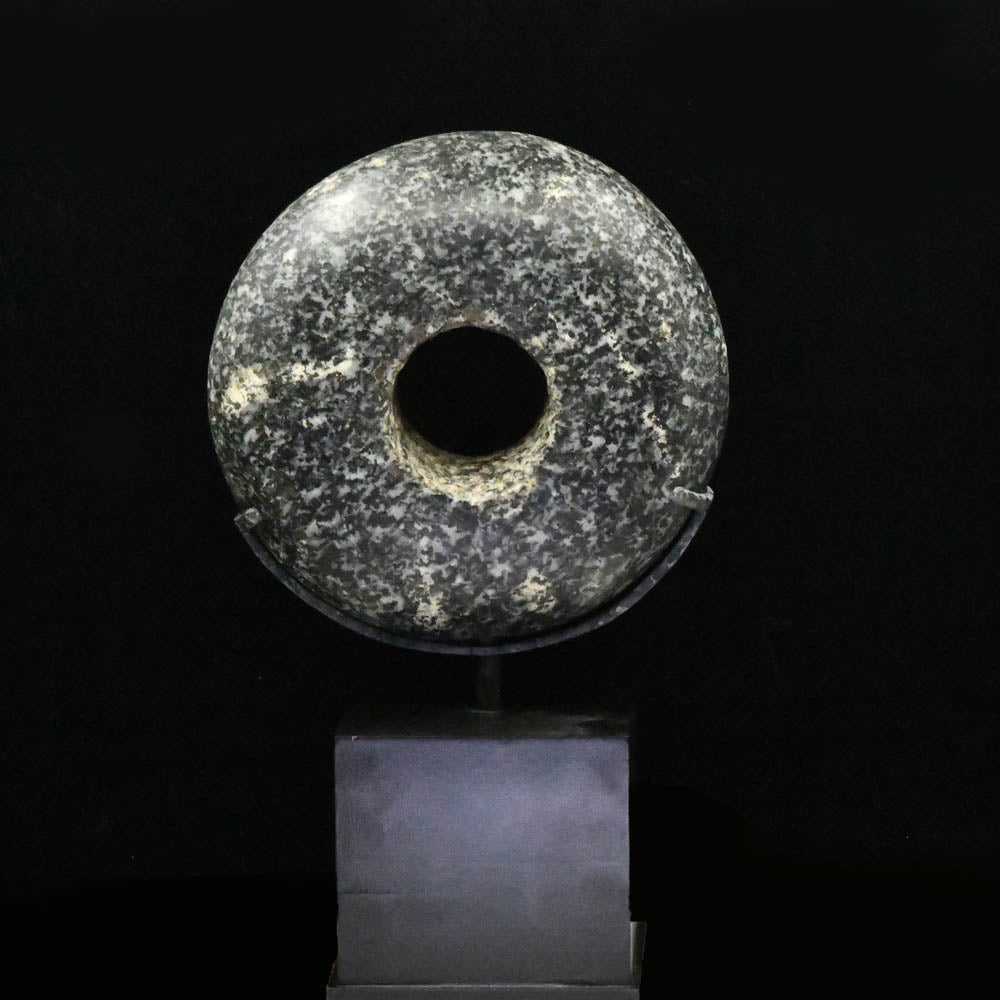
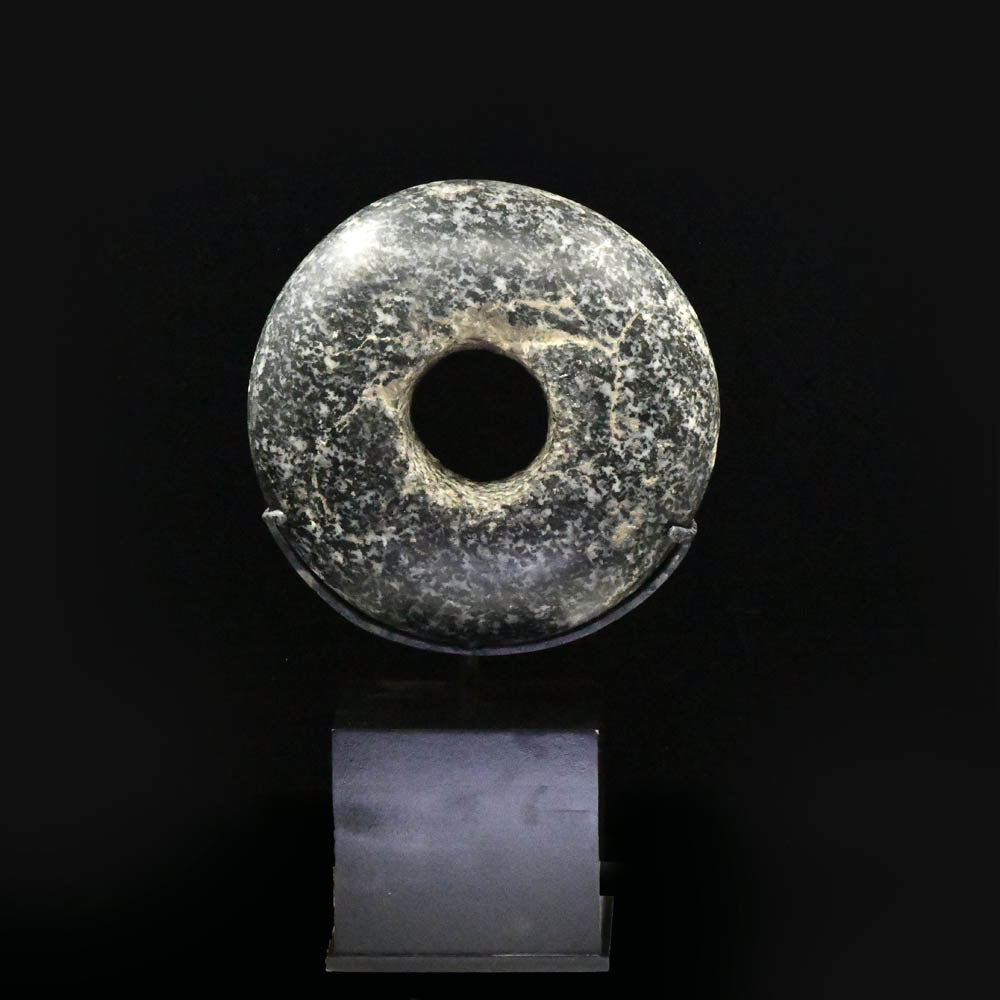
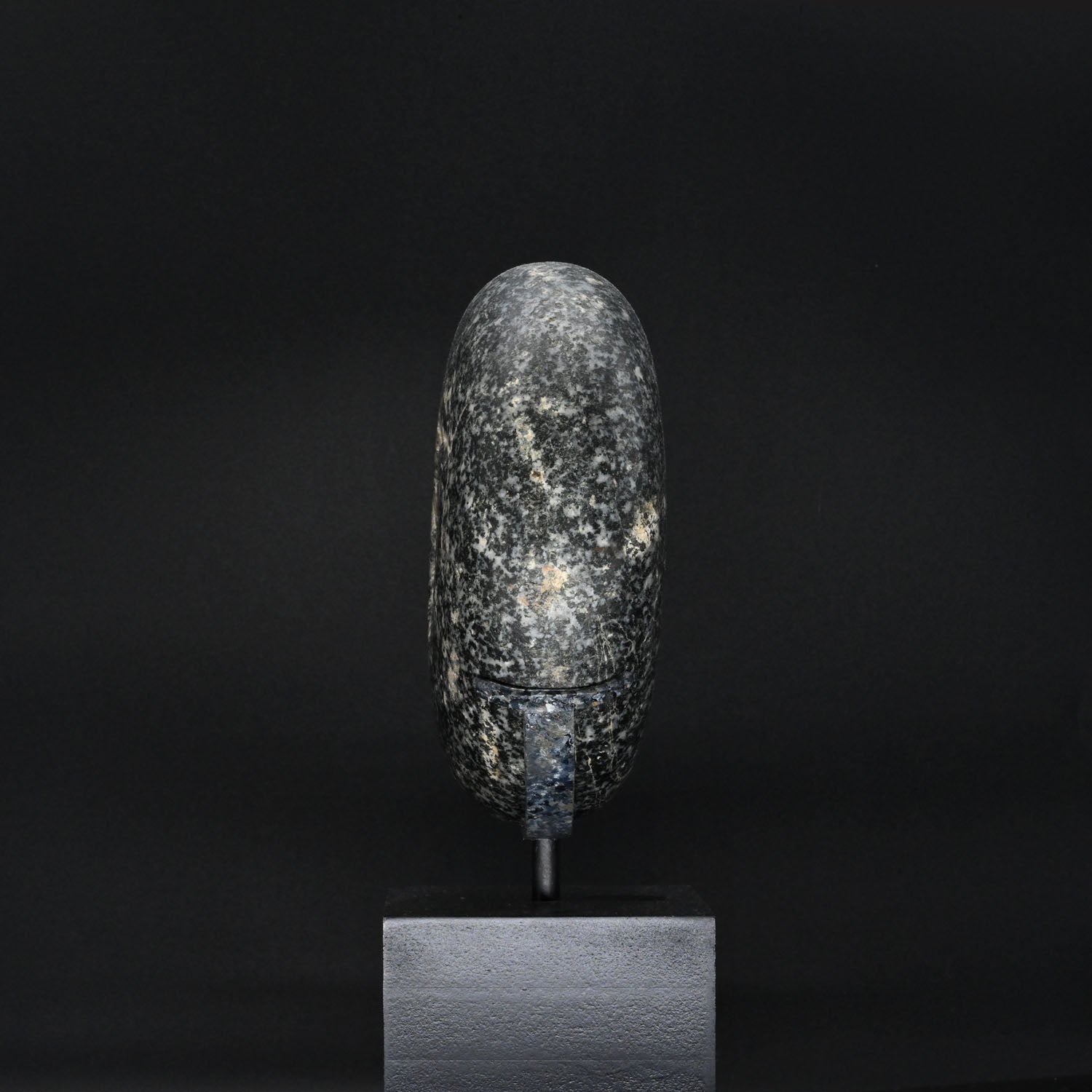
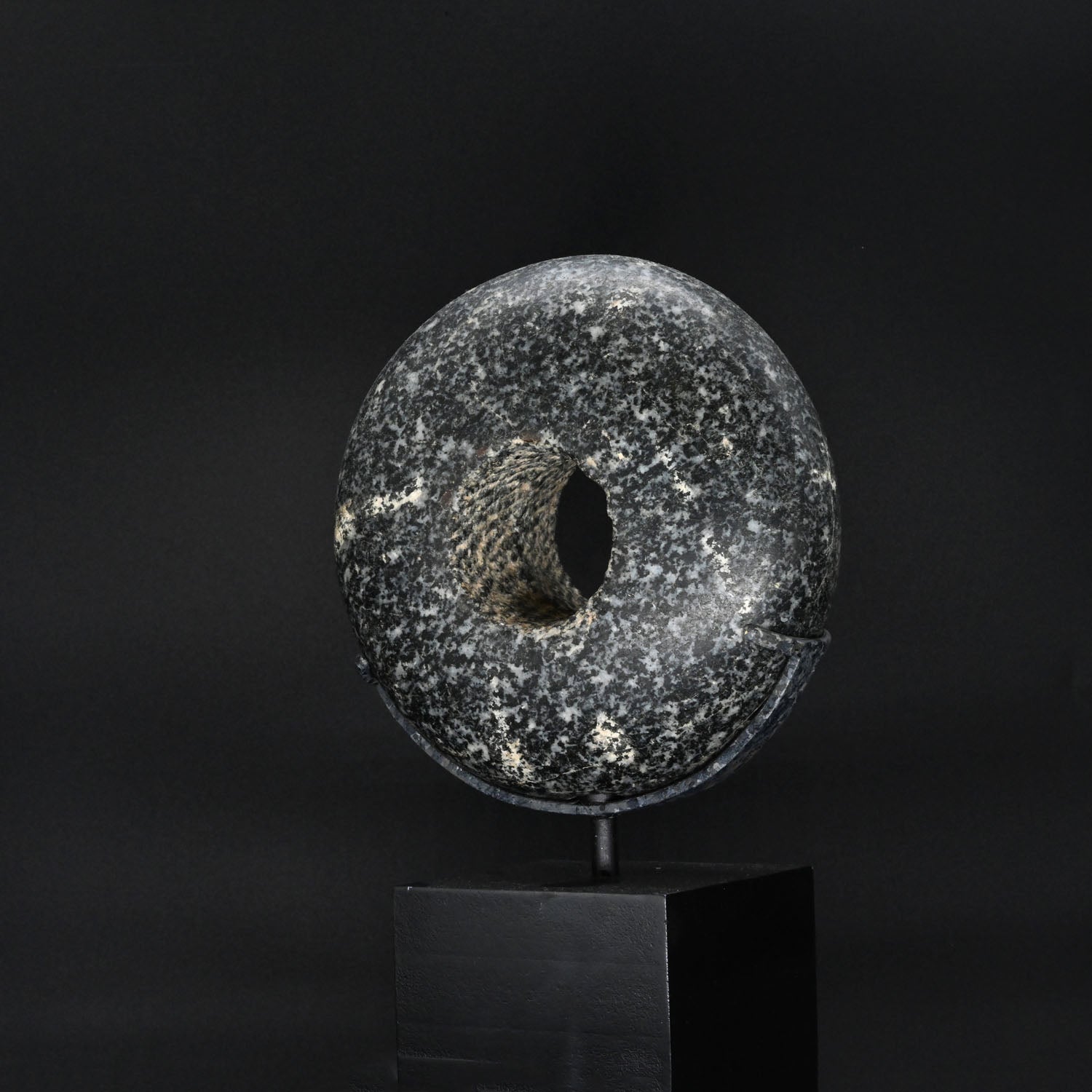
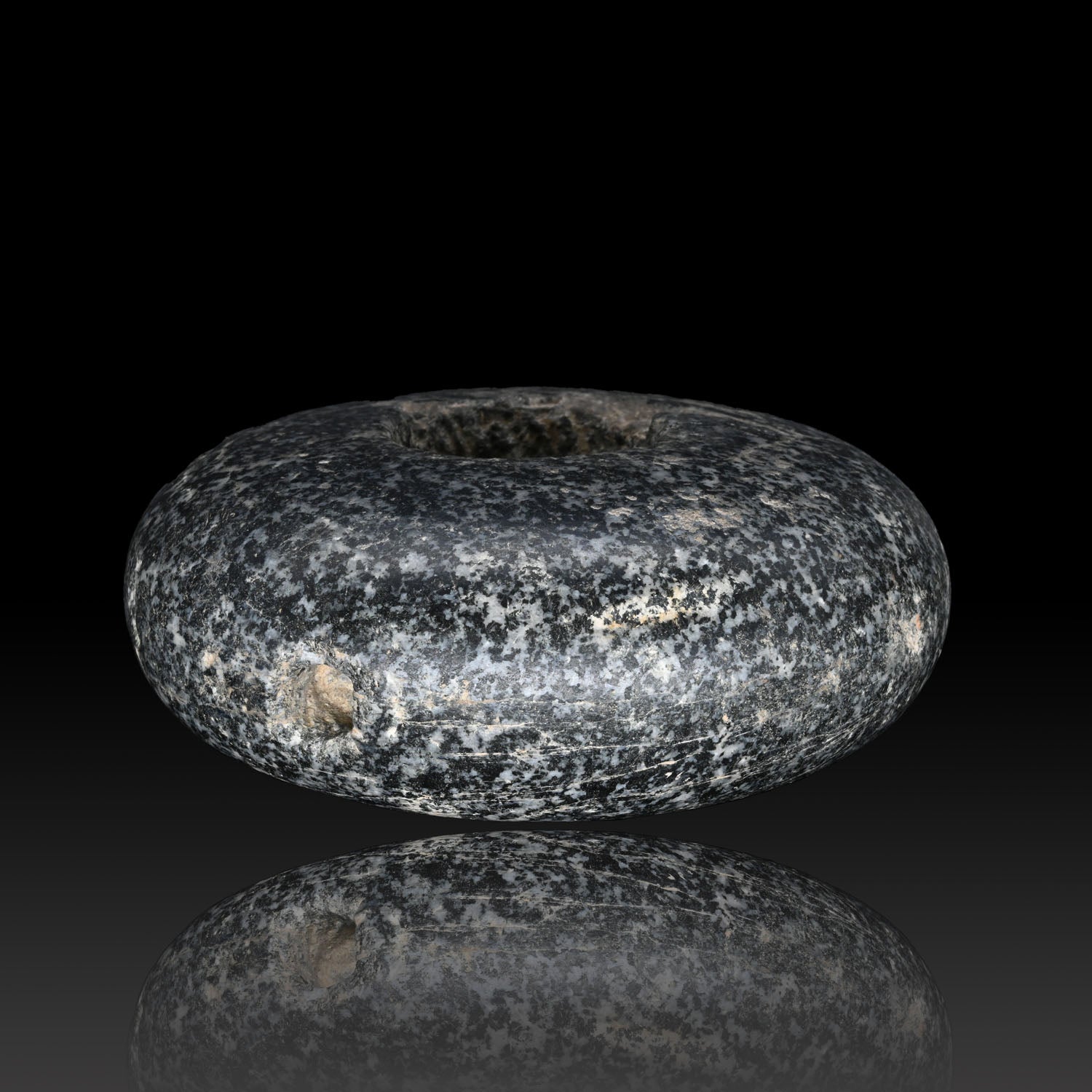
A Large Egyptian Diorite Rotary Grinding Stone, Old Kingdom, ca. 2543-1980 BCE
Cet article est admissible à la livraison gratuite aux États-Unis et à des frais fixes de 75 $ pour l'expédition internationale.
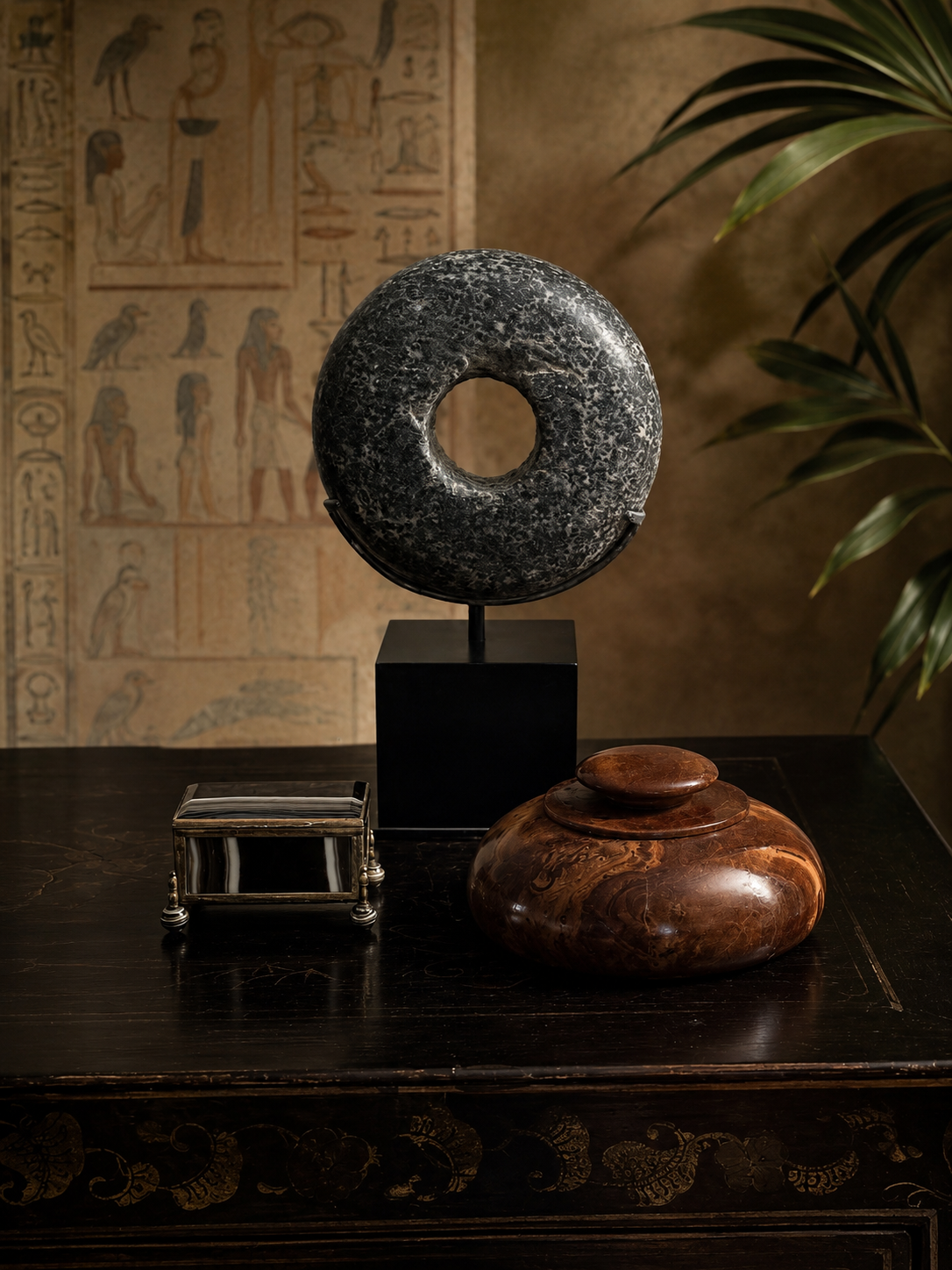
This substantial rotary grinding stone is carved from speckled grano-diorite, one of the hardest and most durable stones employed by the ancient Egyptians. Ring-shaped in form, it features a broad central shaft hole and a smoothly rounded outer edge, while one side retains a small circular recess associated with its original operation. Objects of this type were essential tools in ancient Egyptian workshops and households, where they were used in the processing of grain, minerals, pigments, and other materials necessary for daily life.
The grinding stone is particularly noteworthy for its material. Diorite and grano-diorite were prized by Egyptian craftsmen for their durability but were exceptionally difficult to work. The same family of stone was selected for some of Egypt's finest royal sculpture, including masterpieces created during the age of the pyramid builders. The successful shaping of such a hard material required considerable skill and labor, making even utilitarian objects impressive demonstrations of ancient stone-working technology.
Unlike many surviving examples that show extensive wear, breakage, or repairs, this grinding stone remains intact and well-preserved. Its balanced proportions, attractive mottled surface, and pleasing geometric form give it a distinctly sculptural quality. Today it displays as an abstract work of ancient design while retaining its historical significance as a functional object from one of the most important periods of Egyptian civilization.
Tools and implements from the Old Kingdom are encountered far less frequently than scarabs, amulets, or later funerary objects. As such, this piece offers collectors an opportunity to acquire an authentic artifact directly connected to the practical and industrial life of Egypt during the era of the great pyramids.
Medium: Diorite
Dimensions: Diameter: 6 inches (15.2 cm)
Condition: Overall intact and in very good condition Presented on a museum quality custom mount.
Provenance: The John J. Slocum Collection. Mr. Slocum (1914-1997) collected most of his antiquities while serving as US cultural attache to Egypt in the 1960s. Later, he served as Assistant to the Director of The Smithsonian, was appointed by President Reagan to the Presidential Cultural Property Advisory Committee, and was a Trustee Emeritus of the Archaeological Institute of America. He was a well-respected scholar/collector, whose medieval crusader coins were sold in a single-owner sale at Sotheby's, London in 1997.
DES QUESTIONS? Cliquez simplement sur l'onglet Nous contacter à votre droite.
Nous expédions du mardi au vendredi par transporteur terrestre et généralement le jour même si votre commande est reçue avant 14h. Aux États-Unis continentaux, l'emballage, l'expédition et l'assurance sont gratuits. Selon la taille et la destination, les délais de livraison varient de un à cinq jours ouvrables.
Pour les envois à l'étranger, nous facturons un faible taux forfaitaire qui comprend l'emballage, la préparation de tous les documents douaniers, l'assurance et les frais de transport, en conformité avec toutes les exigences douanières américaines et internationales.
Les envois à l'étranger sont envoyés via FedEx, DHL ou UPS International Priority, veuillez donc nous contacter si vous avez une préférence en matière d'expédition. Les clients internationaux sont responsables de tous les droits et taxes.
Sands of Time offre une garantie d'authenticité et de provenance inconditionnelle à vie. Chaque objet que vous achetez chez nous est accompagné d'un certificat d'authenticité, indiquant sa culture, sa provenance et son âge.
De plus, nous faisons preuve de diligence raisonnable pour nous assurer que l'objet, à notre connaissance, n'a pas été obtenu illégalement d'une fouille, d'un monument architectural, d'une institution publique ou d'une propriété privée. Dans la mesure du possible, il est fait référence aux collections ou publications existantes.Dans la mesure du possible, il est fait référence aux collections ou publications existantes.
Choisir les options
Derniers affichages
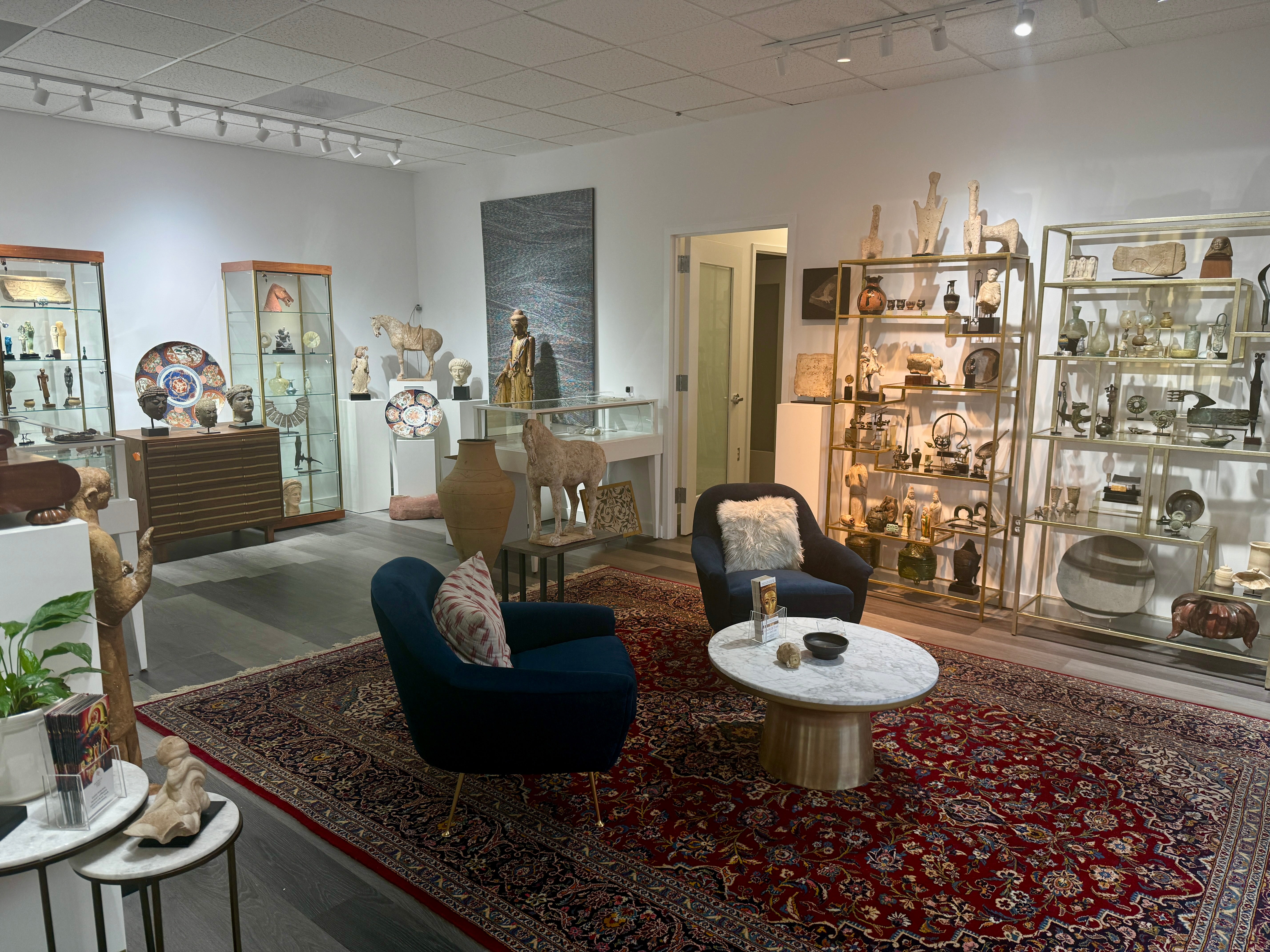
Come Visit Us!
1010 Wisconsin Ave NW, Suite 340
Washington DC. 20007
Tues - Fri, 10:00am - 6:00pm
Sat/Sun/Mon By appointment


