

An Egyptian Illustrated Book of the Dead Papyrus Fragment, Late Period ca 664 - 332 BCE
This object qualifies for free and fast worldwide shipping.
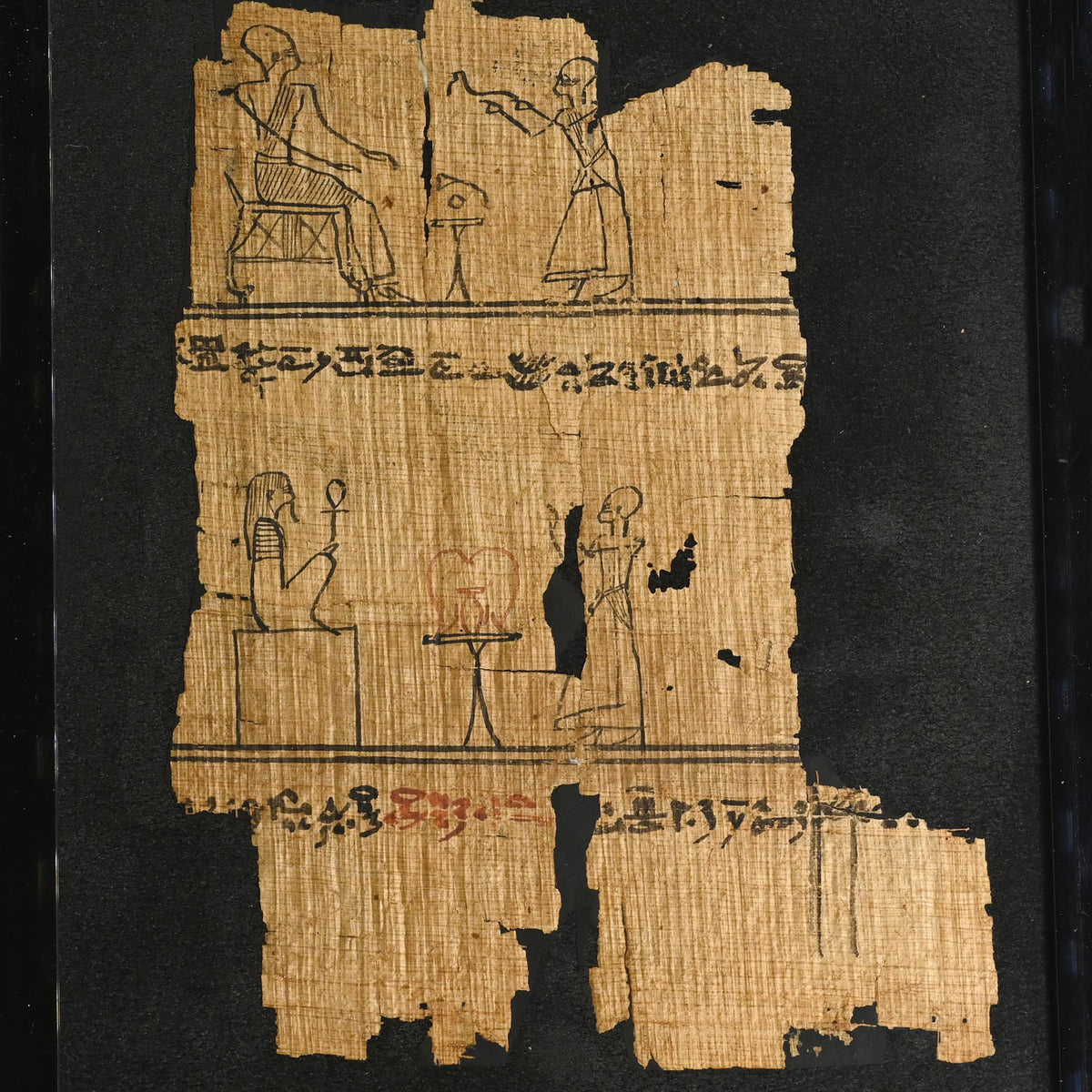
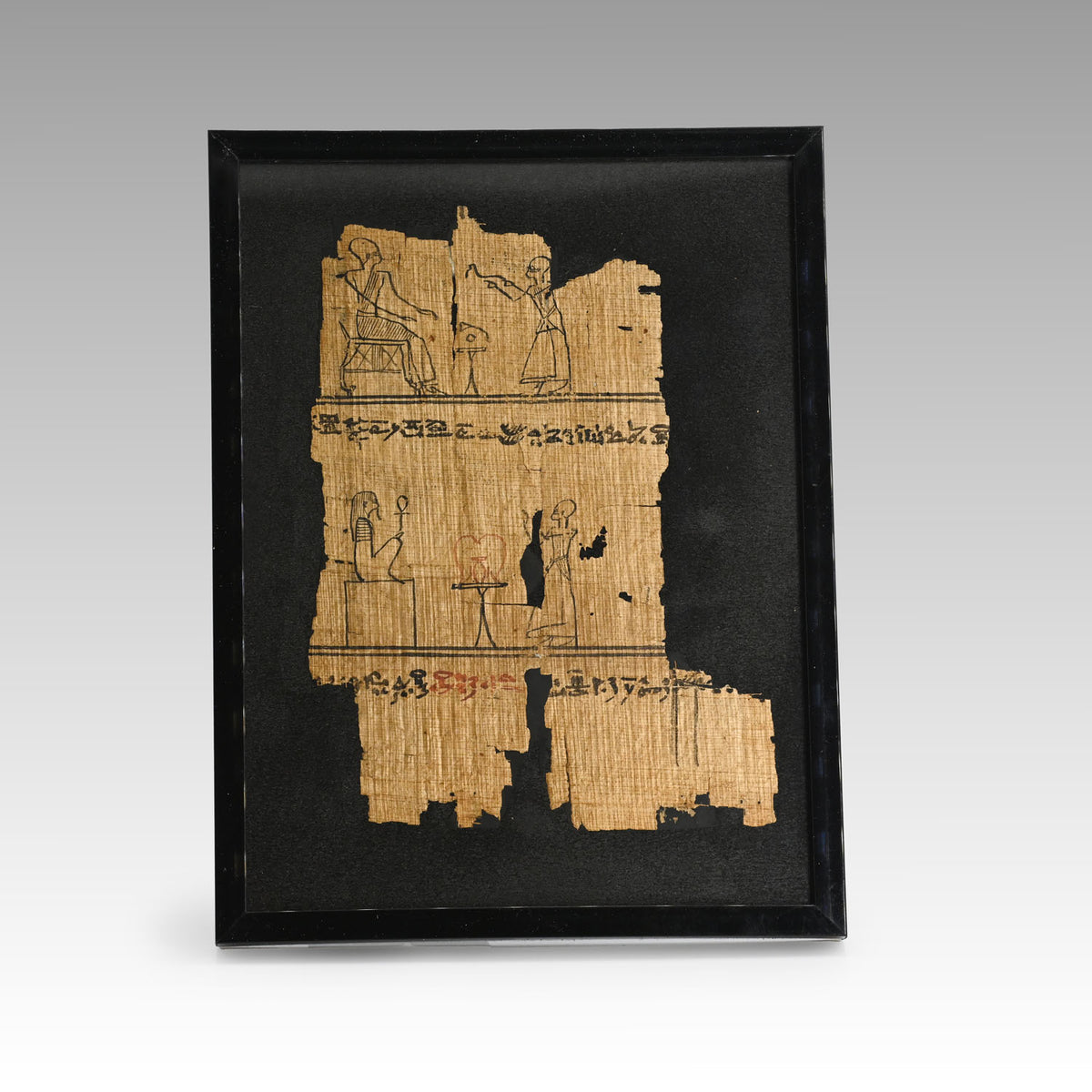
This finely illustrated papyrus fragment preserves portions of the Egyptian "Book of the Dead" comprising two registers of funerary vignettes accompanied by horizontal lines of hieratic text. Executed in black ink with occasional details and rubrication in red, the composition reflects the manuscript traditions of the Late Period. In the upper register, the deceased stands before an enthroned figure, with a small offering stand positioned between them. In the register below, the deceased is depicted standing before a seated deity holding an ankh, the hieroglyphic symbol of life. Between the figures is a pedestal supporting an object outlined in red. Both scenes are delineated by double horizontal ground lines. The surviving inscriptions correspond to chapters of the "Book of the Dead" concerned with the restoration of the physical faculties of the deceased and the preservation of the heart in the afterlife. Partial translation:
Upper horizontal line (Chapter 26): “[May Geb], heir of the gods, [separate] my jaws, may he open my eyes, which are blind, …”
Lower horizontal line, with rubrication in red (Chapter 27 or 28): “Spell for not letting the heart [of the deceased] be taken [from him in the necropolis.]”
End of the horizontal line to the right: “[Giving the … of a man] to him in the necropolis.”
Known to the ancient Egyptians as the Book of Going Forth by Day, the Book of the Dead comprises a collection of funerary spells intended to protect and guide the deceased through the afterlife. Chapters 26–28 concern the restoration and protection of the heart, regarded by the ancient Egyptians as the seat of intellect, memory, emotion, and moral consciousness. Unlike other internal organs, the heart was generally retained within the body during mummification, as its preservation was essential to the judgment of the deceased before Osiris.
Medium: Papyrus, black and red ink
Dimensions: Papyrus: Height: 6 1/2 inches (16.5 cm), Width: 4 3/4 inches (12 cm). Frame: 8 1/2 x 6 1/2 inches (21.5 x 16.5 cm)
Condition: Fragmentary, with irregular edges, areas of loss and separation along the papyrus fibers. Substantial portions of both illustrated registers and their accompanying inscriptions are preserved, with much of the original black and red ink remaining clearly visible. Archival mounted and framed against a black background.
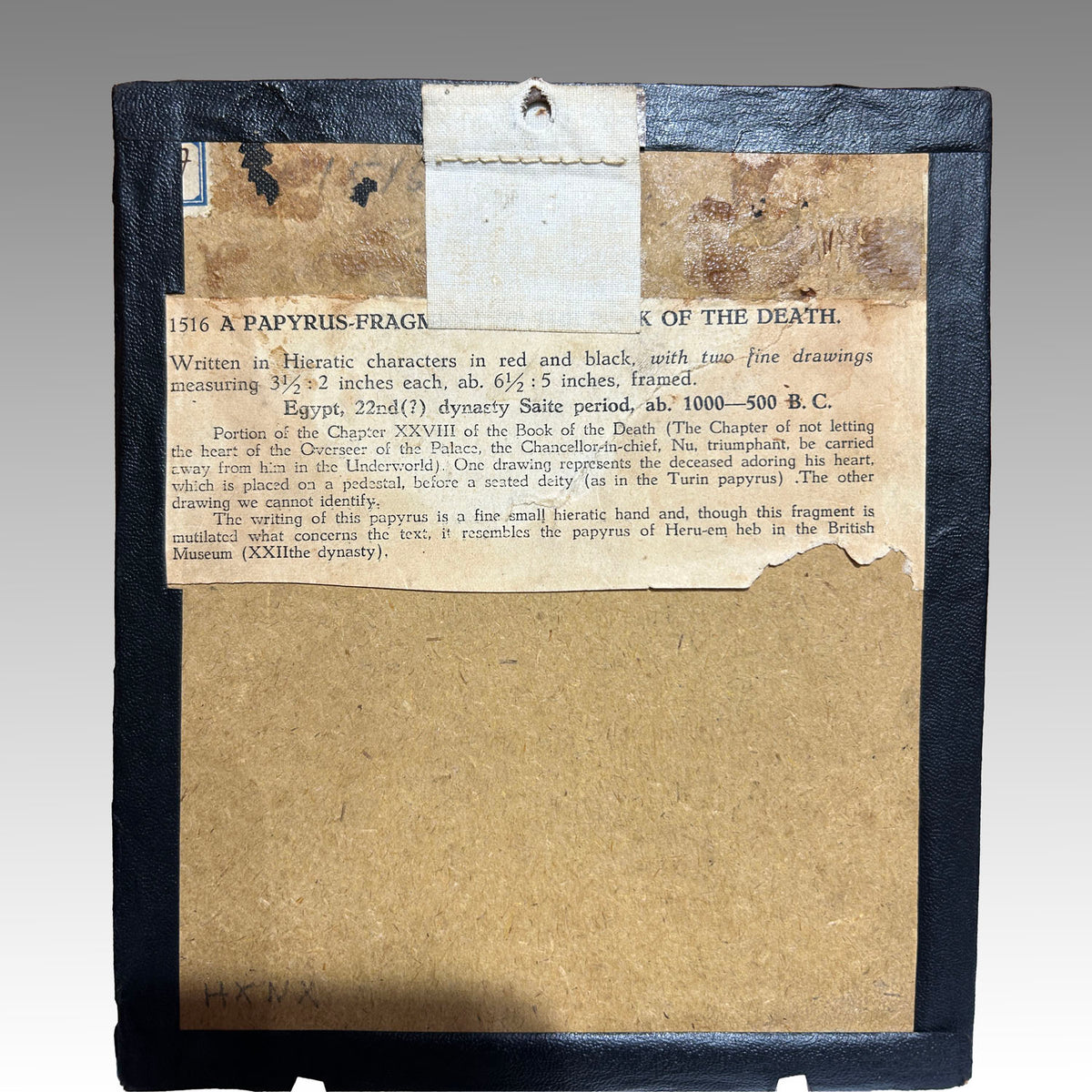
Provenance: Nora Scott (July 14, 1905 – April 4, 1994), Curator of Egyptian Art at the Metropolitan Museum of Art, (retired 1972). Gifted to L. Virginia Burton (1918–2009) Associate Curator of Egyptian Art at the Metropolitan Museum of Art (retired 1977), and then by descent.
We ship Tuesday to Friday with FedEx and usually same day if your order is received before 2pm. Within the continental USA, packing, shipping and insurance is free. Depending on size and destination, delivery times range from one to five business days.
For overseas shipments we charge a small flat rate which includes packing, preparation of all customs paperwork, insurance and carrier fees in compliance with all USA and International customs requirements. Overseas shipments are sent using either USPS Priority Mail or FedEx but contact us if you have a shipping preference. International customers are responsible for all duties and taxes.
Sands of Time provides a lifetime, unconditional guarantee of authenticity and provenance. Every object you purchase from us is accompanied by a Certificate of Authenticity, stating culture, provenance, and age.
Furthermore, we conduct due diligence to ensure the item, to the best of our knowledge, has not been illegally obtained from an excavation, architectural monument, public institution, or private property. Wherever possible, reference is made to existing collections or publications.Wherever possible, reference is made to existing collections or publications.
Choisir les options
Recently viewed

COME VISIT US!
1010 Wisconsin Ave NW, Suite 340
Washington DC. 20007
Tues - Fri, 11:00am - 5:00pm
Sat/Sun/Mon by appointment
A trusted source for collectors, curators, and connoisseurs for over 30 years.


