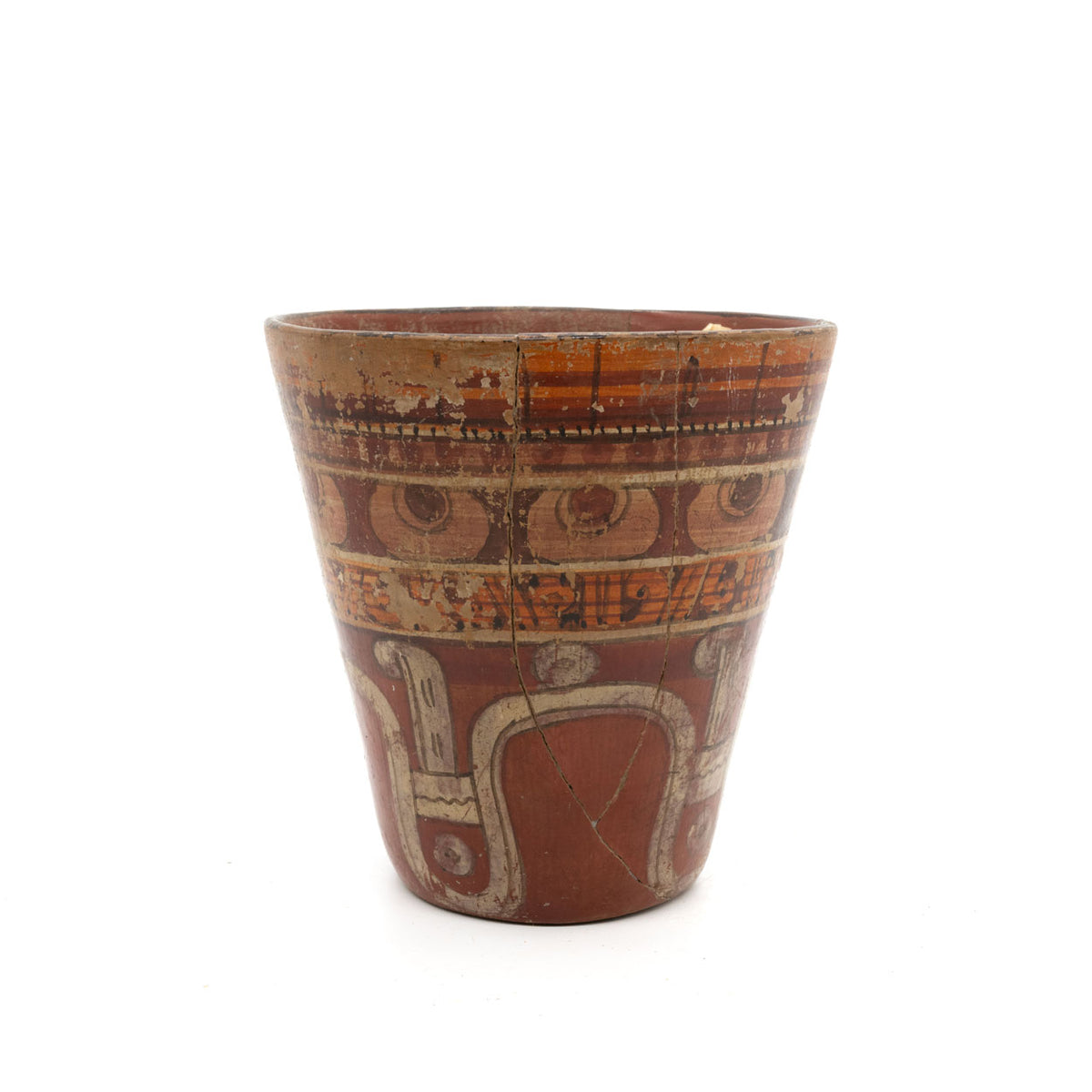
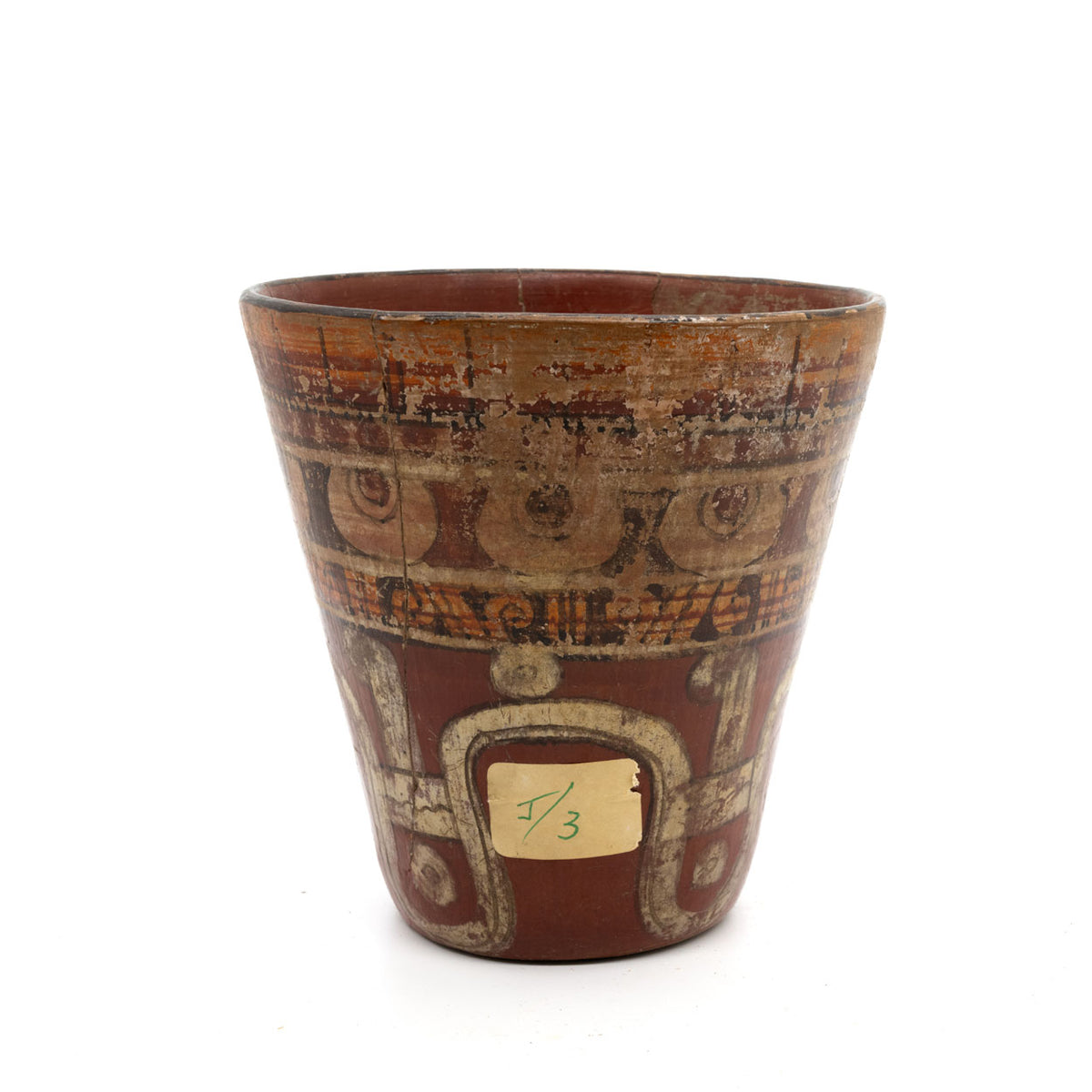
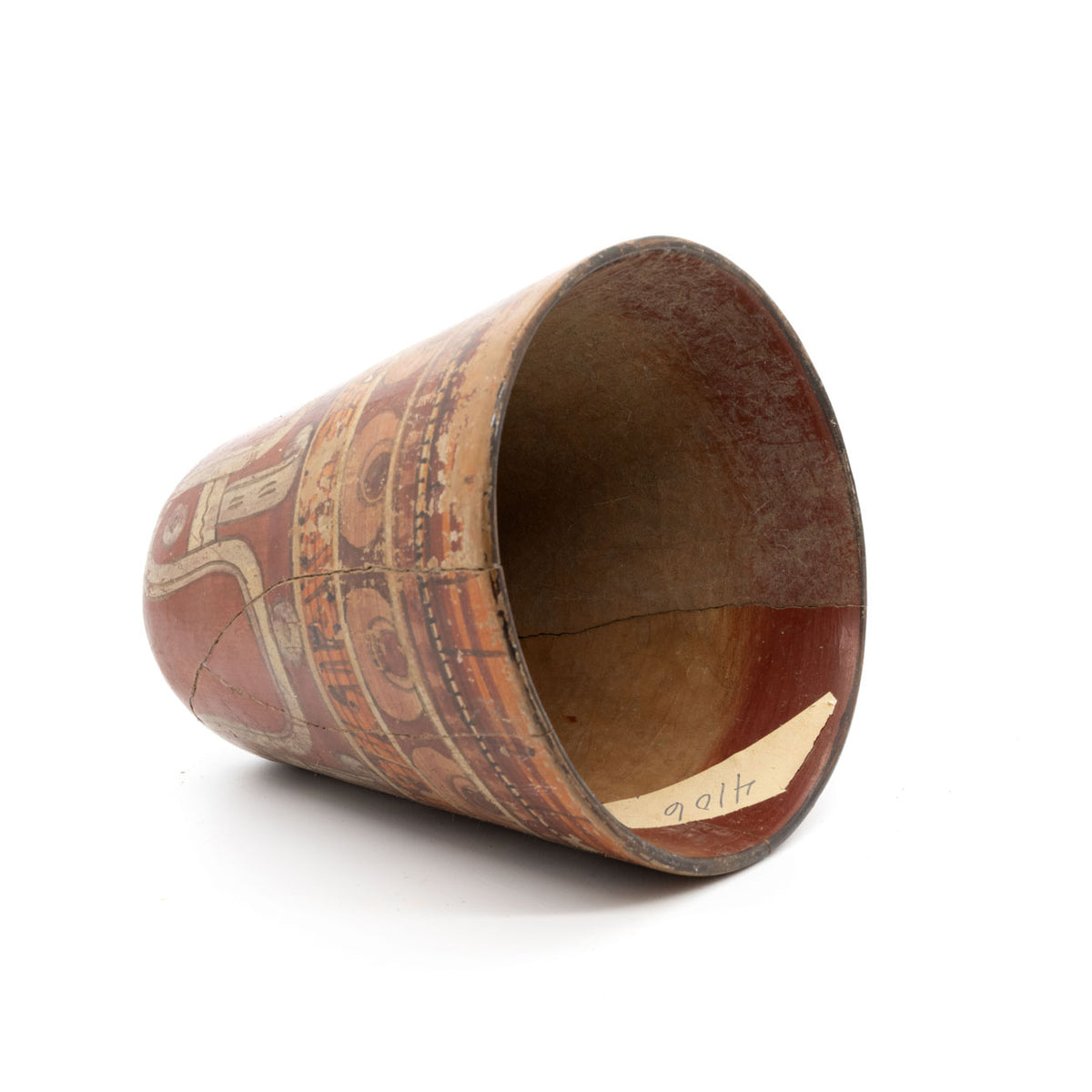
A Maya Polychrome Chocolate Cup, Maya Lowlands, Late Classic Period, ca. 600 – 800 CE
Cet article est admissible à la livraison gratuite aux États-Unis et à des frais fixes de 75 $ pour l'expédition internationale.
A finely potted cylindrical vessel with gently flaring walls, known as an uk’ib (“drinking cup”), used for the consumption of cacao in elite feasting and ritual contexts. Decorated in a classic polychrome palette of red, orange, cream, and black, the exterior is organized into horizontal registers. A band of pseudo-glyphs appears below an upper register of repeating circular motifs, rather than at the rim. These are not legible hieroglyphs but deliberate imitations of script, a feature seen on many Late Classic vessels where the visual authority of writing was evoked without conveying a specific text.
The main field presents a bold, graphic composition dominated by a U-shaped, curvilinear element with rounded terminals. This motif may represent a highly stylized serpent, reduced to its essential form, with the circular elements suggesting simplified heads or eyes. In Maya visual language, serpents are associated with rulership, ceremony, and controlled access to power, aligning with the elite function of cacao vessels. Though partially worn, the composition retains a strong graphic presence characteristic of Late Classic courtly ceramics.
The vessel was hand-built using the coil method, then finished with slips and burnishing before low-temperature firing. The result is a refined surface with a painterly quality typical of high-level Maya ceramic production. This example reflects the technical and artistic skill achieved by Maya ceramicists during the Late Classic period, combining a well-resolved form with a painted program that balances abstraction and symbolic content.
Medium: Clay
Dimensions: Height: 5 3/4 inches (14.6 cm)
Condition: A small loss to the lower wall and base, professionally restored, otherwise complete and reassembled from several large pieces. Visible age-related wear with scattered areas of surface abrasion and pigment loss throughout. Regardless, it presents well and is a great example.
Provenance: Property from a New York City Collection, purchased from Parke Bernet, November 26, 1974, sale number 386, lot 88J, with lot stickers and a copy of the sale invoice.
DES QUESTIONS? Cliquez simplement sur l'onglet Nous contacter à votre droite.
Nous expédions du mardi au vendredi par transporteur terrestre et généralement le jour même si votre commande est reçue avant 14h. Aux États-Unis continentaux, l'emballage, l'expédition et l'assurance sont gratuits. Selon la taille et la destination, les délais de livraison varient de un à cinq jours ouvrables.
Pour les envois à l'étranger, nous facturons un faible taux forfaitaire qui comprend l'emballage, la préparation de tous les documents douaniers, l'assurance et les frais de transport, en conformité avec toutes les exigences douanières américaines et internationales.
Les envois à l'étranger sont envoyés via FedEx, DHL ou UPS International Priority, veuillez donc nous contacter si vous avez une préférence en matière d'expédition. Les clients internationaux sont responsables de tous les droits et taxes.
Sands of Time offre une garantie d'authenticité et de provenance inconditionnelle à vie. Chaque objet que vous achetez chez nous est accompagné d'un certificat d'authenticité, indiquant sa culture, sa provenance et son âge.
De plus, nous faisons preuve de diligence raisonnable pour nous assurer que l'objet, à notre connaissance, n'a pas été obtenu illégalement d'une fouille, d'un monument architectural, d'une institution publique ou d'une propriété privée. Dans la mesure du possible, il est fait référence aux collections ou publications existantes.Dans la mesure du possible, il est fait référence aux collections ou publications existantes.
Choisir les options
Derniers affichages
Come Visit Us!
1010 Wisconsin Ave NW, Suite 340
Washington DC. 20007
Tues - Fri, 10:00am - 6:00pm
Sat/Sun/Mon By appointment


