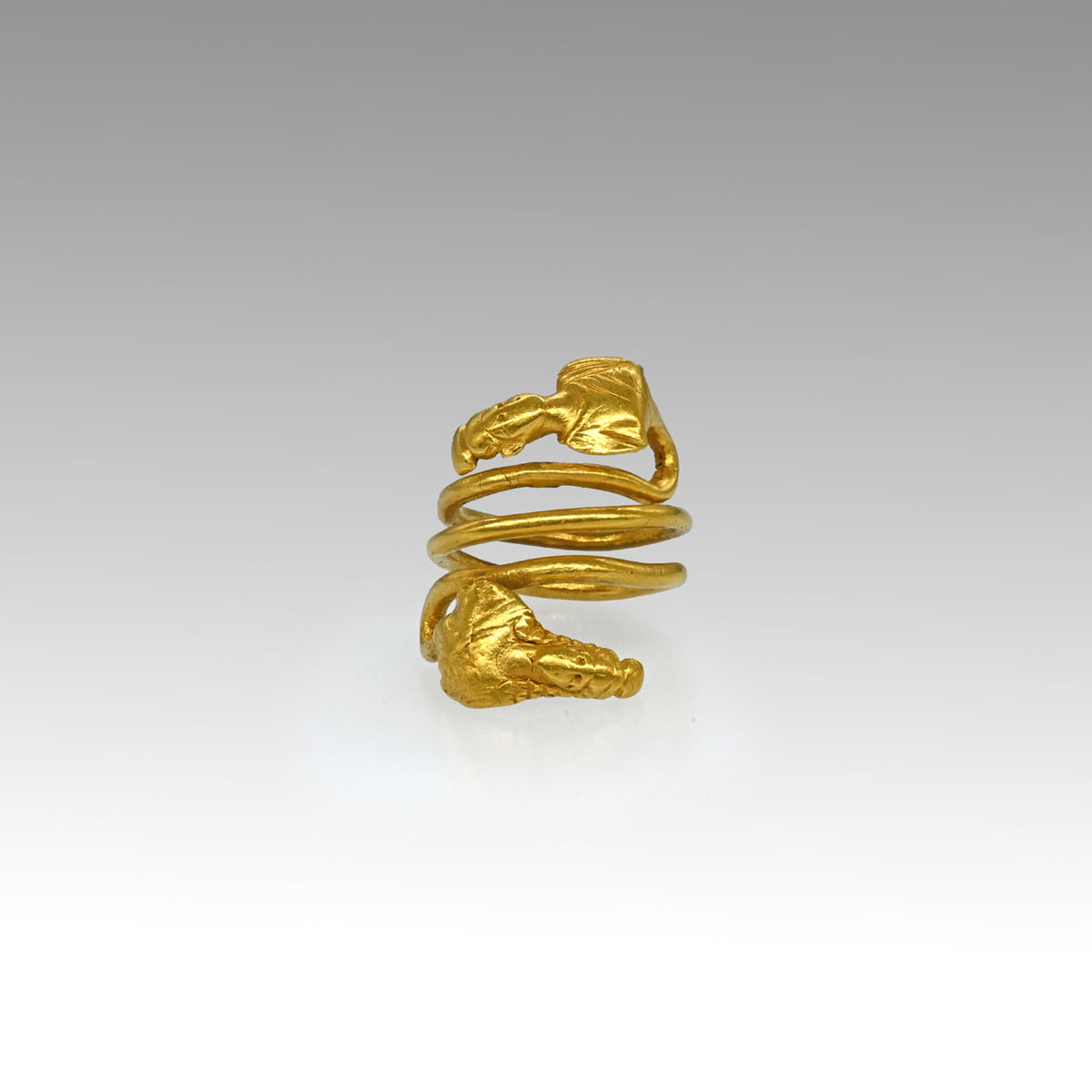
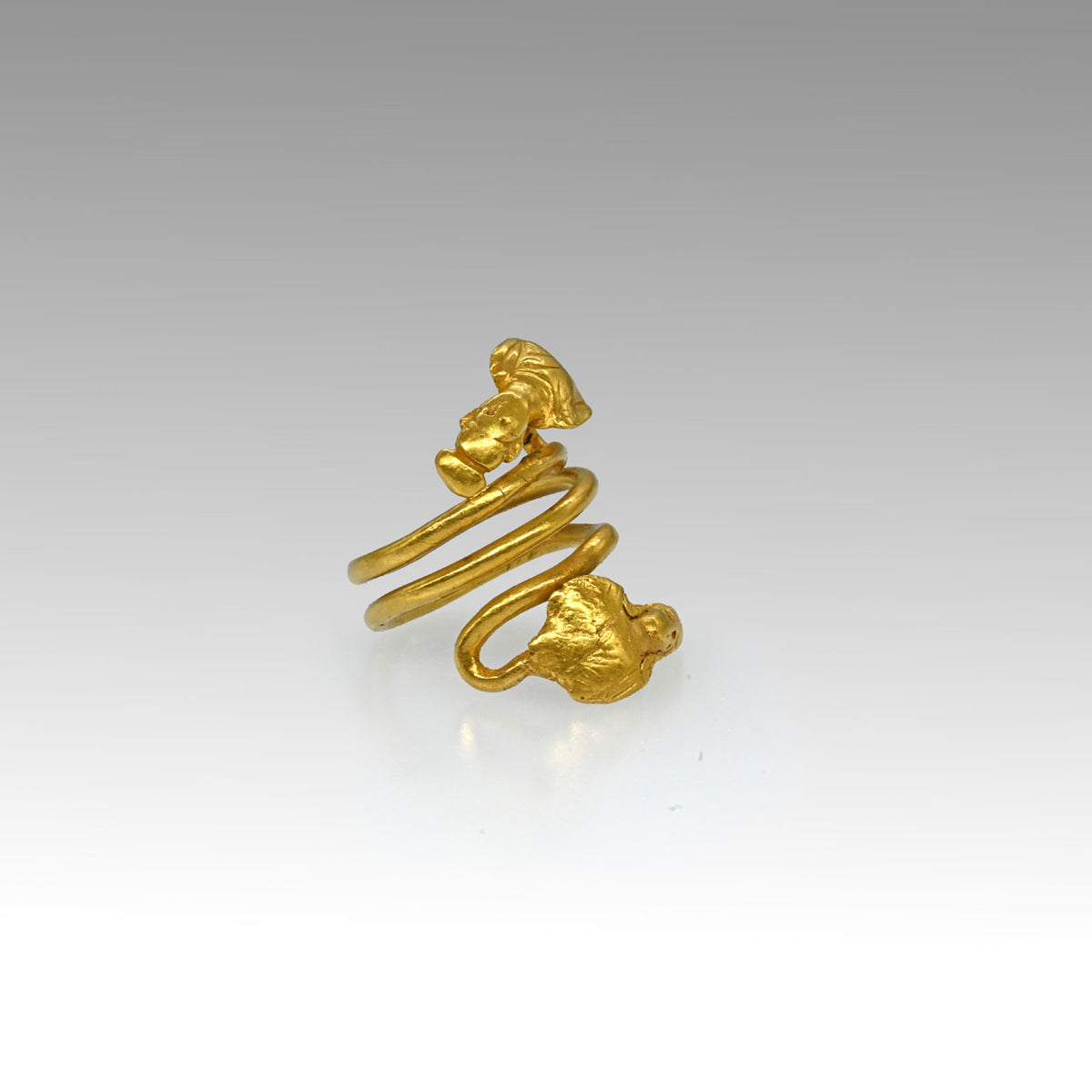
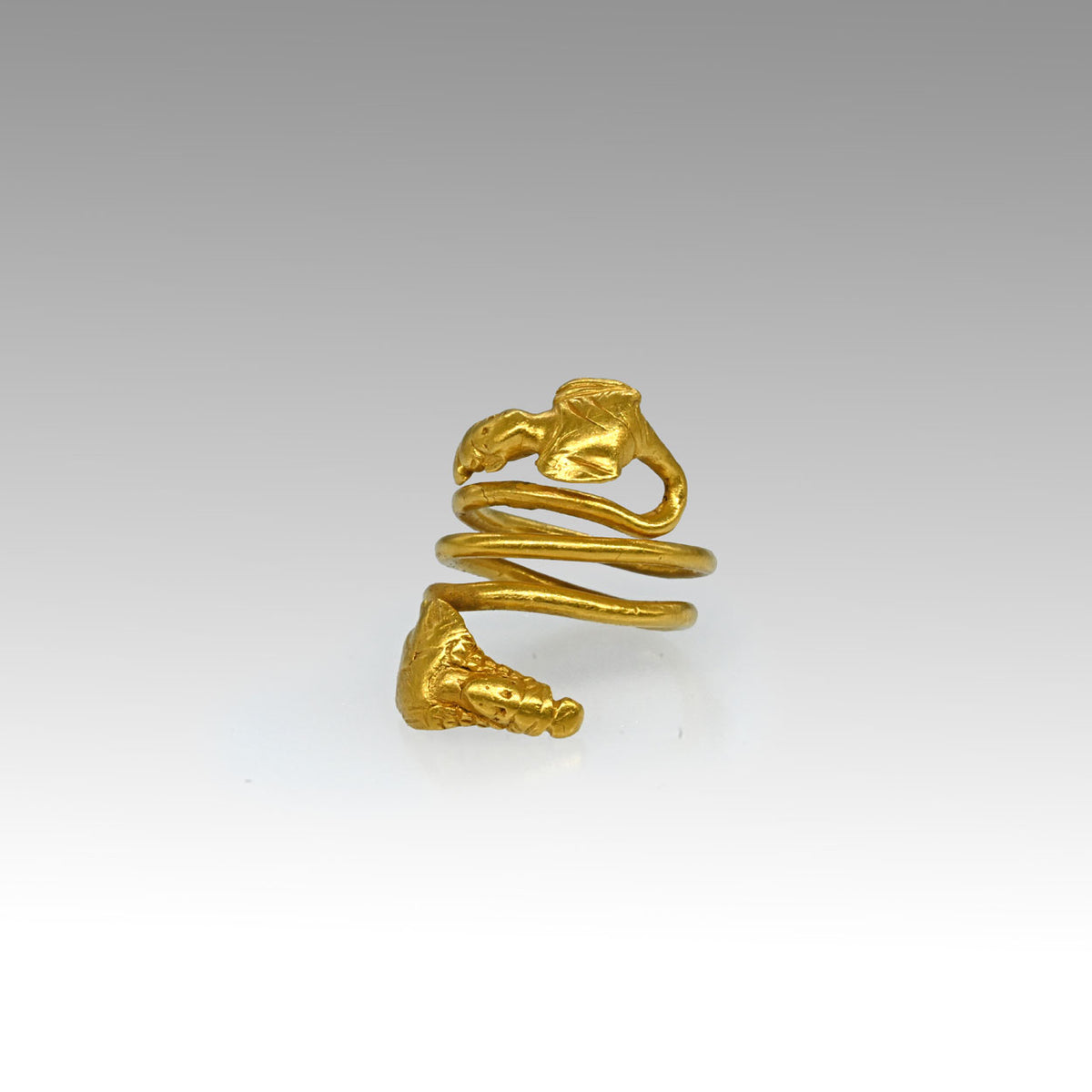
A Published Egypto-Roman Gold Spiral Snake Ring with Isis and Ptah Terminals, Roman Imperial Period, ca. 1st century CE
Cet article est admissible à la livraison gratuite aux États-Unis et à des frais fixes de 75 $ pour l'expédition internationale.
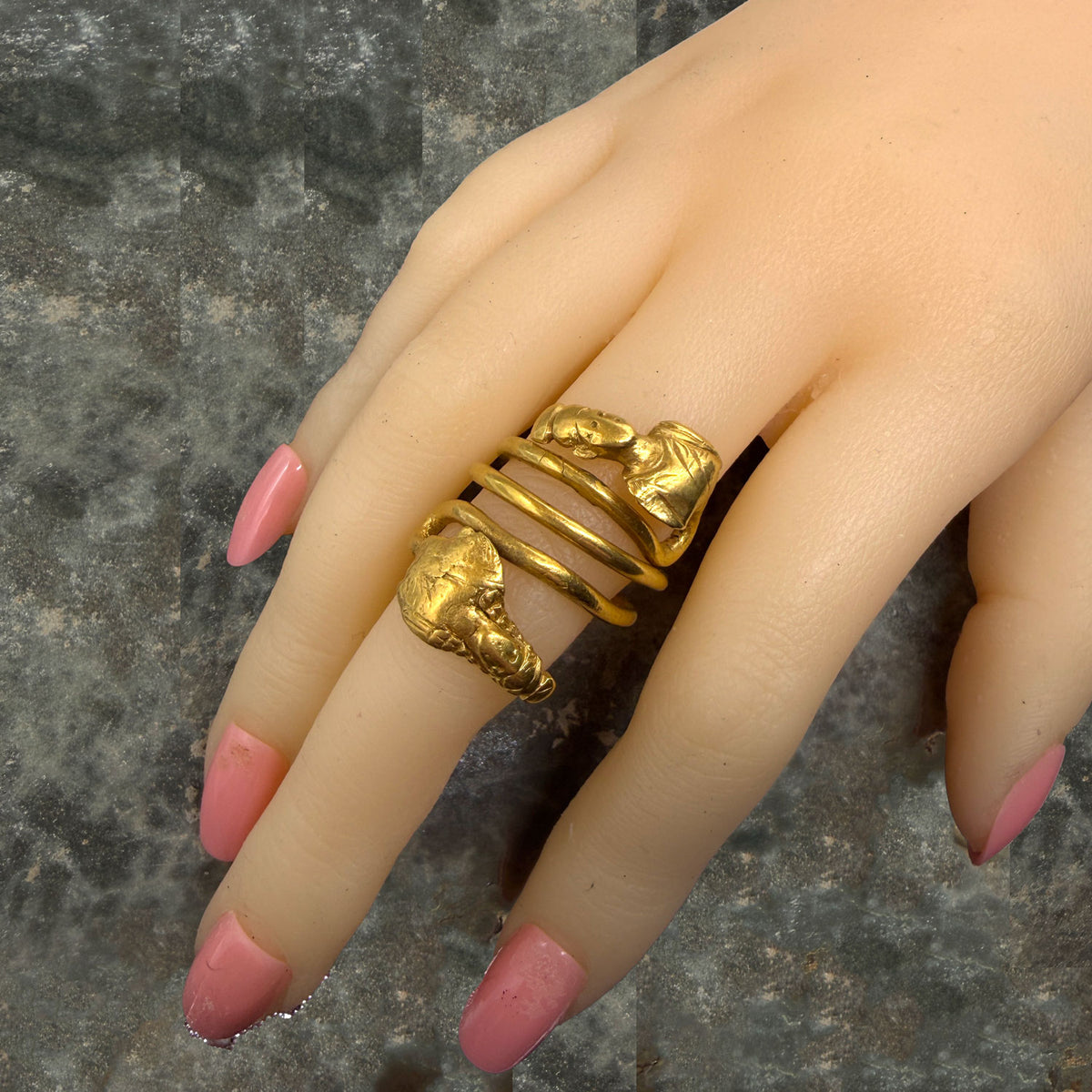
A rare Egypto-Roman gold spiral snake ring, formed from a continuous length of high karat thick, rounded gold wire coiled three times to encircle the finger, terminating in opposing busts of Egyptian deities, probably Isis and Ptah. Each terminal is modelled in high relief, depicting the head and upper torso of a deity. The female bust, probably representing Isis, wears an elaborate headdress, while the opposing male bust, tentatively identified as Ptah, is distinguished by a close-fitting skullcap, a characteristic attribute of the god. Both figures have carefully delineated facial features, with incised details defining their headdresses and garments.
The serpent held considerable religious significance in both Egyptian and Roman cultures, where it was associated with protection, regeneration, fertility, and divine power. Snake rings were particularly popular during the Hellenistic and Roman periods, their sinuous forms lending themselves naturally to jewellery designed to coil around the finger or wrist. The combination of a serpentine body with anthropomorphic divine terminals is particularly unusual, reflecting the blending of Egyptian religious imagery with Roman jewellery traditions.
Following the Roman conquest of Egypt in 30 BCE, the worship of Egyptian deities, particularly Isis, spread throughout the Roman world. Jewellery incorporating their images often served both decorative and amuletic purposes. The present ring is a distinctive example of this cultural exchange, combining the protective symbolism of the serpent with the imagery of Egyptian divinities.
Published: Jack Ogden and Barbara Deppert-Lippitz, "A Golden Past: Jewelry from the Ancient World" (1990) p. 6, no. 2.
For related example see: The British Museum, inv. no. 1926,0407.12 and Marshall, FH, Catalogue of the Finger Rings Greek, Etruscan & Roman in the Department of Antiquities, British Museum (London, 1907), no. 241
Medium: Gold
Dimensions: US ring size 5½ (UK=K 1/2, DE=17, CH=10, FR=50.6, EU=50.6, JP=10). Length: 1 1/8 inches (2.85 cm)
Condition: Intact and in very good condition, with minor surface wear consistent with use and a small modern repair to the hoop. Catalog note: EDX analysis of the gold revealed a composition of approximately 97.04% gold and 2.96% silver, equivalent to approximately 23.3 karats, with no copper detected. This high degree of purity is consistent with other good-quality early Romano-Egyptian goldwork.
Provenance: Private London collection, previously in a distinguished New York private collection assembled between 1975 and 1995. Documented and authenticated in the early 1990s by Dr. Jack Ogden and Barbara Deppert-Lippitz, leading specialists in ancient jewelry.
DES QUESTIONS? Cliquez simplement sur l'onglet Nous contacter à votre droite.
Nous expédions du mardi au vendredi par transporteur terrestre et généralement le jour même si votre commande est reçue avant 14h. Aux États-Unis continentaux, l'emballage, l'expédition et l'assurance sont gratuits. Selon la taille et la destination, les délais de livraison varient de un à cinq jours ouvrables.
Pour les envois à l'étranger, nous facturons un faible taux forfaitaire qui comprend l'emballage, la préparation de tous les documents douaniers, l'assurance et les frais de transport, en conformité avec toutes les exigences douanières américaines et internationales.
Les envois à l'étranger sont envoyés via FedEx, DHL ou UPS International Priority, veuillez donc nous contacter si vous avez une préférence en matière d'expédition. Les clients internationaux sont responsables de tous les droits et taxes.
Sands of Time offre une garantie d'authenticité et de provenance inconditionnelle à vie. Chaque objet que vous achetez chez nous est accompagné d'un certificat d'authenticité, indiquant sa culture, sa provenance et son âge.
De plus, nous faisons preuve de diligence raisonnable pour nous assurer que l'objet, à notre connaissance, n'a pas été obtenu illégalement d'une fouille, d'un monument architectural, d'une institution publique ou d'une propriété privée. Dans la mesure du possible, il est fait référence aux collections ou publications existantes.Dans la mesure du possible, il est fait référence aux collections ou publications existantes.
Choisir les options
Derniers affichages

Come Visit Us!
1010 Wisconsin Ave NW, Suite 340
Washington DC. 20007
Tues - Fri, 10:00am - 6:00pm
Sat/Sun/Mon By appointment


