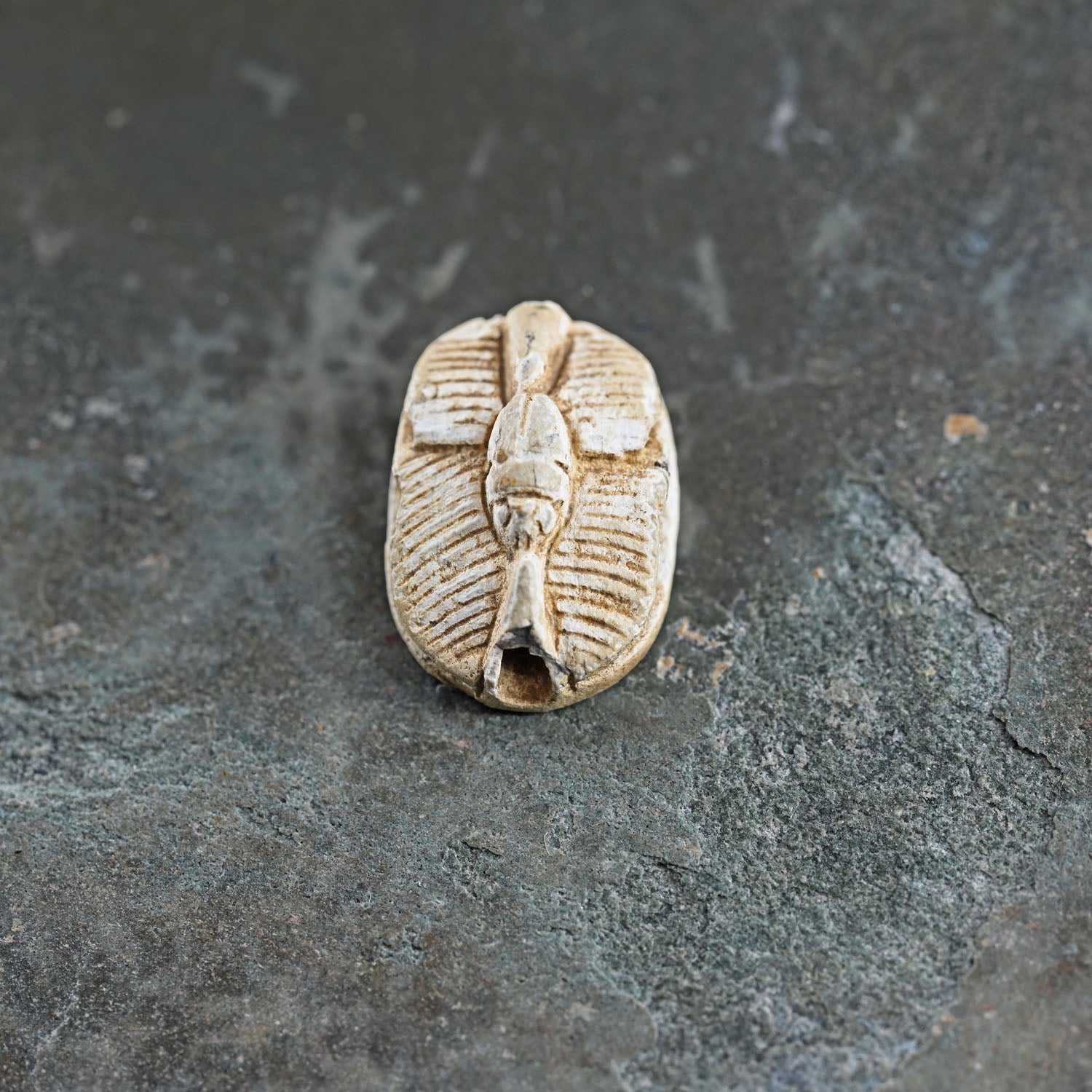
An Egyptian Steatite Design Scarab, Hyksos Period, ca. 1759 - 1539 BCE
This object qualifies for free USA shipping and a flat rate fee of $75 if shipping internationally.
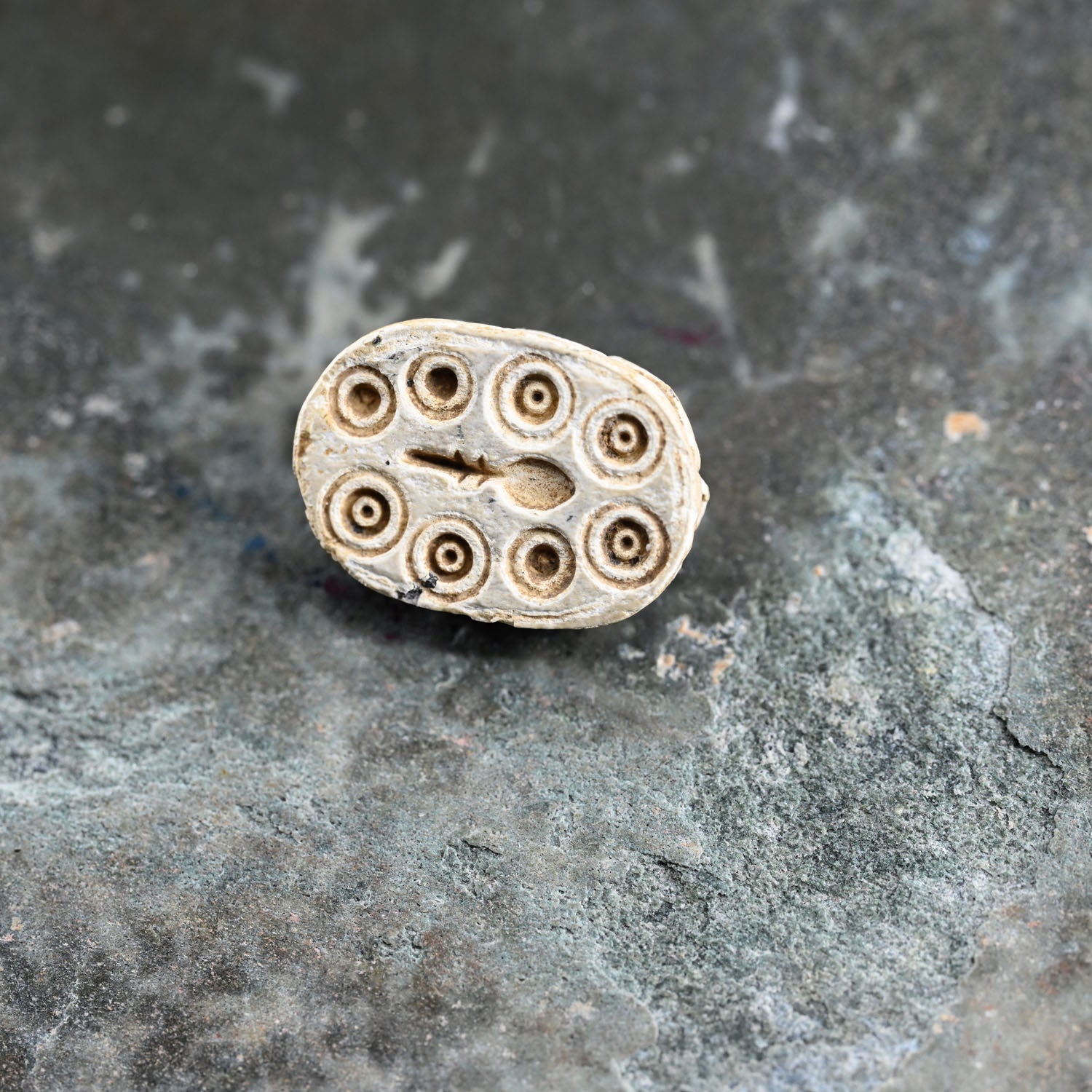
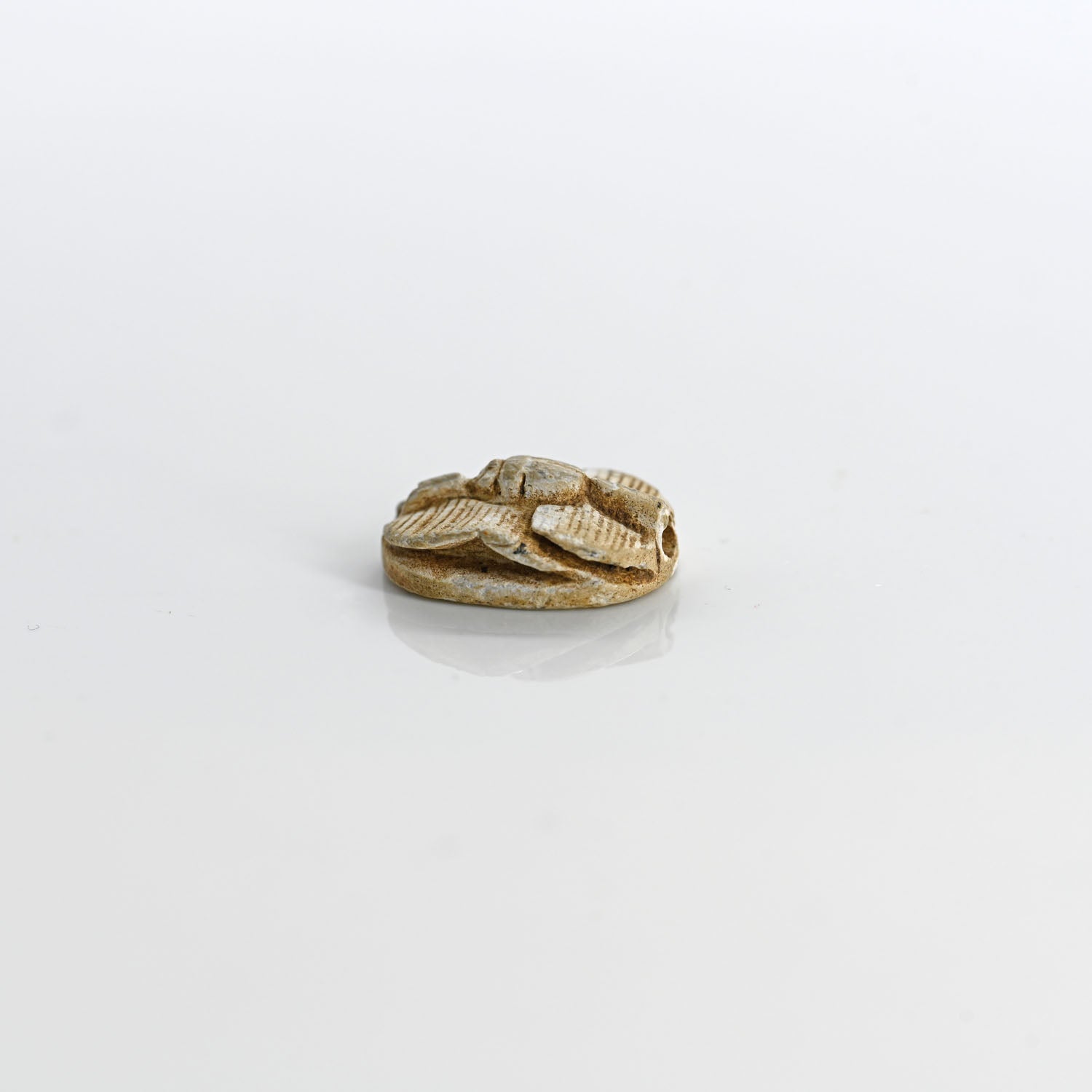
The flat scarb is depicted naturalistically with legs folded at the sides, a longitudal ridge with a miniature scarab centered down the back. The underside is depicted with a central nefer symbol, surrounded by a ring of eight deeply-incided concentric circles.
The Hyksos Period was a time of complex cultural interaction in the Nile Delta when local Egyptian traditions mixed with Levantine influences. Scarabs were among the most popular amulets in everyday and funerary life, worn on cords, set into rings, or laid in tombs. Steatite was commonly used because it took a fine polish and accepted a brightly colored glaze, often blue or green, which imitated faience. The decorative, non-hieroglyphic underside design here—a symmetrical cross with stepped linear fillings—is typical of “design” scarabs produced for personal use rather than as official seals, and it reflects the geometric tastes of the period as well as economical production for a broad market.
Medium: Steatite
Dimensions: Length: 5/8 inch (1.5 cm)
Condition: Minor loss to the suspension hole, otherwise the scarab is intact and in excellent condition.
Provenance: Nora Scott (1905 – 1994), Curator of Egyptian Art at the Metropolitan Museum of Art, (retired 1972), and acquired from the Metropolitan Museum of Art by deaccession. Gifted to L. Virginia Burton (1918–2009) Associate Curator of Egyptian Art at the Metropolitan Museum of Art (retired 1977), and then by descent.
QUESTIONS? Just click the Contact Us tab on your right.
We ship Tuesday to Friday via ground courier and usually same-day if your order is received before 2pm. Within the continental USA, packing, shipping, and insurance are free. Depending on size and destination, delivery times range from one to five business days.
For overseas shipments, we charge a low flat rate that includes packing, preparation of all customs paperwork, insurance, and carrier fees, in compliance with all U.S. and International customs requirements.
Overseas shipments are sent via FedEx, DHL, or UPS International Priority, so contact us if you have a shipping preference. International customers are responsible for all duties and taxes.
Sands of Time provides a lifetime, unconditional guarantee of authenticity and provenance. Every object you purchase from us is accompanied by a Certificate of Authenticity, stating culture, provenance, and age.
Furthermore, we conduct due diligence to ensure the item, to the best of our knowledge, has not been illegally obtained from an excavation, architectural monument, public institution, or private property. Wherever possible, reference is made to existing collections or publications.Wherever possible, reference is made to existing collections or publications.
Choose options


